Photo of the delivery note, no typing while the cold chain waits
The truck arrives with perishable raw material and the receiving lead types line by line while the product loses temperature. One photo of the delivery note and the labels is enough for everything to flow into the ERP with full traceability after a single validation tap.
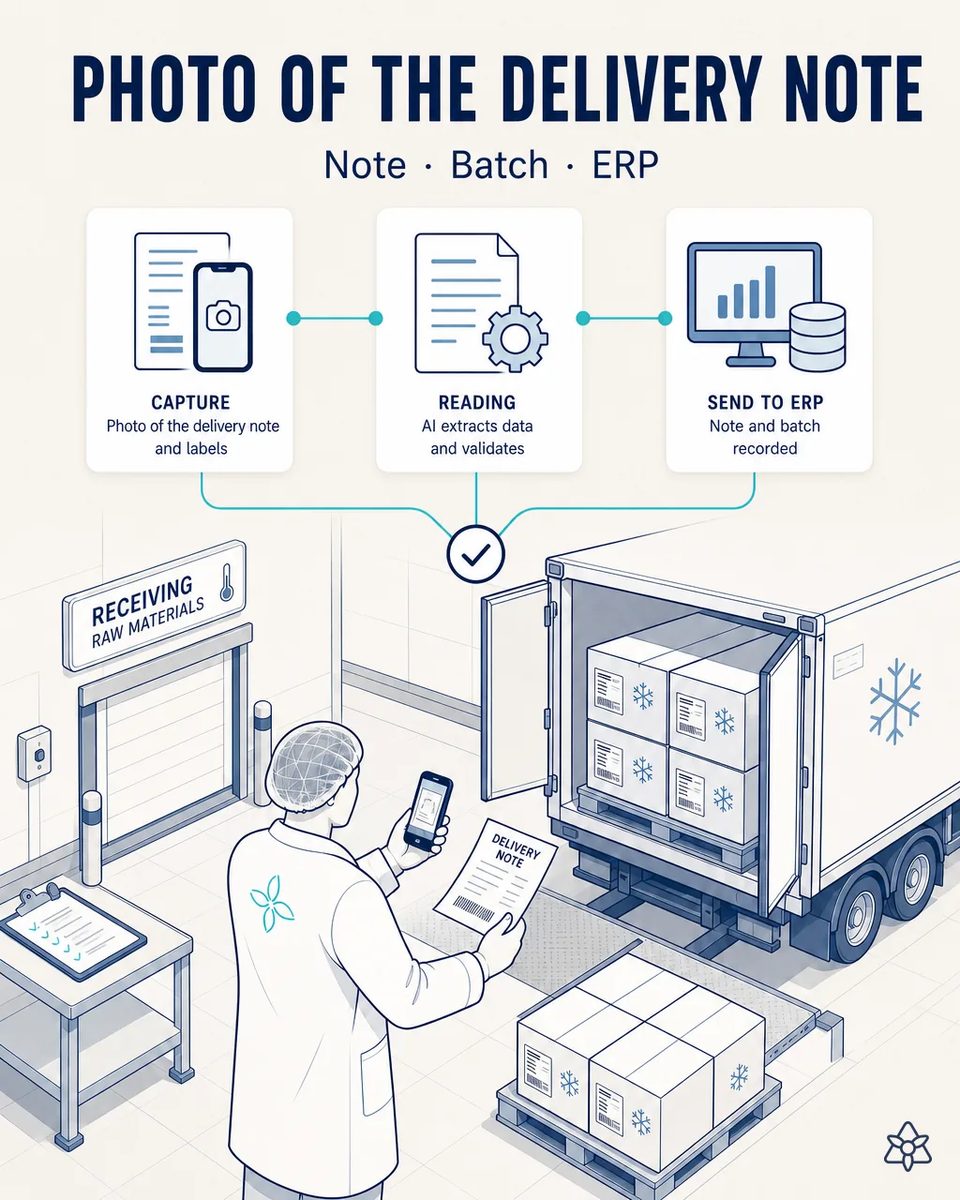
Traceability starts with typing done under cold-chain pressure.
Receiving perishable raw material trades off traceability against speed: with temperature-sensitive product, every minute typing into the ERP is a minute of compromised cold chain. Rush it, and batches get entered wrong — surfacing weeks later in an untraceable safety alert.
- The truck arrives with meat, poultry, cheese, dough or flour: a delivery note of twelve to twenty lines, one lot per box and labels every supplier prints their own way, some with standard symbology and some with a typed block of text.
- With temperature-sensitive product, every minute typing into the ERP is a minute of compromised cold chain, and the dock is neither a chiller nor a freezer.
- Both exits are bad: either you type slowly and correctly with the product out of the chiller, or you type fast and the lots end up wrongly associated. In practice haste always wins, because the cold does not wait and neither does the driver.
- And that resurfaces weeks later, in the safety alert where you have to prove which filling lot the tray that reached the customer came from. If the box-to-lot association was made wrong on the dock, the chain is broken at the first link and no later traceability repairs it.
Connect in photo-to-analog mode — no changes asked of the supplier.
Connect photo-to-analog mode: computer vision reads the delivery note's layout without asking the supplier to change theirs, extracting the tabular structure. For box labels: it reads GS1-128, QR, barcode, or plain OCR. One tap validates on the tablet.
Vision recognizes each supplier's delivery note exactly as it comes, and the box labels by GS1-128, QR, barcode or plain text. Nobody has to negotiate a common format with suppliers, which is the reason this problem has gone unsolved for years in almost every plant in the sub-sector.
Today's receiving versus receiving captured
| Aspect | Today | With iLEAN Connect |
|---|---|---|
| Product out of the chiller | As long as the typing takes | As long as a photo takes |
| Raw-material lots | Wrongly associated when rushed | Read off the box label |
| Delivery note format | Different per supplier | Read exactly as it arrives |
| Note-to-label cross-check | Nobody does it | Discrepancy flagged before validating |
| Safety alert | Traceability broken backwards | Full chain back to the supplier |
| Receiving and warehouse licenses | Several | One, for whoever validates |
Truck held up while typing in the cold → photo in seconds. Hidden batch errors → zero. Broken traceability → complete.
Impact estimate — to be validated with your numbers.
The block below is an estimate to be validated against your plant's actual data. We put it forward so the committee has an order of magnitude; we refine it during the assessment.
- 💰 CFO angle: the receiving and warehouse module typically requires several active licenses; with Connect only the supervisor validates: a 50-70% reduction, recurring.
- Estimated payback 3-8 months, depending on trucks per day.
- Cold-chain minutes that stop being spent on the dock, truck after truck.
- And hidden lot errors that stop appearing weeks later, with a safety alert on the table and traceability broken backwards.
Typical 50-70% reduction in receiving/warehouse module licenses. Estimated payback 3-8 months. *Estimate to validate*.
And the fair question from the production manager
“Does it recognize every one of our suppliers' delivery notes?” — yes, and without asking any of them to change theirs: the model extracts the tabular structure with no need for a template per supplier. Labels are read by standard symbology when they carry it and by optical recognition when they do not. It is an anchored task, where the best models drop below 1.5% error [1], and the receiving lead validates before anything gets in.
[1] OpenAI paper "Why Language Models Hallucinate", 2025 — on the reliability of AI in anchored tasks.
What people ask about digitizing receiving
Is each box's expiry date read?
Yes, and it is one of the highest-value parts: the filling's expiry conditions the finished product's, so tying it to the lot from receiving avoids having to hunt for it later on a label that is already inside the freezer.
Does it work with raw materials as different as meat, cheese and flour?
Yes. What changes between them is the format of the document and the label, and the model recognizes the structure with no per-supplier template. A sack of flour and a box of frozen chicken go through the same flow.
What if the delivery note and the labels do not match?
The discrepancy is highlighted in the summary before the supervisor validates. Today nobody performs that cross-check with a truck waiting at the dock, and that is exactly where wrongly associated lots slip through.
Do we need an industrial code reader?
Not necessarily: a phone or tablet photo works, and it reads GS1-128, QR, barcode or plain text. If the plant already has readers and they work well, they are integrated rather than replaced.
Can we start with receiving alone?
Yes, and it is a good starting point: the result is visible from the first truck and does not depend on the rest of the matrix being deployed. It is also the case the warehouse team grasps fastest, because the before and after is measured in minutes at the dock.
More cases from this series
- Photo of the production order at batch start-upHow an empanada plant gets the production order and filling sheet into the central system in zero…
- The forming machine panel, read without touching itAn external camera reads the aging forming-and-sealing machine's panel without touching it, correlating…
- The line lead dictates while walkingThe line lead of an empanada plant dictates incidents while walking, through an earpiece, and gets…
- The modified-atmosphere packer, stitched to the ERPThe modified-atmosphere packer is stitched to the ERP: batch, date, and allergens flow automatically, no…
- The quality spreadsheet stops being retyped by handThe quality lab's spreadsheet flows straight into the ERP after validation, with no manual retyping and…
- The supplier's filling alert, in zero secondsiLEAN reads a supplier's delay alert by email and reschedules the production order before the line runs…
Tell us how long a raw-material truck takes to be logged in today.
We work on your plant's real data, not ours. Assessment with no commitment.
Request estimated ROI within 48h ‹ See all cases of empanada plants See food industry