Photo of the production order at batch start-up
In an empanada plant, the paper production order and the filling sheet define the batch: which formula, which allergens, which format. Today that paper can sit undigitized for hours. With iLEAN Connect, one phone photo is enough for the batch to exist in the central system in zero seconds, without changing the line lead's routine.
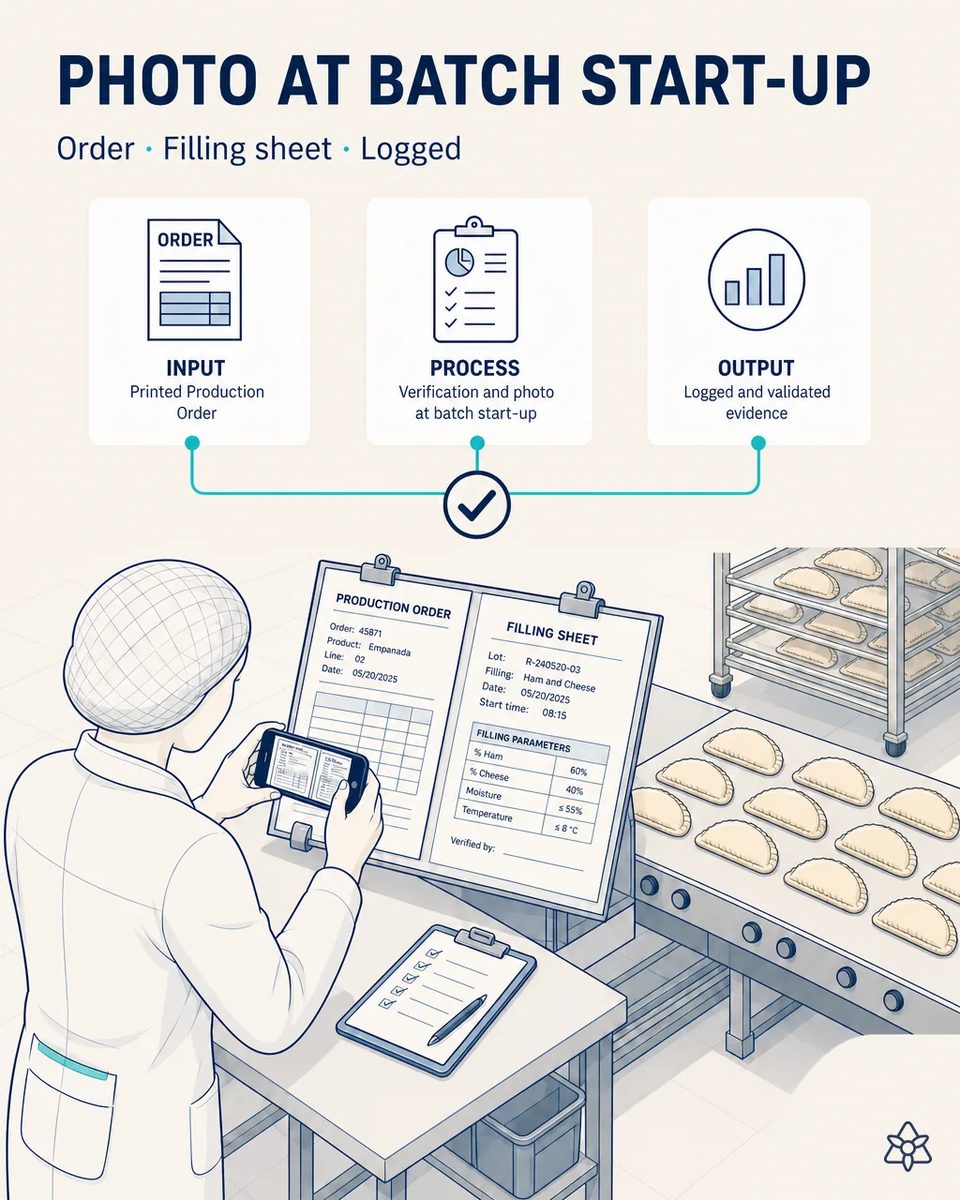
The two sheets of paper that define the batch take hours to exist.
The shift's production order prints from ERP data, and any formula change or quality note gets scribbled on by hand. The first-pack filling sheet is handwritten by quality policy. Both can sit undigitized for hours — when the auditor arrives or the shift changes, someone has to reconstruct from memory which formula and which allergens that batch carried. When several filling formulas run in the same day (in-house brand plus contract manufacturing for third parties), that paper sheet is the only source of truth for the batch's allergens.
- The shift's production order prints from ERP data, but gets written on by hand the moment anything deviates: a filling formula change, a piece-weight adjustment, a dough lot that comes in drier than usual.
- The first-pack filling sheet is handwritten by quality policy, and it is the only source of truth for which allergens that particular batch carried: gluten, egg, dairy.
- Hours can pass between the signing of those two sheets and their digitization, and over a production weekend considerably more.
- When in-house brand and contract manufacturing for third parties run in the same day, that gap is exactly the one that hurts: the batch is formed, cut, crimped and packed, but it exists in no queryable system until somebody finds a quiet moment to type it in.
Connect in photo mode — the line lead keeps filling in their paperwork.
Connect photo mode: the line lead photographs the order and the filling sheet with a phone. A grounded LLM extracts formula, batch, allergens, and format, storing them in central memory. No habit change.
It is the simplest of the twelve to deploy and the one that creates least friction on the floor: nobody changes a habit, a photo is simply added to what was already being done. That is usually why it is the first one approved and the first one to prove value.
Start-up on paper versus start-up captured
| Aspect | Today, on paper | With iLEAN Connect |
|---|---|---|
| Digitization latency | Hours, and more over a weekend | Second zero |
| The batch's allergens | On a handwritten sheet | Queryable by batch instantly |
| Formula change noted by hand | Lost unless somebody types it | Extracted and tied to the order |
| Piece weight and dough-to-filling ratio | Scribbled in the margin | History per reference |
| Answering an auditor | Reconstruct from memory | One query by batch number |
| The line lead's habit | — | Unchanged: one photo |
Hours of latency between start-up and digitization → zero seconds. Scattered paper allergen sheets → instant batch lookup.
Impact estimate — to be validated with your numbers.
The block below is an estimate to be validated against your plant's actual data. We put it forward so the committee has an order of magnitude; we refine it during the assessment.
- Estimated payback 4-9 months, depending on batches per day and formula changes per shift.
- Hours of latency between start-up and digitization turned into second zero.
- The allergen sheet stops being scattered on paper and becomes a per-batch lookup answered in seconds.
- And the shift handover stops depending on somebody remembering which formula, which piece weight and which dough lot were running when the relief crew walked in.
Estimated payback 4-9 months depending on daily batch volume. *Estimate to validate*.
And the fair question from the production manager
“What if it misreads the filling percentage or an allergen on the sheet?” — reading fields from a document with a known structure is an anchored task, where the best models drop below 1.5% error [1]. And there is a second net: the summary goes to the line tablet and the line lead confirms or corrects it before anything crosses into the central system.
[1] OpenAI paper "Why Language Models Hallucinate", 2025 — on the reliability of AI in anchored tasks.
What people ask about digitizing batch start-up
Do we have to change the handwritten filling sheet?
No, and in many plants it could not be done: it is handwritten by quality policy and signed by whoever checks the first pack. Vision reads the document exactly as it stands today, including the box where the dough lot and the piece weight are written in.
Does it recognize the handwritten notes on the printed order?
They are the part with the most value, because that is where what actually happened in the shift is written down. They are extracted like any printed field, and a low-confidence value is flagged for a person to confirm.
Does it help if three filling formulas rotate in the same day?
That is precisely the scenario it is for. Every photo is tied to its order, its line and its time slot, so the active formula at any moment stops being reconstructed from memory. When in-house brand and private label run in the same day, that tie is what separates a traceable batch from one that has to be rebuilt.
Do we need ERP integration from the start?
No. The case works from the first batch against iLEAN's central memory, and the push to the ERP is connected afterwards, once there is demonstrated value on the floor. That is what lets you start without waiting on the systems team's calendar.
What about weekend batches?
That is where it shows most. Today the gap can be two days; with capture the batch exists in the system from the first cut disc, exactly as on a Tuesday morning. And on Monday nobody has to reconstruct what was produced at six on Saturday.
More cases from this series
- Photo of the delivery note, no typing while the cold chain waitsPhoto of the delivery note and the raw-material labels: full traceability without sacrificing cold-chain…
- The forming machine panel, read without touching itAn external camera reads the aging forming-and-sealing machine's panel without touching it, correlating…
- The line lead dictates while walkingThe line lead of an empanada plant dictates incidents while walking, through an earpiece, and gets…
- The modified-atmosphere packer, stitched to the ERPThe modified-atmosphere packer is stitched to the ERP: batch, date, and allergens flow automatically, no…
- The quality spreadsheet stops being retyped by handThe quality lab's spreadsheet flows straight into the ERP after validation, with no manual retyping and…
- The supplier's filling alert, in zero secondsiLEAN reads a supplier's delay alert by email and reschedules the production order before the line runs…
Tell us how long a batch of empanadas takes to exist in your system today.
We work on your plant's real data, not ours. Assessment with no commitment.
Request estimated ROI within 48h ‹ See all cases of empanada plants See food industry