The modified-atmosphere packer, stitched to the ERP
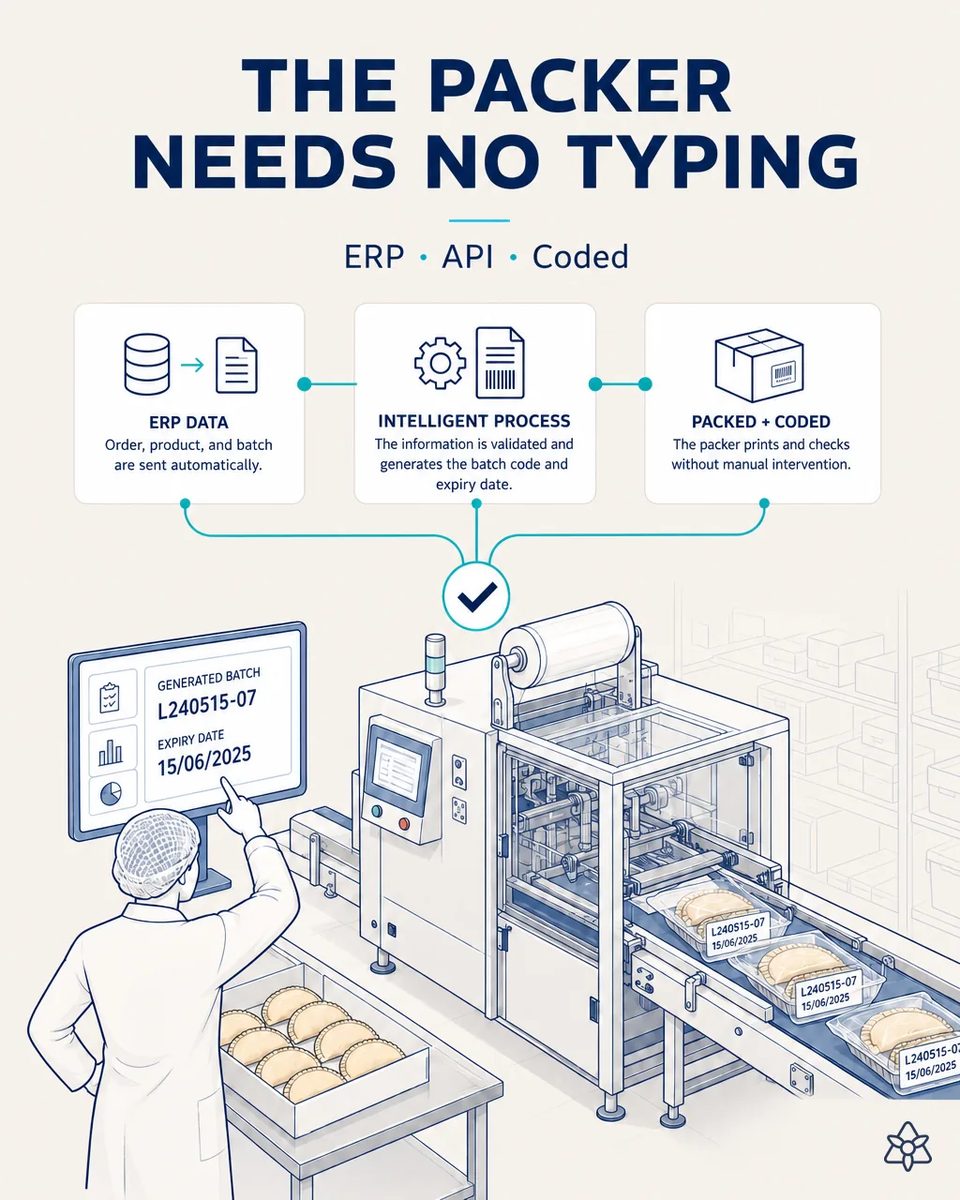
The modified-atmosphere packer has an API but is isolated from the ERP: every batch change is typed by hand on its panel, with error risk. Stitched to the ERP, batch, date, and allergens flow automatically from the active production order.
The same data gets typed twice, right before the product ships.
The modified-atmosphere packer is the last physical step before product ships to the customer. It has a modern API, but it's isolated from the ERP because "integrating it properly takes time." Any typing error for batch, date, or allergen on its panel becomes a recall.
- The modified-atmosphere packer is the last physical step before the tray ships to the customer: what it prints there is what the consumer will read and what a retail chain will claim against if it does not add up.
- It has a modern, documented API, but it sits isolated from the ERP because integrating it properly never reaches the top of the priority list: there is always something more urgent than connecting two systems that, more or less, already work separately.
- One wrong finger on that panel is a recall: a tray labeled without declaring dairy, or with an expiry that does not correspond, is not fixed with rework — it is fixed by calling the customer and pulling product off the shelf.
- And the risk grows with the number of references: the more formulas and formats rotate through the same packer — MAP tray, bulk for foodservice, frozen bag for retail — the more times a day somebody hand-types the data that defines what the consumer will read on the pack.
Connect stitches two modern systems by API, replacing neither.
Connect stitches two modern systems via API: when the ERP marks the order's start, it automatically publishes batch, date, and allergen list to the packer. A batch change becomes one tap in the ERP, not typing on the machine.
The batch change goes from typing on the machine to one tap in the ERP. And what was printed comes back confirmed to the system: not what was asked to be printed, but what the packer reports having printed on that tray. That distinction is what turns coding into evidence instead of an assumption.
The isolated packer versus the stitched packer
| Aspect | Today | With iLEAN Connect |
|---|---|---|
| Typing batch and expiry | Twice per changeover | Once, in the ERP |
| Printed allergen list | Depends on the panel | Travels from the active order |
| Labeling recall risk | Permanent | Eliminated at source |
| Format or formula change | Minutes on the panel | One tap in the ERP |
| What was actually printed | Assumed | Confirmed and returned to the system |
| The two systems | — | Neither is replaced |
Recurring typing errors, some triggering recalls → zero human-origin coding errors.
Impact estimate — to be validated with your numbers.
The block below is an estimate to be validated against your plant's actual data. We put it forward so the committee has an order of magnitude; we refine it during the assessment.
- Estimated payback 3-6 months, counting only the changeover time recovered on the panel across every batch change in the shift.
- A drastic reduction in mislabeling recall risk, which is where the case's real value sits.
- Zero human-origin errors in coding batch, expiry and allergens, on MAP trays as well as bulk cases.
- And with many references rotating on the same line, the number of batch changes stops increasing your exposure to error.
Estimated payback 3-6 months, with a drastic reduction in mislabeling recall risk. *Estimate to validate*.
And the fair question from the production manager
“Isn't a classic integration with the machine builder cleaner?” — it is, the day the project reaches the top of the list, and that is exactly the problem: this is the textbook case of a modern machine still isolated because there was never time. This stitch replaces neither system and asks for no downtime window. Publishing the data is besides an anchored task, with the best models below 1.5% error [1] in reading the order.
[1] OpenAI paper "Why Language Models Hallucinate", 2025 — on the reliability of AI in anchored tasks.
What people ask about connecting the MAP packer
Do we have to replace the packer or the ERP?
Neither. Connect leans on the API the packer already has and on what the ERP publishes when the production order starts. There is no migration, no long project and no downtime window: the packer keeps its own panel and its own recipes exactly as they are.
What if the printing fails or comes out illegible?
It is detected, because what comes back to the system is confirmation of what was actually printed, not what was asked to be printed. Today that failure raises no signal and gets discovered, with luck, at final inspection.
Does it cover the allergen list too?
That is what most justifies the case. Allergens travel from the order's active formula, so a tray carrying the previous formula's declaration stops being possible by construction, not by the operator's attention. A dairy-free run cannot inherit the dairy line from the run before it.
Does it work for bulk and for frozen product?
Yes. What changes is the data set published for each format — MAP tray, bulk case or frozen bag — not the mechanism of the stitch or the prior validation.
Does the same pattern work for other machines?
Yes: any modern island with an API that is fed by hand today fits the same way, from the case labeler to the metal detector. You start with the packer because it is the last barrier before the customer.
More cases from this series
- Photo of the production order at batch start-upHow an empanada plant gets the production order and filling sheet into the central system in zero…
- Photo of the delivery note, no typing while the cold chain waitsPhoto of the delivery note and the raw-material labels: full traceability without sacrificing cold-chain…
- The forming machine panel, read without touching itAn external camera reads the aging forming-and-sealing machine's panel without touching it, correlating…
- The line lead dictates while walkingThe line lead of an empanada plant dictates incidents while walking, through an earpiece, and gets…
- The quality spreadsheet stops being retyped by handThe quality lab's spreadsheet flows straight into the ERP after validation, with no manual retyping and…
- The supplier's filling alert, in zero secondsiLEAN reads a supplier's delay alert by email and reschedules the production order before the line runs…
Tell us how many batch changes your team types into the packer today.
We work on your plant's real data, not ours. Assessment with no commitment.
Request estimated ROI within 48h ‹ See all cases of empanada plants See food industry