Planning the dairy plant around what really costs money to stop: the drying tower and the UHT line.
In a dairy plant, starting and stopping the milk-powder spray-drying tower or the UHT line is expensive: hours bringing the system up to temperature while burning energy with no product, powder or carton out of spec at every transition, and CIP cleaning cycles that eat capacity. The iLEAN Planning Agent models those centers as continuous and builds the month's plan with long campaigns and the fewest startups — from the Excels you already have.
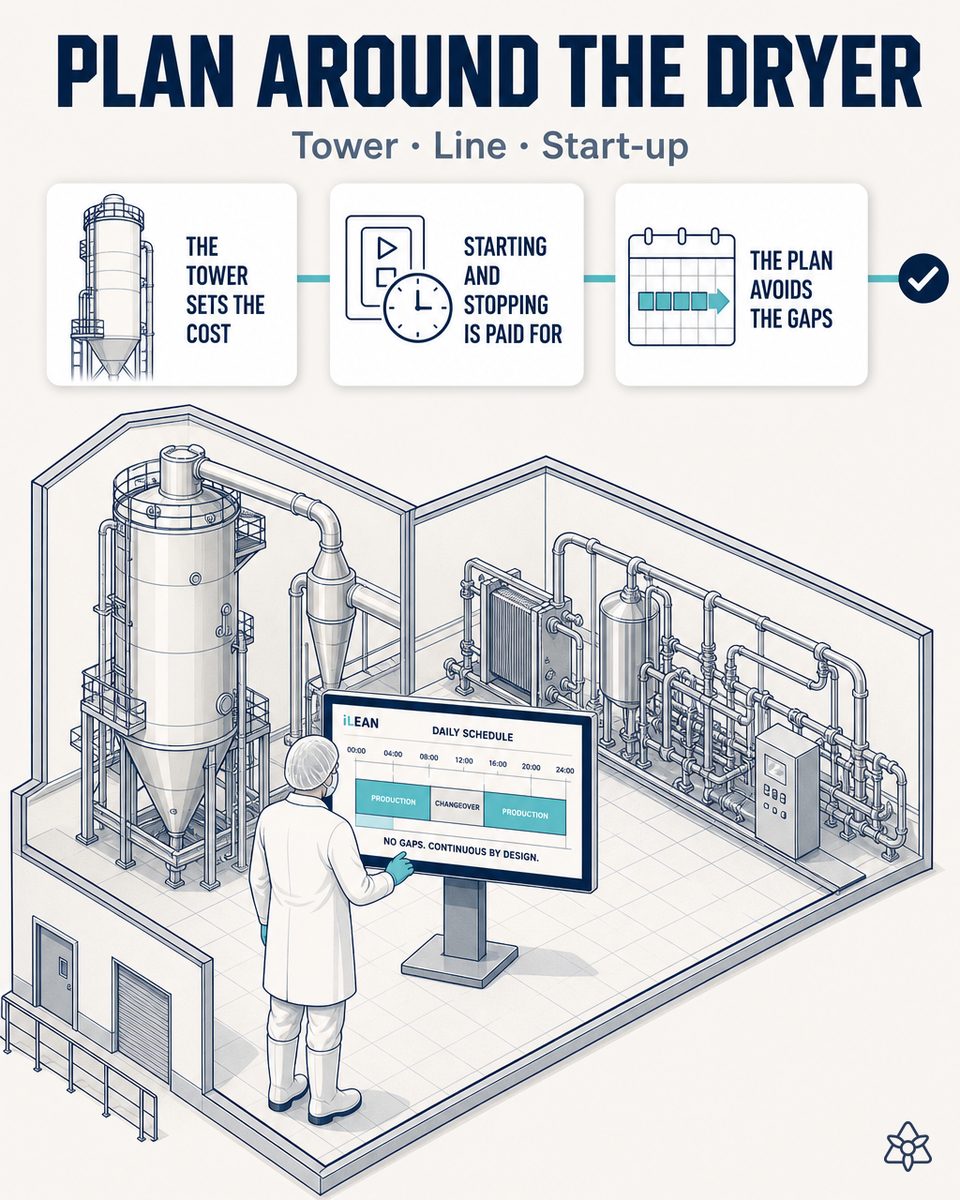
The plan is built in Excel looking at demand — and the drying tower and the UHT line pay the price.
The drying tower and the UHT line of a dairy plant are not machines you can switch on and off at no cost. Every startup carries a bill that almost nobody adds up in one place:
- Reheating energy. Bringing the drying tower or the UHT exchanger up to operating condition takes hours — burning steam or gas without a single sellable kilo coming out.
- Transient product. Until temperature and humidity stabilize, the powder comes out with moisture or particle size out of range and the UHT carton fails spec; on branded product, that is rework or scrap.
- CIPs that eat capacity. Every product change or stop drags a long cleaning cycle behind it; chaining campaigns badly multiplies the CIPs and leaves the line cleaning when it should be producing.
And who decides how many times the tower starts and how many CIPs happen each month? The production plan. A plan built in Excel, looking at demand SKU by SKU, tends to fragment: short campaigns, frequent changeovers, extra CIPs. Not because the planner doesn't know better — they know perfectly well — but because with Excel they barely get to one viable plan, and comparing alternatives that group campaigns better would take days they don't have.
Connect absorbs your Excels; the Agent builds the plan that respects the tower and the UHT line.
The iLEAN Planning Agent was born planning centers that truly cannot stop — continuous centers in heavy industry where continuity is a hard constraint. That same machinery is tuned to what your plant needs: strict continuity if you decide so, or a heavy penalty per startup so the engine minimizes them without banning them.
The user drops in their Excels. The agent builds the model of the dairy plant, its lines and its SKUs, and returns an editable receipt. The engine solves with the continuous-center constraints. The human compares three scenarios and approves with a stamp.
The specific iLEAN piece for your dairy plant:
- Connect — absorbs the chaotic documents the plant already has: the production Excel with its thousand tabs, the commercial demand that arrives by email, the rates per SKU and line. No mandatory template and no prior integration project.
- Planning Agent — builds the planner's database on its own (centers, lines, items, constraints, demand), asks only when something blocking cannot be derived from the documents, and solves with a constraint-optimization engine. For the drying tower and the UHT line it applies what matters: minimum campaign length, grouping that minimizes CIPs, continuity or startup penalties as configured, and each SKU's affinity to its line. And since it plans the full cascade, it coordinates raw-milk reception and the upstream process with drying or packing downstream, flagging the limiting input when things get tight.
- Three scenarios, not one plan — maximum output, tight inventory and stability (long campaigns, minimal changeovers). Side by side, with KPIs and the differences explained one by one.
The plant's discrete centers — carton and bottle packing, cheese slicing and portioning, final packaging — are treated the other way around: they are not asked for long campaigns; the same output is compressed into fewer hours and, if your contract allows it, placed in the cheap-energy windows.
The approved plan is exported to the Excel with the production-schedule format the plant already uses. The team's routine does not change on day one — what changes is how long it takes to get to a good plan.
Plan in Excel vs. plan with the Planning Agent
| Aspect | The planner's Excel | With the Planning Agent |
|---|---|---|
| Time to build the month's plan | Days | One morning, with the agent building the model |
| Tower / UHT startups | Whatever the manual fit produces | Minimized by the engine (constraint or penalty) |
| CIP cleaning cycles | Multiplied by short campaigns | Grouping that minimizes unnecessary CIPs |
| Transient product (powder/carton out of spec) | Whatever each startup brings | Fewer startups, less transient product |
| Discrete centers (packing, slicing) | Inherited shifts at partial load | Compressed and, when it pays, moved to off-peak hours |
| Strategy alternatives | A single viable plan | 3 scenarios compared with KPIs + what-ifs |
| Replanning after a disruption | Just as many days again | Minutes: recalculate and compare |
| Format of the approved plan | The usual Excel | The very same Excel — exported automatically |
Impact estimate for your plant — to be validated with your numbers.
The block below is an estimate to be validated with the specific data of your plant. We put it forward so the committee has an order of magnitude; we refine it during the diagnostic.
- Dairy plant with a milk-powder spray-drying tower and/or UHT line, plus discrete centers (packing, cheese slicing), monthly plan currently built in Excel by one person.
- First planning session with the agent on the existing documents — no prior data project. First comparable plan in one morning.
- Expected reduction of continuous-center startups and unnecessary CIPs ≥30% versus the manual plan, through campaign grouping the engine finds and Excel does not. (Conservative range — estimate to be validated.) Every avoided startup is reheating energy and transient product that is not thrown away.
- Indicative payback between 4 and 9 months, depending on your continuous centers' consumption, the cost of transient product and the planning hours freed up.
The defensible technical anchor comes from the planner's most documented real case: a high-demand industrial plant in heavy industry — with a strict continuous center — whose agent built the complete model on its own (a kiln with 3 lines, 128 items with their production rates, 5 operating constraints and ~4,600 tons of demand) from a 114 MB zip with an 18-sheet Excel, and delivered 3 optimized scenarios in under an hour. The same class of constraint engine, tuned to what a drying tower or a UHT line needs.[1]
And the operations director's reasonable doubt
“What if the plan the AI proposes is not executable in my plant?” — that is why there is human verification at every gate. The absorption receipt shows everything the agent has understood from your documents and is corrected inline before anything is solved; the scenarios are compared with the differences explained; and the plan only goes to production when the person in charge approves it with a stamp. If the demand does not fit in full, the system does not say “infeasible”: it delivers a partial plan with its coverage and flags exactly what is left out, so a person decides. The AI proposes; the plant signs.
[1] Real iLEAN case, high-demand plant in heavy industry — verified pilot figures: 114 MB of documents, 18 sheets, 128 items, ~4,600 t, 3 scenarios in <1 h, 99.5% coverage.
What people ask about production planning with an agent
Are the drying tower or the UHT line “continuous” centers like a tile factory's kiln?
Not with the same severity, and it pays to be honest. In a tile factory, stopping the kiln cracks the refractories and costs a fortune — a hard “never stop” constraint. A spray-drying tower or a UHT line does not break by stopping, but stopping is genuinely expensive: hours of reheating burning energy with no product, powder or carton out of spec during the transient, and long CIP cycles that eat capacity. The planner lets you choose the treatment: strict continuity or a heavy penalty per startup — and the plan comes out with the long campaigns these centers reward.
What does the agent need to build my dairy plant's plan?
The documents you already have: the production Excel, the commercial demand (even if it arrives by email), each SKU's rates on each line, the CIP calendar and the allergen or raw-milk constraints. No mandatory template. The agent reads the documents, builds the model (centers, lines, items, constraints, demand) and returns an editable receipt before solving anything. Whatever is missing from the documents is not hidden: the decision taken is shown, and the human corrects it if it does not work for them.
How does the plan avoid unnecessary CIPs and startups?
With plant constraints configured through data: minimum campaign length, grouping of compatible SKUs so one CIP serves several, each product's affinity to its line, and continuity or startup penalties for the tower/UHT. The constraint-optimization engine searches for the plan that satisfies all of it — not an Excel that eyeballs an approximation.
And the packing and slicing centers, which I can stop without drama?
They are planned the opposite way from the tower. A discrete center — carton filler, cheese slicing, final packaging — costs in proportion to the hours it is switched on: it pays to produce the same output in fewer hours and, if your electricity contract has time-of-use bands, place them in the off-peak windows. The engine plans the full cascade and uses the intermediate buffers to shift those hours without leaving either the tower or the packing line starved.
Who approves the plan: the AI or the plant?
The plant, always. The AI proposes: the absorption receipt is editable, the scenarios are compared, and the plan only goes to production when the person in charge approves it with a stamp. And the approved plan is exported to the Excel with the production-schedule format the plant already uses — the team's routine does not change on day one; what changes is how long it takes to get to a good plan.
More cases from this series
- Dairy batch recall with AI — a recall done right is measured in minutes, not hours.When a food safety alert lands, iLEAN identifies the batch, the affected distribution points and drafts…
- Audit evidence exists before the inspector asks for itEvery critical changeover generates its dossier with before and after photos, log and signature, ordered…
- Digitizing the concentrate evaporator panel without touching the machineA camera reads degrees Brix, temperature and vacuum off the evaporator's isolated panel. No machine…
- Bulk orange and aseptic input intake, without typing into the ERPPhoto the delivery note, the weighbridge ticket and the pallet labels; one-tap validation and straight…
- The shift lead's knowledge stops dying at end of shiftAn earpiece and voice: the shift lead dictates what they see without breaking stride, and gets support…
- Lab analysis reaches the ERP without anyone typing itiLEAN reads the lab sheet when it is saved, structures it and posts it to the ERP after validation. From…
Tell us your case and in 48h we'll send you the estimated ROI of this AI project for your plant.
We work on your plant's real data, not ours. Diagnostic with no commitment.
Request estimated ROI in 48h ‹ All dairy cases See food industry