Batch and expiry stop being typed twice
The coder printing batch and expiry on the carton is about ten years old and has an open API. The ERP knows which batch is being packed and what expiry applies. And still, at every production change someone types the same data into both systems, because integrating it properly never climbed high enough up the list. That duplicate keying is, literally, where recalls for misprinted expiry are born.
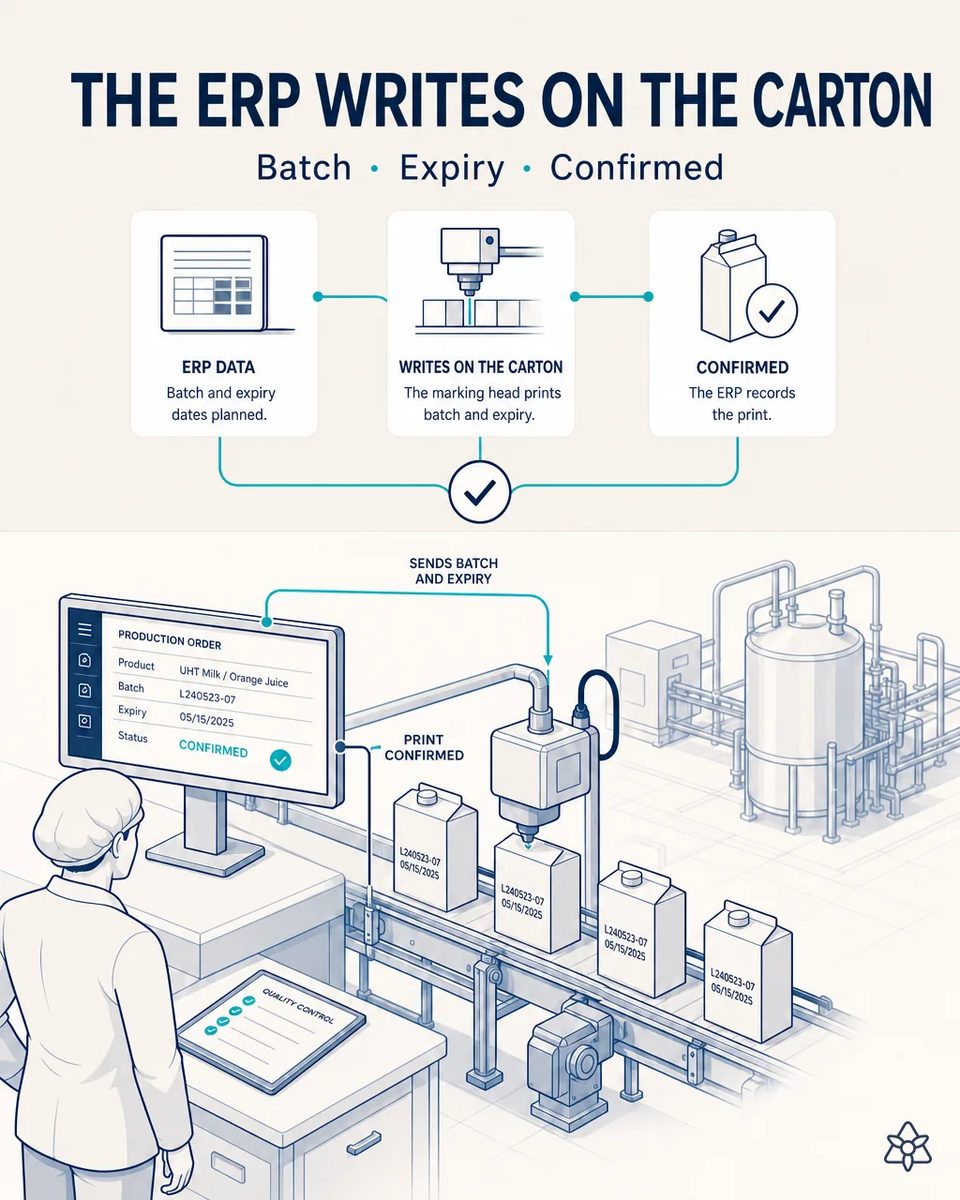
The same batch and expiry typed twice, and the changes are constant.
In a plant exporting to more than twenty countries, printed expiry is not one figure but several. Declared shelf life changes with the product, with the format and sometimes with the destination market, because each market has its own labeling rules. The operator picks the right template on the coder's panel. The overwhelming majority of the time they get it right, because they have been doing it for years. The day they do not, the error is printed on tens of thousands of packs and is found on the pallet, in the container or — expensively — on the shelf in the destination country, with the brand name on it. It is an error that more training and more attention do not fix. It is fixed by eliminating the point where it can occur.
- The coder printing batch and expiry on the carton is about ten years old and has an open API. The ERP knows which batch is being packed and what shelf life applies. And still, at every production change, someone types the same data into both.
- In a plant exporting to more than twenty countries, printed expiry is not one figure but several: it changes with the product, the format and sometimes the destination market, because each market has its own labeling rules.
- The operator picks the right template on the panel. The overwhelming majority of the time they get it right. The day they do not, the error is printed on tens of thousands of packs and found on the pallet, in the container or on the shelf in the destination country.
- It is an error that more training and more attention do not fix. It is fixed by eliminating the point where it can occur.
Connect stitches the ERP and the coder over API, replacing neither.
Connect stitching two modern systems together over API, replacing neither. The flow:
What was printed comes back confirmed to the ERP: not what was asked to be printed, but what the marking head says it printed, batch by batch. That distinction is what turns the coding of a carton into evidence instead of an assumption — and what makes an entire class of recall structurally impossible rather than merely unlikely.
- When the production order is launched, the ERP pushes product, batch, production date, applicable shelf life and destination market.
- Connect translates that data into the template the marking head expects and loads it automatically.
- The head prints and confirms what it actually printed.
- Connect writes that confirmation back to the ERP as evidence tied to the batch.
- If someone forces a manual change on the panel it is not blocked: it is logged as a deviation, with its reason and its owner.
Neither the ERP nor the coder changes. They simply stop standing a meter apart without speaking.
The isolated coder versus the stitched coder
| Aspect | Today | With iLEAN Connect |
|---|---|---|
| Keying per production change | Twice: ERP and coder panel | Once, in the ERP |
| Expiry for the destination market | Template picked by hand | Pushed from the ERP with the order |
| What was actually printed | Believed | Confirmed by the head, tied to the batch |
| A manual change on the panel | Invisible | Logged as a deviation with its owner |
| Misprinted expiry on 30,000 packs | Possible at every changeover | Structurally impossible |
| The ERP and the coder | — | Neither is replaced |
from two keying operations per production change, to zero. From "we believe the right thing was printed", to the machine's own confirmation, batch by batch. From a labeling error possible at every changeover, to one that is structurally impossible.
Estimated impact — to validate with your own numbers.
The block below is an estimate to be validated against your plant's actual data. We put it forward so the committee has an order of magnitude; we refine it during the assessment.
- Estimated payback 4-8 months on format changeover time alone.
- The bulk of the value lies in eliminating an entire class of error whose unit cost is a recall with the brand name on it, in the destination country.
- Two keying operations per production change become zero, and the changeover stops depending on picking the right template under pressure.
- To confirm before sizing: that the installed model exposes an API or RPC. Heads more than a decade old sometimes do not and need an intermediate adapter, which raises initial CAPEX without breaking the approach.
estimated payback 4 to 8 months on format changeover time alone. The bulk of the value lies in eliminating an entire class of error whose unit cost is a recall. *Estimate to validate.* To confirm before sizing: that the installed model exposes an API or RPC. Heads more than a decade old sometimes do not, and would need an intermediate adapter, which raises initial CAPEX without breaking the approach.
And the fair question from the production manager
«Isn't a classic ERP integration cleaner?» — it is, on the day the project reaches the top of the list, and that is exactly the problem: this is the classic case of a modern coder still isolated because there was never time. This stitching replaces neither system, asks for no shutdown window and does not compete in that queue. The only place a model is involved is in reading the head's confirmation back against the order, an anchored task where the best models drop below 1.5% error [1]; the rest is a deterministic API exchange. And if someone forces a manual change on the panel it is not blocked: it is logged as a deviation, with its reason and its owner.
[1] OpenAI paper "Why Language Models Hallucinate", 2025 — on the reliability of AI in anchored tasks.
What people ask about connecting the coder
Do we have to replace the coder or touch the ERP?
Neither. Connect leans on the API the coder already exposes and on what the ERP publishes when the production order is launched. Both keep doing what they do today.
What if the head fails to print or prints something else?
It is detected, because what comes back is confirmation of what was actually printed, not of what was requested. Today that failure raises no signal: the system assumes the right thing was printed.
Does it cover the different expiry per export market?
That is the most expensive failure and the one that most justifies the case. Product, format and destination market travel from the ERP with the applicable shelf life, so the wrong template stops being an option on the panel.
How do we know if our coder can be integrated?
Tell us the model. If it exposes an API or RPC it integrates directly; if it is older and does not, an intermediate adapter is needed, which changes the initial cost but not the approach.
Does the same pattern work for other machines?
Yes: any island with an interface that is fed by hand today — a case packer, a palletizer labeler — fits the same way. You start with the coder because that is where the recall is born.
More cases from this series
- Audit evidence exists before the inspector asks for itEvery critical changeover generates its dossier with before and after photos, log and signature, ordered…
- Digitizing the concentrate evaporator panel without touching the machineA camera reads degrees Brix, temperature and vacuum off the evaporator's isolated panel. No machine…
- Bulk orange and aseptic input intake, without typing into the ERPPhoto the delivery note, the weighbridge ticket and the pallet labels; one-tap validation and straight…
- The shift lead's knowledge stops dying at end of shiftAn earpiece and voice: the shift lead dictates what they see without breaking stride, and gets support…
- Lab analysis reaches the ERP without anyone typing itiLEAN reads the lab sheet when it is saved, structures it and posts it to the ERP after validation. From…
- Milk collection alerts, read at second zeroThe carrier's message is cross-checked against the process plan and returns a concrete action, not a…
Tell us your coder model and we will tell you whether it integrates this week or needs an adapter.
We work on your plant's real data, not ours. Assessment with no commitment.
Request estimated ROI within 48h ‹ See all cases of dairy and citrus See food industry