Four verification rings, from the tanker to the container
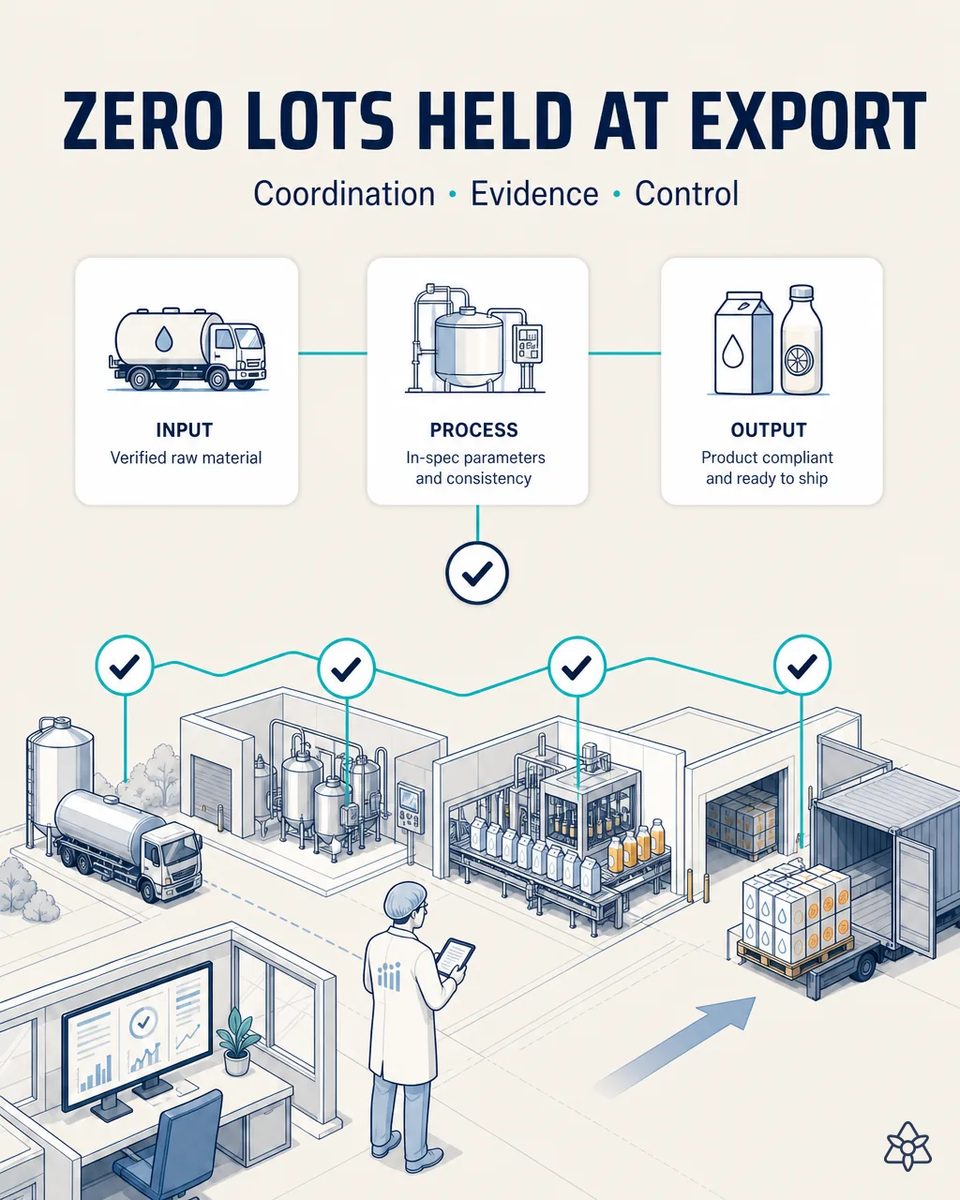
For a plant that has staked its growth on doubling exports, the worst possible day is not a high-scrap day: it is the day a container is held at the border, or a lot is withdrawn from the destination market, or a re-inspection raises a non-conformity that puts the certification opening that market in question. The flagship adds no new technology: it orchestrates everything above into four verification rings, so that no lot leaves the site without all four checks green and signed.
Reputation, certification and export plan: three assets one incident can touch at once.
Reputation, certification and export plan are three separate assets that a single incident can touch at once. A recall of exported product combines direct collection and destruction costs, commercial channel blockage, re-certification costs and a reputational cost in the destination market that is multi-year and hard to bound. And there is a second problem, less dramatic and just as real: a plan to double export volume built on manual processes requires doubling the administrative headcount that sustains them. Growth eats its own margin. The eleven preceding cases each solve their own piece. What is missing is the coordination: making it impossible for a lot to leave with any piece unverified.
- A recall of exported product combines direct collection and destruction costs, commercial channel blockage, re-certification costs and a reputational cost in the destination market that is multi-year and hard to bound.
- The worst day is not a high-scrap day. It is the day a container is held at the border, or a lot is withdrawn abroad, or a re-inspection raises a non-conformity that puts the certification opening that market in question.
- And the less dramatic problem: a plan to double export volume built on manual processes requires doubling the administrative headcount that sustains them. Growth eats its own margin.
- The eleven preceding cases each solve their own piece. What is missing is the coordination: making it impossible for a lot to leave with any piece unverified.
Four rings that must all be green — it is all of the above, orchestrated.
Connect + Edge + Agents + legacy integration + JIDOKA AI + SMED AI, coordinated against a single objective, in four rings:
The flagship adds no new technology. No single ring solves the problem on its own: each already exists today in some form and the lot still escapes. The strength is in the sequence — the lot cannot reach ring four with ring two unverified — and in the fact that a missing piece is flagged and resolved inside the site, where it costs a hundred times less than at customs.
- Ring 1 — Intake (cases 5 and 7): no tanker is discharged and no input pallet enters without human validation over consolidated data. The batch origin is born traced, not typed.
- Ring 2 — Process (cases 1, 2, 6 and 10): the startup sheet, the sterilizer and evaporator curves, the lab analysis and the visual changeover validation are tied to the batch as they happen. JIDOKA AI blocks startup if the changeover is not verified.
- Ring 3 — Outlet (cases 8 and 9): the coder prints what the ERP says and confirms what it printed; the Edge camera inspects one hundred percent of seals and coding. No badly sealed or badly coded pack enters the pallet.
- Ring 4 — Dispatch (case 11): before the pallet leaves the warehouse for the container, Agents checks that the lot has its complete dossier for the destination market and issues it. If a piece is missing, the lot is not dispatched: it is flagged and resolved inside the site, which is where it costs a hundred times less.
SMED AI cuts across all four rings, accelerating changeovers between batches, because the argument cannot be "safer but slower".
The four rings, and what each one closes
| Ring | Which cases it draws on | What it closes |
|---|---|---|
| 1 · Intake | Tanker release (5) + goods receipt (7) | No tanker discharged and no input pallet in without a human signature |
| 2 · Process | Startup (1) + evaporator (2) + lab (6) + changeover (10) | Sheet, curves, analyses and changeover tied to the batch as they happen |
| 3 · Outlet | Coder (8) + seal inspection (9) | No badly coded or badly sealed pack enters the pallet |
| 4 · Dispatch | Evidence pack (11) | No lot leaves without its complete dossier for the destination market |
| JIDOKA AI | Across rings 2 and 3 | Blocks startup if the changeover is not verified |
| SMED AI | Across all four | Faster changeovers, so it is never safer but slower |
from detection that happens outside — on the shelf, at customs, in the audit — to detection that happens inside, at the relevant ring, with the product still at home. From an export doubling plan that requires doubling administration, to one that scales without it.
Estimated impact — to validate with quality and general management.
The block below is an estimate to be validated against your plant's actual data. We put it forward so the committee has an order of magnitude; we refine it during the assessment.
- Estimated payback 8-15 months in the conservative scenario, counting no avoided incident at all.
- Counting the first one — a held container, a withdrawn lot, a non-conformity at re-inspection — effectively immediate.
- Detection moves from outside — the shelf, customs, the audit — to inside, at the relevant ring, with the product still at home.
- And an export doubling plan that scales without doubling administration, because the evidence is generated as a by-product of producing.
estimated payback 8 to 15 months in the conservative scenario, counting no avoided incident at all. Counting the first one, effectively immediate. *Estimate to validate with quality and general management.*
And the fair question from the production manager
«Do we have to deploy all twelve cases to get this?» — no, and framing it that way would be the way never to start. The rings are built in layers and each case pays on its own from the first month. With tanker release and goods receipt you already have ring one; add the startup sheet and the lab sheet and half of ring two is closed, which is where most of the missing traceability sits. Where a ring depends on a model reading a document or an image, that is an anchored task with the best models below 1.5% error [1], and each ring ends in a human signature.
[1] OpenAI paper "Why Language Models Hallucinate", 2025 — on the reliability of AI in anchored tasks.
What people ask about the complete system
Where do you start?
With the case that has fewest dependencies and shortest deployment, which in this matrix is the UHT line startup, or with tanker release if the silo risk is the board's concern. What matters is that each layer pays on its own.
What happens when a lot reaches dispatch with a piece missing?
It is not dispatched. It is flagged, and the missing piece — a changeover image, a lab result, a coding confirmation — is resolved inside the site. That is the whole difference: the same gap at customs costs a hundred times more.
Does it slow the plant down?
That is what SMED AI is for. It cuts across all four rings accelerating changeovers between batches, because the argument cannot be safer but slower — especially with a plan to double volume.
Does it replace the ERP or the process control system?
No. Ring one rests precisely on the ERP order being the truth, and ring two on the process control system's logs. iLEAN cross-checks them against each other and against what actually happens at the bay and on the line.
Can the return be estimated before committing?
Yes: with the number of lots held in the last three years, the cost of the last withdrawn lot and the weeks spent per audit, the return per ring is estimated before deciding the order.
More cases from this series
- Audit evidence exists before the inspector asks for itEvery critical changeover generates its dossier with before and after photos, log and signature, ordered…
- Digitizing the concentrate evaporator panel without touching the machineA camera reads degrees Brix, temperature and vacuum off the evaporator's isolated panel. No machine…
- Bulk orange and aseptic input intake, without typing into the ERPPhoto the delivery note, the weighbridge ticket and the pallet labels; one-tap validation and straight…
- The shift lead's knowledge stops dying at end of shiftAn earpiece and voice: the shift lead dictates what they see without breaking stride, and gets support…
- Lab analysis reaches the ERP without anyone typing itiLEAN reads the lab sheet when it is saved, structures it and posts it to the ERP after validation. From…
- Milk collection alerts, read at second zeroThe carrier's message is cross-checked against the process plan and returns a concrete action, not a…
Tell us how many lots have been held in the last three years — that number is the ROI.
We work on your plant's real data, not ours. Assessment with no commitment.
Request estimated ROI within 48h ‹ See all cases of dairy and citrus See food industry