One hundred percent seal inspection, not a sample
At eight thousand one-liter packs an hour, the human eye does not control the seal: it controls a sample. And a defective transverse seal on UHT product is not a cosmetic defect, it is the loss of commercial sterility, which shows up swollen on a shelf in the destination country weeks later. An Edge camera at the filler outlet inspects one hundred percent of packs in milliseconds and rejects the defective one before it enters the case.
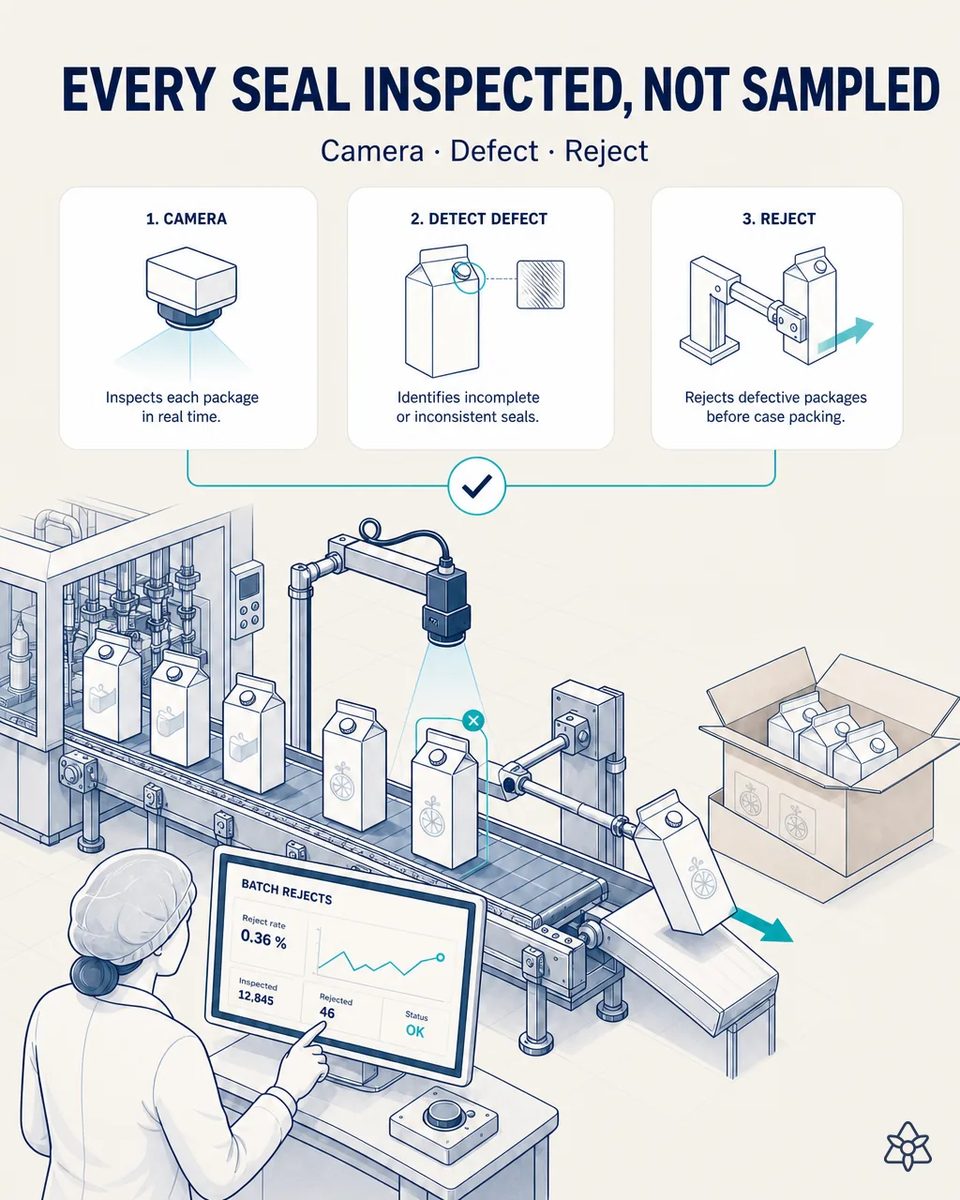
At eight thousand packs an hour, the eye does not control the seal. It controls a sample.
The throughput of a modern aseptic filler is far beyond what a person can inspect consistently across a full shift. That is why control is done by periodic sampling, which is statistically sound and completely blind to the sporadic defect. And the sporadic defect is exactly the one that does damage: the reel that starts sealing badly mid-shift, the pack malformed right after a format change, the misaligned cap on one particular run. All of them pass sampling without trouble. The cost does not show up on the line. It shows up when the product is already in another country, with the brand on it and no possibility of quick containment.
- The throughput of a modern aseptic filler is far beyond what a person can inspect consistently across a full shift. So control is done by periodic sampling: statistically sound, and completely blind to the sporadic defect.
- And the sporadic defect is exactly the one that does damage: the reel that starts sealing badly mid-shift, the pack malformed right after a format change, the misaligned cap on one particular run. All of them pass sampling without trouble.
- A defective transverse seal on UHT product is not cosmetic: it is the loss of commercial sterility, which shows up swollen on a shelf in the destination country weeks later.
- The cost does not show up on the line. It shows up when the product is already in another country, with the brand on it and no possibility of quick containment.
Edge — one hundred percent inspection in milliseconds, before casing.
Edge, in-line AI vision. The flow:
The value is not only in rejecting: it is that the trend becomes visible before it becomes a problem. Every defect is logged against the batch and the reel, so the reject curve per line climbs on a screen instead of being a hunch that this reel seems odd. Hearing that from the operator is not the same as watching a curve rise ten minutes after the reel change — and being able to stop it before the case packer fills a pallet.
- Industrial camera mounted over the conveyor at the filler outlet, before casing.
- Vision model trained on good and bad packs from that specific line and format — not a generic model: incomplete transverse seal, malformed fold, fill level out of range, misaligned or missing cap, illegible coding.
- Local inference, in milliseconds, with no dependency on the network or the cloud. The line does not stop if the internet does.
- Automatic rejection of the defective pack before casing: it never reaches the pallet.
- Every defect is logged against the batch, so the reject curve per line and per reel is visible in real time.
The value is not only in rejecting: it is that the trend becomes visible before it becomes a problem. Hearing that "this reel seems odd" is not the same as watching a curve climb.
Today's inspection versus Edge vision
| Aspect | Sampling inspection | With iLEAN Edge |
|---|---|---|
| Coverage | A sample per interval | Every pack, at filler speed |
| Incomplete transverse seal | Passes between samples | Rejected before the case |
| Fill level and cap | Checked by eye | Classified in milliseconds |
| Where the defect is found | On a shelf abroad, swollen | At the filler outlet |
| The reel that starts sealing badly | Suspected | A reject curve per reel, in real time |
| Dependency on network or cloud | — | None: local inference |
from sampling-based inspection, to one hundred percent inspection. From finding the defect in the customer complaint, to rejecting it on the line. From intuition about a reel's quality, to a reject curve per batch.
Estimated impact — to validate with your own numbers.
The block below is an estimate to be validated against your plant's actual data. We put it forward so the committee has an order of magnitude; we refine it during the assessment.
- Estimated reduction of at least 30 % in pack defect complaints.
- Estimated payback 6-12 months per installed line.
- That timeline drops considerably the moment a single avoided recall of exported product is counted.
- And a reject curve per line and per reel that turns intuition about a reel's quality into a number you can act on mid-shift, before the pallet is built and the container is booked.
estimated reduction of at least 30 % in pack defect complaints, with payback of 6 to 12 months per installed line. That timeline drops considerably once a single avoided recall of exported product is counted. *Estimate to validate.*
And the fair question from the production manager
«What if it rejects good packs?» — the false positive is the real risk of any vision system, which is why the model is trained on good and bad packs from your specific line and format, with that filler's lighting, not on a generic model. Borderline cases are not simply rejected: they are flagged for a person to decide, and every decision feeds back into training. Classifying a seal against a learned reference is an anchored task, where the best models drop below 1.5% error [1].
[1] OpenAI paper "Why Language Models Hallucinate", 2025 — on the reliability of AI in anchored tasks.
What people ask about seal inspection
What exactly does the camera check?
Incomplete transverse seal, malformed fold, fill level out of range, misaligned or missing cap and illegible coding. The catalog is defined with your quality team on that specific line and format, and extended if a new defect shows up.
Does it keep up with the filler?
Yes: inference is local and resolves in milliseconds per pack, at eight thousand packs an hour. It does not depend on the plant network or the cloud, so the line does not stop if the internet does.
Where does the rejected pack go?
It is diverted at the filler outlet, before casing, and counted against the batch and the reel in use. It never reaches the pallet, which is the whole point: a swollen pack on a shelf abroad is found weeks too late.
How many defective packs do you need to train it?
Fewer than feared, because a carton's defect catalog is short and repetitive. What is needed is that they be real packs from your line, in each format you run, under that filler's lighting.
Does it replace the sampling plan?
It makes the sampling plan a formality. Your quality procedure can stay as it is; what changes is that the sporadic defect the sample never sees is now caught pack by pack, and the reject curve tells you when to look at the reel.
More cases from this series
- Audit evidence exists before the inspector asks for itEvery critical changeover generates its dossier with before and after photos, log and signature, ordered…
- Digitizing the concentrate evaporator panel without touching the machineA camera reads degrees Brix, temperature and vacuum off the evaporator's isolated panel. No machine…
- Bulk orange and aseptic input intake, without typing into the ERPPhoto the delivery note, the weighbridge ticket and the pallet labels; one-tap validation and straight…
- The shift lead's knowledge stops dying at end of shiftAn earpiece and voice: the shift lead dictates what they see without breaking stride, and gets support…
- Lab analysis reaches the ERP without anyone typing itiLEAN reads the lab sheet when it is saved, structures it and posts it to the ERP after validation. From…
- Milk collection alerts, read at second zeroThe carrier's message is cross-checked against the process plan and returns a concrete action, not a…
Tell us how many pack complaints you had last year and how many came from outside the country.
We work on your plant's real data, not ours. Assessment with no commitment.
Request estimated ROI within 48h ‹ See all cases of dairy and citrus See food industry