The UHT line startup sheet, digitized with one photo
In a plant filling UHT milk into aseptic cartons, every line startup begins with two sheets of paper: the startup sheet — product, format, batch, sterilization temperature — and the record where the CIP operator signs that the circuit was left clean. Both define the batch and both are written by hand, because last-minute notes never fit the printed form. With iLEAN Connect the operator takes two photos at startup and the batch exists in central memory at second zero, without changing a single gesture of the routine.
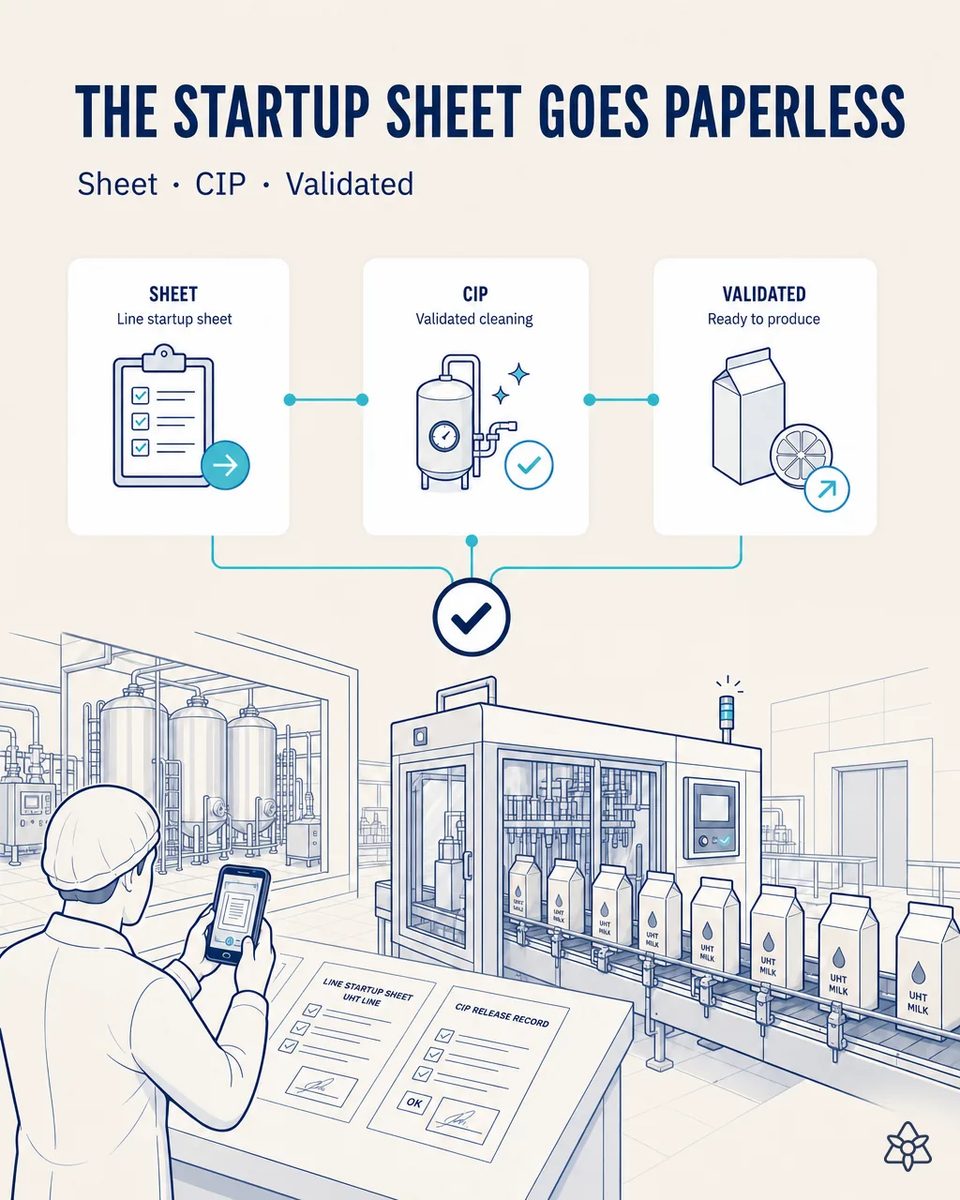
The two documents that legally define the batch spend the morning in a folder.
The sheet is printed first thing with ERP data, and what actually happens gets written on top of it: the silo change, the temperature adjustment on the sterilizer, the malformed pack ten minutes into the run. The CIP release record is handwritten by standard. These two documents are what legally define the batch. And both end up in a folder in the office, where they can sit for four to eight hours before anyone digitizes them. That gap goes unnoticed while everything runs well. It gets noticed on the day the destination market's health authority arrives for re-inspection and asks for evidence that this specific batch started on a clean circuit. Then someone has to go and find the paper, and the paper may not be where it should be.
- The startup sheet prints first thing with ERP data — product, format, batch, source silo — and what actually happens gets written over it by hand: the silo change, the sterilizer temperature adjustment, the malformed pack ten minutes into the run.
- The CIP release record is handwritten by standard. The CIP operator signs that the circuit was left clean, and that signature is the only proof the batch started on a clean line.
- Both go into a folder in the production office and wait there four to eight hours, sometimes until the next morning, before anyone types them into anything.
- During that gap the batch exists physically on the pallet but in no queryable system — and that is exactly the window in which a re-inspection or a customer complaint can ask for it.
Connect in photo mode — the operator keeps the sheet and adds two photos.
Connect in "photo of the analog" mode. Step by step:
It is the simplest of the twelve to deploy and the one that meets least resistance at the filler, because it asks for nothing new: the operator fills in the sheet as always and photographs it together with the CIP record. The paper still exists; it just stops being the only place the data lives. That is usually why it is the first case a plant approves.
- The operator starts the line exactly as always and fills in the sheet by hand.
- When finished, they take two photos with a mobile or industrial tablet: the startup sheet and the CIP release record.
- A language model grounded in the plant's own vocabulary extracts the structured fields: batch, product, format, source silo, sterilization temperature and hold time, release signature, handwritten notes.
- Everything is stored in iLEAN's central memory against the batch number, along with the original image of both documents.
- A query by batch returns the startup sheet, the CIP record and the photo of the first pack on a single screen.
No habit change, no new form and no tablet the operator has to learn. The paper still exists; what changes is that it stops being the only place the data lives.
Today's startup versus the captured startup
| Aspect | Today, on paper | With iLEAN Connect |
|---|---|---|
| Latency until the batch exists digitally | 4-8 h, more across a night shift | Second zero |
| Sterilization temperature and hold time | Handwritten on the sheet | Extracted and tied to the batch |
| CIP release signature | In a folder, hopefully | Photographed and linked to the batch |
| Proving a clean-circuit startup at re-inspection | Somebody goes to find the paper | One query by batch number |
| Handwritten deviations | Lost unless someone types them | Read and stored with the original image |
| Operator's routine | — | Unchanged: two photos |
from 4-8 h of latency between startup and digital record, to second zero. From half a morning searching last month's binder, to the time it takes to type a batch number. From evidence scattered on paper, to evidence queryable by batch with the original image attached.
Estimated impact — to validate with your own numbers.
The block below is an estimate to be validated against your plant's actual data. We put it forward so the committee has an order of magnitude; we refine it during the assessment.
- Estimated payback 4-9 months, depending on the number of line startups per day.
- Counting only the transcription time recovered by the production manager and the quality clerk, who today retype what the operator already wrote.
- From 4-8 hours of latency between startup and digital record, down to second zero — and from half a morning searching last month's binder, to the time it takes to type a batch number.
- Not counted, and larger: having the startup sheet and the CIP release ready on the day the destination market's health authority arrives for re-inspection.
estimated payback 4 to 9 months depending on startups per day, counting only the transcription time recovered by the production manager and the quality clerk. *Estimate to validate.* It excludes the value of having evidence ready on audit day, which is the larger and harder-to-quantify argument.
And the fair question from the production manager
«What if it misreads the sterilization temperature on the sheet?» — reading fields off a document whose structure is known is an anchored task, where the best models drop below 1.5% error [1]. And there is a second net: every value is checked against its physical range — a UHT hold temperature has a narrow window — and any low-confidence field is flagged for the quality clerk to confirm before it is written against the batch.
[1] OpenAI paper "Why Language Models Hallucinate", 2025 — on the reliability of AI in anchored tasks.
What people ask about digitizing the UHT line startup
Do we have to redesign the startup sheet or the CIP record?
No. Both stay exactly as they are, because the CIP release is handwritten by standard and the startup sheet is what your operators already know by heart. The model reads the document structure as it exists today, including the plant's own abbreviations.
Does it read the handwritten notes on top of the printed data?
Those are the most valuable part, because that is where the silo change or the sterilizer adjustment is written. They are extracted like any other field, and a doubtful value is flagged for a person rather than guessed.
What happens on a night shift or a weekend startup?
That is where the gap is widest today: the sheet waits until the office opens on Monday. With capture the batch exists in central memory from the first minute, whatever the hour and whoever is on shift.
Does the photo of the first pack go with it?
Yes. The startup sheet, the CIP release and the photo of the first carton off the filler come back on one screen when you query the batch number, with the original images attached.
Do we need the ERP or the process control system connected first?
No. The case works from the first startup against iLEAN's central memory, and it is the fastest of the twelve to show value. The push to the ERP is connected later, once that value is demonstrated.
More cases from this series
- Audit evidence exists before the inspector asks for itEvery critical changeover generates its dossier with before and after photos, log and signature, ordered…
- Digitizing the concentrate evaporator panel without touching the machineA camera reads degrees Brix, temperature and vacuum off the evaporator's isolated panel. No machine…
- Bulk orange and aseptic input intake, without typing into the ERPPhoto the delivery note, the weighbridge ticket and the pallet labels; one-tap validation and straight…
- The shift lead's knowledge stops dying at end of shiftAn earpiece and voice: the shift lead dictates what they see without breaking stride, and gets support…
- Lab analysis reaches the ERP without anyone typing itiLEAN reads the lab sheet when it is saved, structures it and posts it to the ERP after validation. From…
- Milk collection alerts, read at second zeroThe carrier's message is cross-checked against the process plan and returns a concrete action, not a…
Tell us how many hours a month you spend transcribing startup sheets.
We work on your plant's real data, not ours. Assessment with no commitment.
Request estimated ROI within 48h ‹ See all cases of dairy and citrus See food industry