Defect ejected on the line
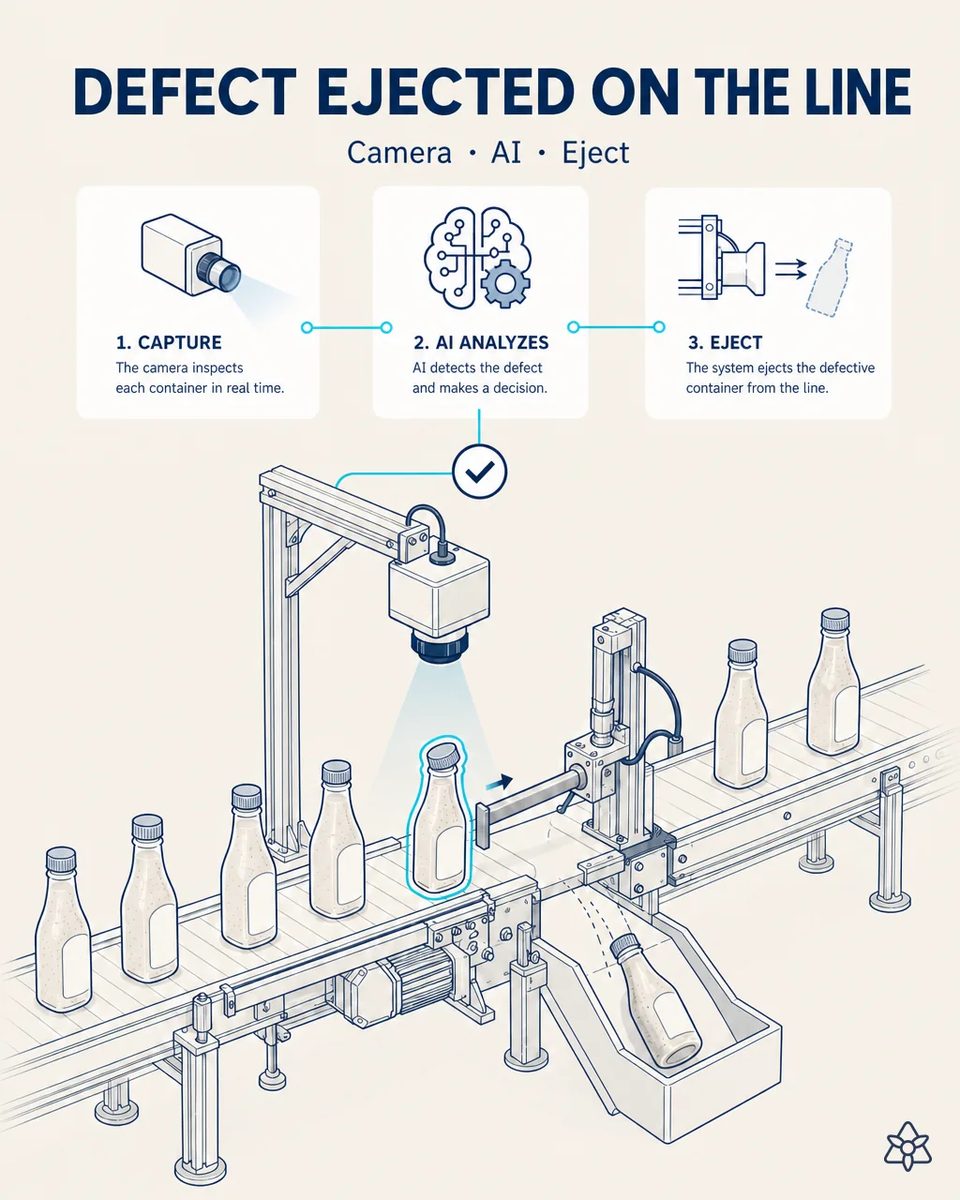
At real packing-line speed, the human eye gets tired and lets defective containers through. iLEAN Edge places a camera over the line, infers in milliseconds, and ejects the defective container before palletizing.
At filling speed, a person can only sample.
100% human visual inspection is impossible at real cadence on a line running several formats per shift; defects that slip through reach the retailer as a claim or a returned pallet.
- A line running mayonnaise jars in the morning, ketchup squeeze bottles at noon and dressing sachets in the afternoon cannot be inspected container by container by the human eye.
- So quality samples 1-2% and trusts the rest. Underfills, cocked caps, missing induction seals and crooked labels get through between samples.
- Those defects reach the retailer as a claim or a returned pallet, and sometimes as a conversation about the shelf space.
- On cans the stakes are higher: a visibly deformed lid or seam is not a cosmetic flaw, it is a reason to pull the container after the thermal process.
Edge — a camera over the line and a decision in milliseconds per container.
an Edge camera over the line, running a model trained on good and bad examples of that specific format (bottle, sachet, can), infers in milliseconds per container and triggers automatic ejection before palletizing.
The model is trained on good and bad examples of each specific format, infers locally in milliseconds and triggers the ejector before palletizing. Coverage goes from a sample to every container, and the operator stops being the inspection system. And what used to arrive as a returned pallet now shows up as a trend on a screen, by format and by shift, while there is still time to adjust the capper or the labeler. The checkweigher keeps doing its job; the camera does the one nobody could do at that cadence.
Sampling today versus every container inspected
| Aspect | Today | With iLEAN Edge |
|---|---|---|
| Inspection coverage | 1-2% sampled | 100% of containers |
| Fill level of a clear jar or bottle | Checked on samples | Seen on every unit |
| Cap, lid and seal | Missed between samples | Classified and ejected |
| Label position and presence | A retailer claim | Rejected before the case packer |
| Several formats per shift | Same eyes, more fatigue | Model switched with the format |
| Ambiguous containers | Pass by default | Held for a person |
1-2% sampling → 100% inspection coverage. Visual-defect claims → drastic reduction.
Impact estimate — to be validated with your current defect rate.
The block below is an estimate to be validated against your plant's actual data. We put it forward so the committee has an order of magnitude; we refine it during the assessment.
- Estimated payback 5-12 months, depending on your current defect rate.
- Inspection coverage goes from 1-2% sampling to every container on the line.
- Visual-defect claims drop drastically, and with them the returned pallets that cost freight twice.
- And quality time moves from staring at a conveyor to reading the defect trends the camera reports by format and shift.
estimated payback 5-12 months depending on the current defect rate. *Estimate to validate.*
And the fair question from the production manager
"What if it ejects good jars and we lose throughput?" — a false reject is the real risk of any vision system, which is why the model is trained on your formats, under that station's lighting. Classifying a known container against known defects is an anchored task, where the best models stay under 1.5% error [1]. The threshold is set with quality, and every ejected unit can be reviewed and fed back into training. Ambiguous containers are held for a person instead of being ejected blindly. Nobody on the line has to decide on a container in a fraction of a second.
[1] OpenAI paper "Why Language Models Hallucinate", 2025 — on the reliability of AI in anchored tasks.
What people ask about inspecting every container
How many samples does it take to train a format?
Around twenty good and bad samples are enough to show you a first trained model within a week. Accuracy improves with production data. Bring them with the defects you see most often: underfill, a cocked cap, a crooked label. We show you the model running on your own containers, not on a demo set.
Can it see the fill level through an opaque bottle?
Not by vision alone. On opaque formats it checks cap, label and visible defects, and fill weight stays with your checkweigher. On clear jars and bottles, fill level is checked on every unit by vision.
Does it replace the checkweigher?
No. The checkweigher controls weight; the camera covers what it cannot see, which is closure, label and visible container defects. Nor does it replace the metal detector; each one covers a different risk and they work side by side on the same line.
Does a format change mean retraining?
Each format has its own model, loaded when the line changes format. Adding a new format means a new set of samples. Switching models happens with the format change on the line, without anyone retraining on the spot. A plant with three formats per shift runs three models on the same camera.
Are container images sent to the cloud?
No. Inference runs on the Edge device at the line, and images of rejects are kept locally for review. Only summary data and the images you choose to review leave the station. That keeps the line running even if the plant network goes down.
More cases from this series
- The coder stitched to the ERPBatch, date and allergens travel from the ERP to the coder automatically via API. Zero typing, zero…
- Paperless batch startupThe operator photographs the batch order and formula at startup; the batch already exists in the central…
- The plant manager's headsetThe plant manager dictates incidents while walking the floor; iLEAN listens, structures and pushes back…
- Lab spreadsheet to ERP in secondsiLEAN detects the lab's quality spreadsheet, verifies it, and pushes it to the ERP automatically.…
- Two-tap line verificationNothing iLEAN captures enters the master ERP without a human confirming it first with two taps on an…
- The retort that finally talksAn external camera digitizes the retort's sterilization curve without touching the equipment or its…
Tell us how many visual-defect claims you had last quarter.
We work on your plant's real data, not ours. Assessment with no commitment.
Request estimated ROI within 48h ‹ See all cases of condiments and sauces See food industry