Two-tap line verification
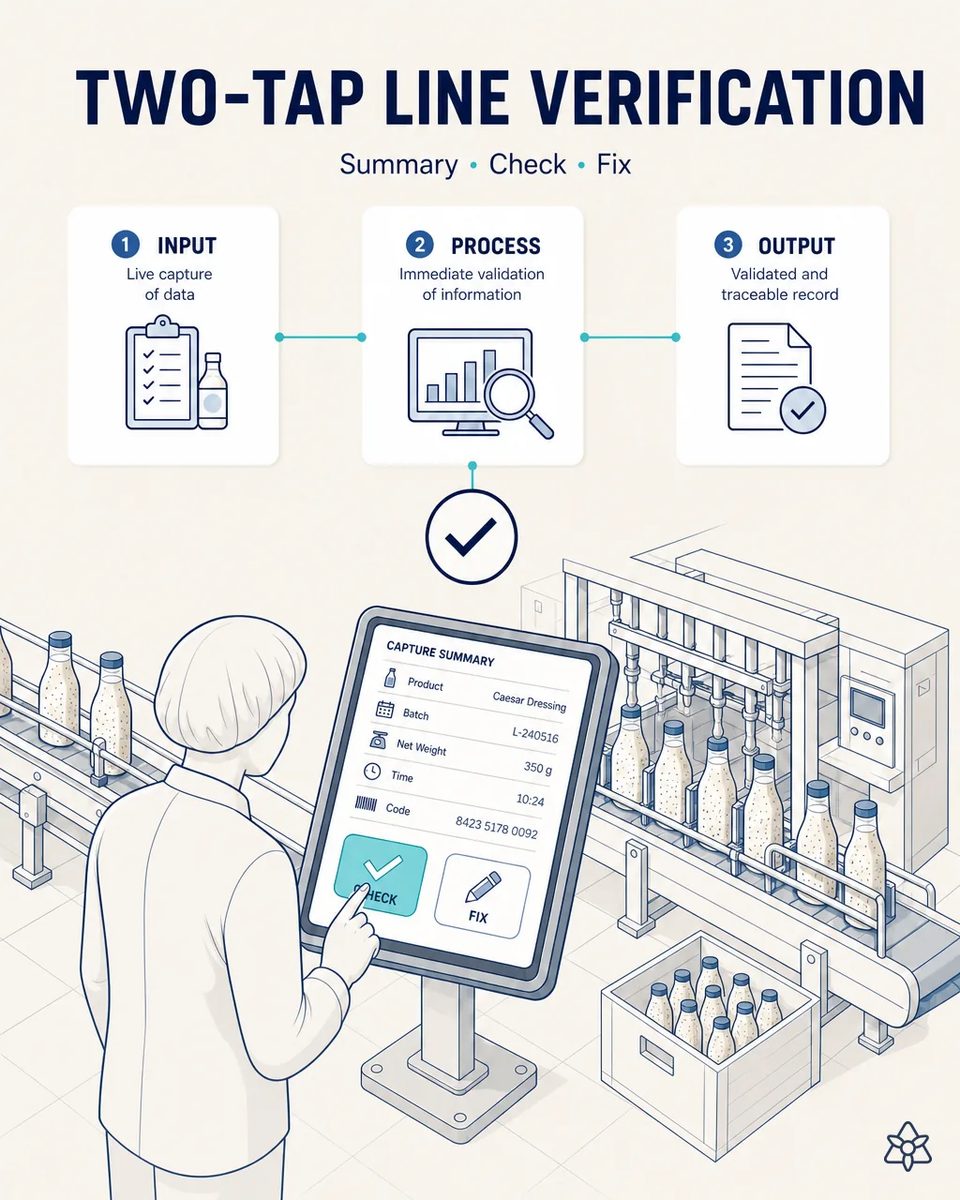
The main cultural brake on digitization is the fear that AI will enter data on its own and contaminate the master ERP. With iLEAN Connect, every capture shows up on a line-side tablet as a two-second visual summary, and the operator confirms with two taps before the data crosses to the central system.
The fear is not the capture. It is bad data in the allergen master.
in a plant with this many recipes and allergens per line, a badly captured data point entering unchecked can contaminate the master ERP with real consequences on declared allergens.
- The first objection to any digitization in a plant like this is cultural: that the AI writes into the ERP by itself and contaminates the master.
- With dozens of recipes and allergen declarations per line, one badly captured field is not a typo: it can change which allergens the system thinks a batch carries.
- So the data either goes in unchecked, with that risk, or does not get captured at all out of distrust.
- Either way the plant loses: a dirty master, or the paper stays and the latency with it.
Connect with early human verification — accept or fix, at the line.
Connect, early human verification mode. Every capture — a batch order photo, a headset dictation, a parsed supplier email — shows up on the industrial tablet as a visual summary. The operator confirms with two taps (accept / fix) before the data enters the central system.
Every capture, whether a batch order photo, a dictated incident or a parsed supplier email, shows up as a two-second visual summary. The operator taps accept or fix, and only then does the data cross. The model never writes to the master; a named person does. That sentence is what gets quality to sign off the rest of the matrix, which is why this piece is built first.
Data entering the ERP today versus verified at the line
| Aspect | Today | With iLEAN Connect |
|---|---|---|
| How data reaches the master | Typed later, or unchecked | Confirmed at the line, seconds later |
| A wrong allergen field | Can reach the declared allergens | Caught at the tablet |
| Batch, net weight and code | Retyped from paper | Shown pre-filled for a glance |
| Operator's effort | A trip to a terminal | Accept or fix, two taps |
| Data nobody dared capture | Stays on paper | Captured, because it is checked |
| Name on the record | Whoever typed it | Whoever confirmed it at the line |
unchecked data contaminating the ERP, or data not captured at all out of distrust → captured and verified data with seconds of latency, clean master.
Impact estimate — to be validated with your quality manager.
The block below is an estimate to be validated against your plant's actual data. We put it forward so the committee has an order of magnitude; we refine it during the assessment.
- No standalone payback: this is the enabling piece of the whole matrix. Its value is strategic, not directly monetizable, and we do not put a number on it.
- Without it the other pieces do not get signed off, because nobody in quality approves AI writing into a master that declares allergens.
- With it, data moves from unchecked or uncaptured to captured and verified with seconds of latency, and the master stays clean.
- And every correction an operator makes is stored, so the plant can see where extraction needs adjusting.
the enabling piece behind the whole iLEAN matrix — without it, the other pieces don't get signed off. *Strategic value, not directly monetizable.*
And the fair question from the production manager
"If someone confirms everything, what is actually automated?" — the typing, which is where the hours and the errors were. Reading a summary is not transcribing. On the extraction behind each summary, an anchored task, the best models are under 1.5% error [1], so the operator works as a safety net, not as a second data-entry clerk. What used to be a walk to a terminal is now two taps without leaving the station. And if the summary looks wrong, fixing it takes the same two taps as accepting it.
[1] OpenAI paper "Why Language Models Hallucinate", 2025 — on the reliability of AI in anchored tasks.
What people ask about two-tap verification
How long does each confirmation take on sauce and canning lines?
About two seconds to read the summary and one tap to accept. A fix opens only the field in question. Most captures are accepted as they come; the time is spent only where the model was unsure.
Is there any path for data to reach the ERP without a tap?
No. It is not a setting someone can switch off; it is how the flow is built. Even a capture the model reads with full confidence waits for the tap. It is the one rule in the whole matrix that has no exceptions, not even for urgent batches.
Which captures go through the tablet on sauce and canning lines?
All of them: batch order photos, dictated incidents, lab spreadsheet changes, delivery notes and supplier emails. The operator sees the same summary format whatever the source, so there is nothing new to learn per case.
Where does the tablet go in an area that is washed down?
On a pedestal or wall mount at the line, in an industrial enclosure rated for washdown. The operator does not leave the station. In practice one tablet per line is the usual starting point. It goes where the operator already stands to watch the filler, so checking costs no steps.
What happens to the corrections?
They are stored with the original capture and the name of who fixed it, which tells you where the model reads badly and which document layouts need attention. Over time the share of corrections falls, and the plant can see it falling. A recurring correction on the same field is the clearest sign that a supplier or a sheet changed its layout.
More cases from this series
- The coder stitched to the ERPBatch, date and allergens travel from the ERP to the coder automatically via API. Zero typing, zero…
- Paperless batch startupThe operator photographs the batch order and formula at startup; the batch already exists in the central…
- The plant manager's headsetThe plant manager dictates incidents while walking the floor; iLEAN listens, structures and pushes back…
- Lab spreadsheet to ERP in secondsiLEAN detects the lab's quality spreadsheet, verifies it, and pushes it to the ERP automatically.…
- The retort that finally talksAn external camera digitizes the retort's sterilization curve without touching the equipment or its…
- Delivery note, no typingOne photo of the delivery note and pallet labels is enough for iLEAN to push it to the ERP after a…
Tell us which data your quality team would never let into the ERP unchecked.
We work on your plant's real data, not ours. Assessment with no commitment.
Request estimated ROI within 48h ‹ See all cases of condiments and sauces See food industry