Delivery note, no typing
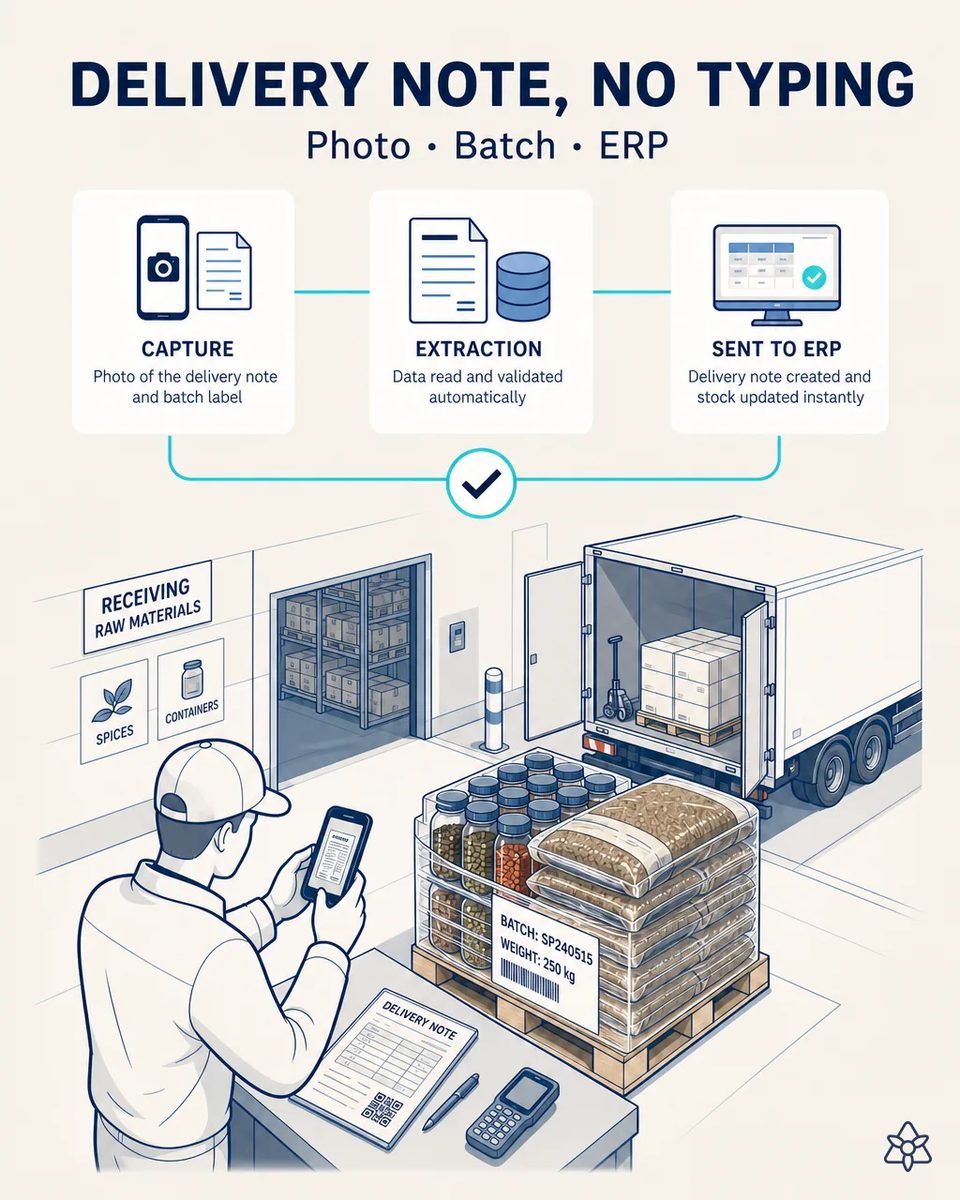
The truck arrives with spices, packaging or meat-line inputs. Instead of typing dozens of lines into the ERP, the receiving supervisor photographs the delivery note and the labels. iLEAN Connect digitizes it in seconds and pushes it to the ERP after one verification tap.
The truck waits, the clock runs and the batch numbers get rushed.
the truck waits racking up demurrage while the receiving supervisor types into the ERP. If they rush to avoid delay, some batches get logged wrong and surface weeks later in a claim that's nearly impossible to trace precisely.
- The truck arrives with vegetable oil, vinegar, egg yolk, glass jars, caps and cartons. Each delivery note carries dozens of lines and each pallet its own supplier batch.
- The receiving supervisor types it all into the ERP while the truck waits and demurrage starts to run.
- Rushing to free the dock means some batches get logged wrong, and nothing flags it at the time.
- The error surfaces weeks later in a claim, when you need to know which oil lot went into which mayonnaise batch and the receiving record says something else.
Connect in photo mode for analog documents — the note as it comes, the labels as they are.
Connect, photo mode for analog documents. Vision AI reads the supplier's delivery note format as-is, and decodes GS1-128, QR, barcode or plain-text OCR on pallet labels. One verification tap on an industrial tablet and everything crosses to the ERP.
The supplier changes nothing. The supervisor photographs the note and the pallet labels, vision reads each format as it is and decodes GS1-128, QR, barcode or plain text, and one tap on the tablet sends it all to the ERP. The truck leaves and the batches are right. And demurrage stops being a line item nobody can explain. Each ingredient lot enters the ERP with its supplier batch, quantity and best-before date, ready for the first mayonnaise or ketchup batch that consumes it.
Receiving at the dock today versus receiving by photo
| Aspect | Today | With iLEAN Connect |
|---|---|---|
| Time per delivery | About 45 minutes | About 5 minutes |
| Supplier batch on each pallet | Typed under pressure | Read from the label |
| Delivery note format | Each supplier its own | Read as it comes |
| A batch logged wrong | Hidden until a claim | Zero: note and label cross-checked |
| Tracing an oil lot to a mayonnaise batch | Doubtful | Exact |
| Seats in the ERP receiving module | Several | Only the supervisor who verifies |
45-minute receiving process → 5 minutes. Hidden batch errors → zero.
Impact estimate — to be validated with your receiving volume.
The block below is an estimate to be validated against your plant's actual data. We put it forward so the committee has an order of magnitude; we refine it during the assessment.
- Estimated payback 3-8 months.
- CFO angle: the ERP receiving module typically needs several active seats; with Connect only the supervisor verifies with one tap, a typical 50-70% cut in receiving and warehouse seats.
- Receiving drops from 45 minutes to 5, and the truck stops racking up demurrage at your dock.
- And hidden batch errors go to zero, which is what keeps any later claim traceable down to the ingredient lot.
estimated payback 3-8 months. CFO angle: the ERP's receiving module typically requires several active seats; with Connect, only the supervisor verifies with one tap — a typical 50-70% cut in receiving/warehouse seats. *Estimate to validate.*
And the fair question from the production manager
"What if the label is creased or the note is a bad photocopy?" — reading a document and a label whose structure is known is an anchored task, and the best models stay under 1.5% error [1]. Codes are decoded, not guessed, and when the note says one batch and the pallet label another, the discrepancy is shown to the supervisor before the tap instead of being discovered later. The supervisor keeps the last word on every delivery. A blurred photo is simply asked for again, at the dock, while the truck is still there.
[1] OpenAI paper "Why Language Models Hallucinate", 2025 — on the reliability of AI in anchored tasks.
What people ask about receiving by photo on sauce and canning lines
Do suppliers need to send a standard delivery note?
No. Each supplier's format is read as it comes, including handwritten additions by the driver. A new supplier format is learned from its first few deliveries. The supervisor does not have to set anything up for that to happen.
Which label codes does it decode?
GS1-128, QR and common barcodes, plus plain-text reading when the label carries no code at all. When a label carries both a code and text, both are read and compared. No handheld scanner is needed; the phone camera that takes the photo is enough.
Does it record best-before dates on egg yolk and oil?
Yes, when they are on the label or the note, and a short-dated delivery is flagged before it is accepted. Short shelf life on egg yolk is exactly the case where a late catch costs a full batch of mayonnaise.
Can receiving go live before any other case?
Yes. It has few dependencies and pays on its own, which is why many plants start here. It is also the case that feeds traceability for every other one, because every batch begins with an ingredient lot. Most plants see the truck leaving the dock faster within the first week.
What happens if a pallet is missing from the note?
The mismatch between the photographed labels and the note lines is shown on the tablet before anything is accepted. The supervisor can accept the rest and leave the gap open, with the reason, so the supplier claim starts from a fact.
More cases from this series
- The coder stitched to the ERPBatch, date and allergens travel from the ERP to the coder automatically via API. Zero typing, zero…
- Paperless batch startupThe operator photographs the batch order and formula at startup; the batch already exists in the central…
- The plant manager's headsetThe plant manager dictates incidents while walking the floor; iLEAN listens, structures and pushes back…
- Lab spreadsheet to ERP in secondsiLEAN detects the lab's quality spreadsheet, verifies it, and pushes it to the ERP automatically.…
- Two-tap line verificationNothing iLEAN captures enters the master ERP without a human confirming it first with two taps on an…
- The retort that finally talksAn external camera digitizes the retort's sterilization curve without touching the equipment or its…
Tell us how long your last ingredient delivery kept the truck at the dock.
We work on your plant's real data, not ours. Assessment with no commitment.
Request estimated ROI within 48h ‹ See all cases of condiments and sauces See food industry