Paperless batch startup
In a condiment and sauce plant, every shift starts with a paper batch order and a formula sheet defining batch, weights, allergens and format. Today both documents can sit undigitized for hours. With iLEAN Connect, two phone photos are enough for the batch to exist in the central system at zero seconds, with no change to the operator's routine.
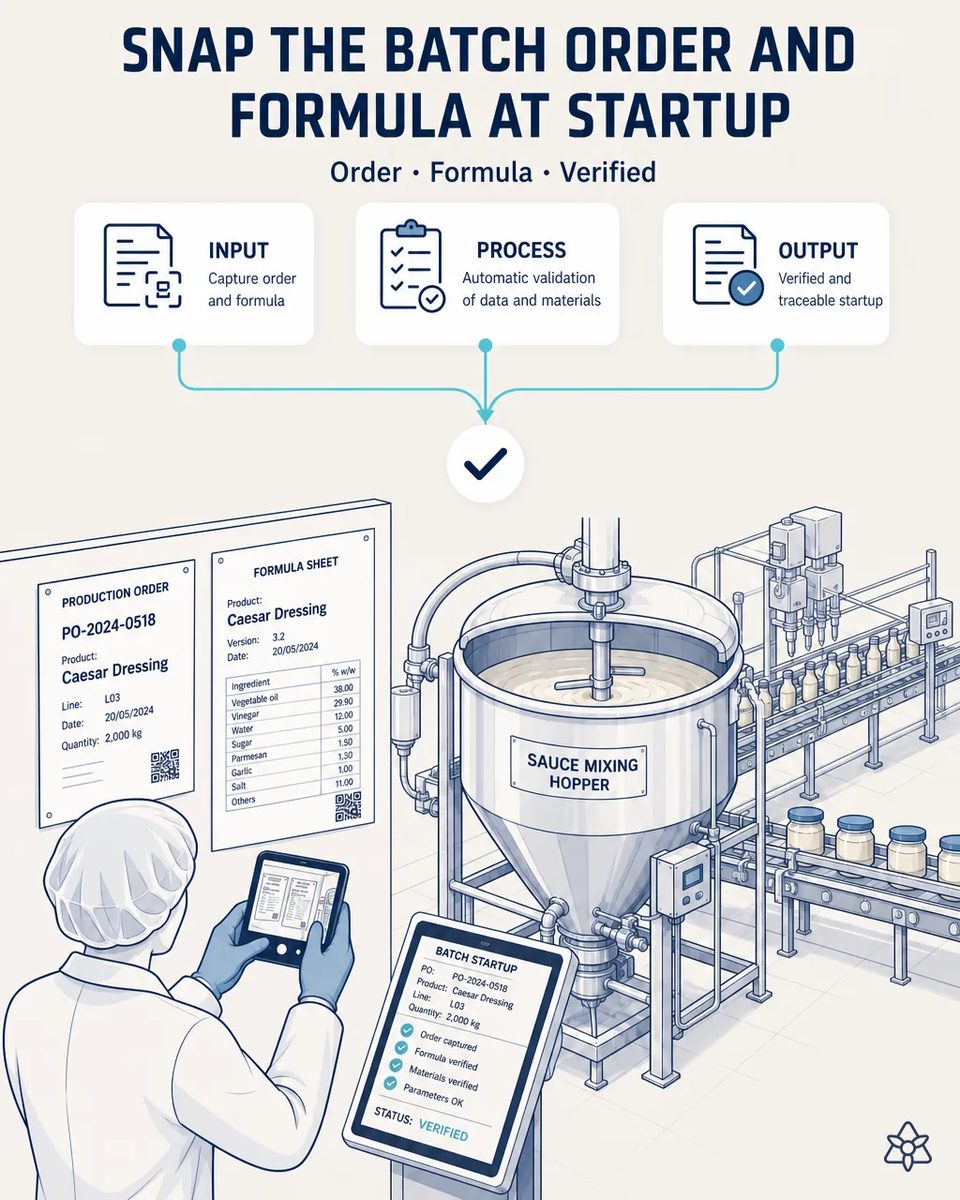
The formula that fixes oil, egg and vinegar spends the shift on paper.
the formula changes by product and by customer (own brand or private label), and its paper version can sit undigitized for hours. If an allergen claim comes in, someone has to reconstruct by hand exactly which formula was used that day — slow and error-prone across a catalog with dozens of active SKUs.
- Every startup at the mixing kettle begins with a printed batch order and a formula sheet: batch, weights per ingredient, declared allergens and packaging format, from a squeeze bottle to a foodservice tub.
- The formula changes by product and by customer: the same mayonnaise base runs under your own brand in the morning and as a private label with a different allergen panel in the afternoon.
- Those two sheets can sit undigitized for 4-8 hours, and on a busy shift the formula version actually used is whatever the operator had in hand.
- When an allergen claim comes in, somebody rebuilds by hand which formula ran that day, across dozens of active SKUs, with a binder and a phone call to whoever was on shift.
Connect in photo mode — two photos at the kettle and the batch already exists.
Connect, photo mode. The operator photographs the batch order and the formula sheet with their phone at startup. A grounded language model extracts the structured fields — batch, formula, weights, allergens, packaging format — and stores them in iLEAN's central memory, ready to cross-check against the ERP or any later query.
Nothing about the startup changes except two photos. The operator still reads the formula, weighs the oil and the yolk, and signs the sheet; the difference is that the batch is queryable from second zero, with the exact formula version and allergens it ran with.
Paper startup versus a startup that exists at second zero
| Aspect | Today, on paper | With iLEAN Connect |
|---|---|---|
| Time until the batch is in the system | 4-8 h, longer at weekends | Zero seconds |
| Formula version at the kettle | Whatever sheet was in hand | Extracted and stored with the batch |
| Allergen panel of a private label | Read off the paper from memory | Structured per batch and customer |
| Weights corrected in pen | Lost unless retyped | Captured as the real dosage |
| An allergen claim from a retailer | Binder, phone calls, half a day | One web lookup by batch |
| What the operator does differently on sauce and canning lines | — | Two photos |
4-8 hours of latency before digitizing the paper → zero seconds. Manual reconstruction of which formula was used → instant web lookup by batch.
Impact estimate — to be validated with your daily batch count.
The block below is an estimate to be validated against your plant's actual data. We put it forward so the committee has an order of magnitude; we refine it during the assessment.
- Estimated payback 4-9 months, depending on how many batches you start per day.
- Transcription time recovered for the production manager, who today types the batch order and the formula into the system at the end of the shift.
- From 4-8 hours of latency to zero seconds: the batch exists before the first jar is filled.
- And the question of which formula ran that day goes from a manual reconstruction to an instant web lookup by batch.
estimated payback 4-9 months depending on daily batch volume, plus recovered transcription time for the production manager. *Estimate to validate.*
And the fair question from the production manager
"What if it misreads a weight on the formula sheet?" — extracting fields from a sheet whose layout you already use every day is an anchored task, and on anchored tasks the best models stay under 1.5% error [1]. On top of that, every capture comes back as a two-second summary on the line tablet, and the operator confirms or fixes it before it reaches the central system. A value read with low confidence is flagged, never guessed.
[1] OpenAI paper "Why Language Models Hallucinate", 2025 — on the reliability of AI in anchored tasks.
What people ask about capturing the batch order and formula
Do we have to redesign our formula sheets?
No. The model reads the layout you already print, including the private-label versions. If a customer sends its own format, it is learned from a handful of examples. The sheet stays the document the operator trusts at the kettle.
Does it read a dosage corrected by hand at the kettle?
Yes, and that correction is often the most valuable field on the sheet, because it records what actually went into the emulsion. A low-confidence reading is flagged for the operator to confirm. That is how the real oil and yolk proportion of each batch ends up on record.
How does it keep own-brand and private-label runs of the same base apart?
Each photo is tied to its batch order, so two runs of the same mayonnaise base for different customers, with different allergen panels, stay as separate records. That separation is what answers a retailer asking about its own label.
Do we need to touch the ERP to get started?
No. The batch lives in iLEAN's central memory from the first photo. The push to the ERP is connected later, once the value is visible. Many plants run several weeks this way before deciding which fields to push.
Does it cope with sheets stained at the kettle?
Within reason, yes: a sheet with oil marks or a fold is still legible to the model. If a field cannot be read, it says so instead of filling it in. The operator simply retakes the photo while still at the kettle.
More cases from this series
- The coder stitched to the ERPBatch, date and allergens travel from the ERP to the coder automatically via API. Zero typing, zero…
- The plant manager's headsetThe plant manager dictates incidents while walking the floor; iLEAN listens, structures and pushes back…
- Lab spreadsheet to ERP in secondsiLEAN detects the lab's quality spreadsheet, verifies it, and pushes it to the ERP automatically.…
- Two-tap line verificationNothing iLEAN captures enters the master ERP without a human confirming it first with two taps on an…
- The retort that finally talksAn external camera digitizes the retort's sterilization curve without touching the equipment or its…
- Delivery note, no typingOne photo of the delivery note and pallet labels is enough for iLEAN to push it to the ERP after a…
Tell us how long a batch order takes to exist in your system today.
We work on your plant's real data, not ours. Assessment with no commitment.
Request estimated ROI within 48h ‹ See all cases of condiments and sauces See food industry