The plant manager's headset
The plant manager of a facility with several product lines spends the shift walking with their hands full. Everything they notice dies at the end of the shift because they can't type. With iLEAN Connect's voice mode, they dictate it while walking and the system structures, logs and supports them back in seconds.
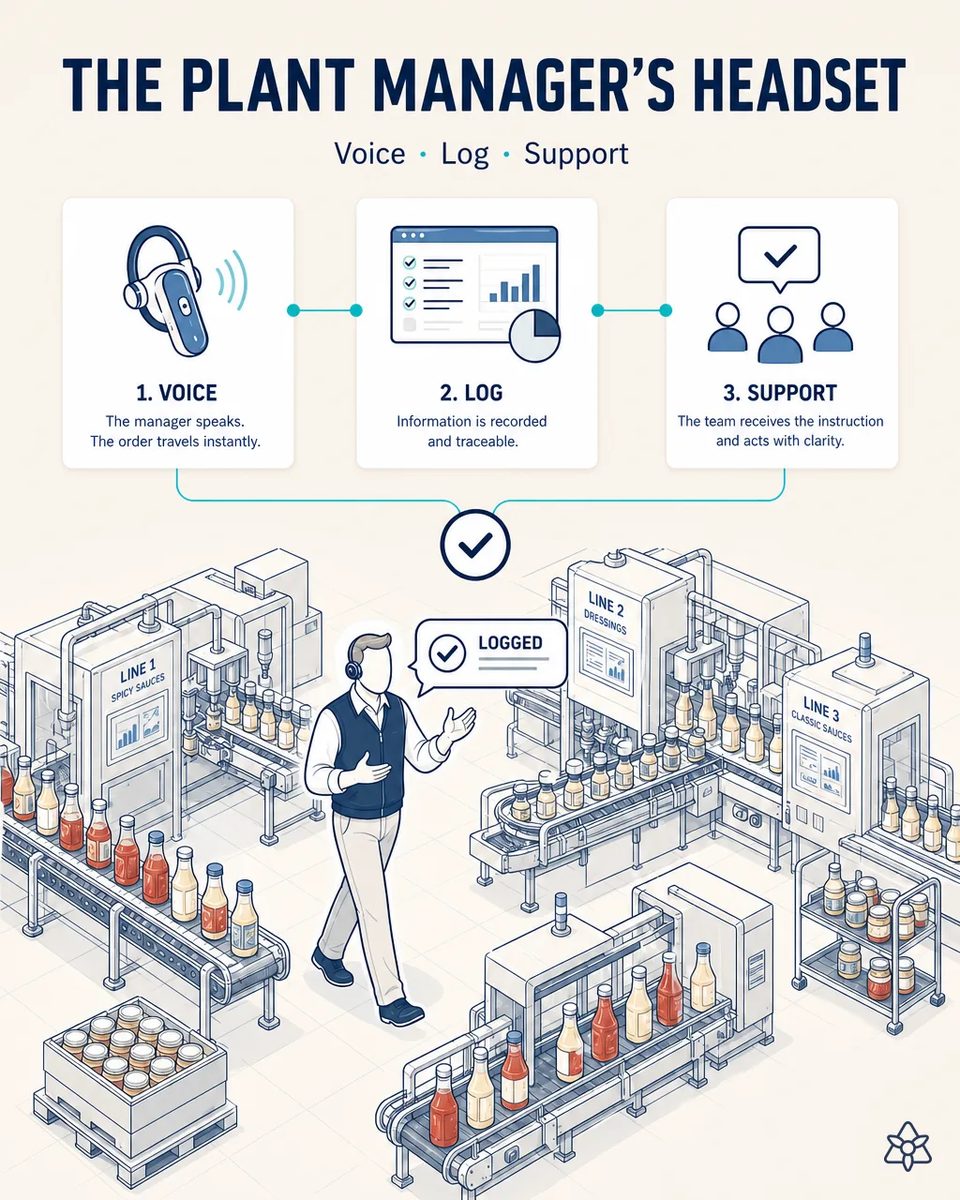
The plant's best sensor walks the floor and never types.
critical operational knowledge — which line looks off, which new operator needs backup, which supplier changed quality — lives in the plant manager's head and never enters the system.
- The manager of a plant with mayonnaise, ketchup and dressing lines spends the shift walking, with hands busy and no keyboard within reach.
- They notice which line looks off, which emulsion is coming out thinner than usual, which new operator needs backup, which supplier's vinegar changed.
- None of it enters a system, because recording means stopping, walking to an office and typing, and the shift does not allow it.
- At shift end that knowledge is gone, and the next time the same viscosity drift shows up on the same line, it is solved again from zero.
Connect in voice mode — a headset, a wake word and the manager in charge.
Connect voice mode with a Bluetooth headset and a custom wake word. A language model structures the dictation as an incident tied to the active batch, line and shift, and pushes confirmation or support back by voice or to a team lead's tablet.
The manager decides what gets recorded and when; nothing is captured otherwise. What they get in return is an incident structured by batch, line and shift, and an answer back in their ear or on a team lead's tablet within seconds. Within weeks the plant has something it never had: a dated history of the floor, written by the person who knows it best. Nobody else on the floor wears one or is heard through it.
The walk-round today versus the walk-round dictated
| Aspect | Today | With iLEAN Connect |
|---|---|---|
| What the manager notices | Gone by the end of the shift | Logged, dated and searchable |
| A thin emulsion on line 2 | Mentioned at the next meeting | Tied to the batch and its formula |
| Backup for a new operator | Asked for in passing | Sent to the team lead's tablet |
| An ingredient behaving differently | A hunch | Recorded against the supplier lot |
| Effort to record it | Stop, walk, type | Say it while walking |
| Conversations on the sauce line | — | Not recorded |
knowledge that dies at shift end → enters the system in real time and gets cross-checked against live data.
Impact estimate — to be validated with whoever leads continuous improvement.
The block below is an estimate to be validated against your plant's actual data. We put it forward so the committee has an order of magnitude; we refine it during the assessment.
- No standalone payback: this is an enabling piece. Its value is strategic and hard to price upfront, so we do not put months on it.
- It is the enabler behind every continuous-improvement effort in the plant, because those efforts need a written history of what happens on the lines.
- Recurring problems become visible: the third time the same line drifts in viscosity, it shows up as a pattern with dates, not as bad luck.
- And what the manager notices is cross-checked against live batch data instead of staying in one person's head.
strategic value, hard to price upfront, but the enabler behind every continuous-improvement effort in the plant. *Estimate to validate with the continuous-improvement lead.*
And the fair question from the production manager
"Will it understand me next to a running filler?" — dictation against a known vocabulary of lines, products and batches is an anchored task, and the best models stay under 1.5% error [1] on it, with the microphone at the manager's mouth rather than in the room. The structured incident is read back before it is filed, so a misheard line number is corrected on the spot. And only the manager is heard, and only after the wake word.
[1] OpenAI paper "Why Language Models Hallucinate", 2025 — on the reliability of AI in anchored tasks.
What people ask about the plant manager's headset
Is the plant manager recorded all day?
No. Nothing is captured until the wake word is said, and only what follows it is processed. Operators on the floor are not recorded. That boundary is part of the setup, and it is what keeps the tool accepted on the floor.
What does the manager get back?
A spoken confirmation, an answer to a question about the active batch, or a support request already routed to a team lead's tablet. The round goes on uninterrupted; nothing has to be looked up on a screen.
Does it know our product and line names?
Yes, the vocabulary is loaded at setup: your mayonnaise, ketchup and dressing references, your line numbers and your shift names. New products and lines are added as they appear, so the vocabulary keeps pace with the catalog.
Can the team leads use it too?
Yes, each with their own headset. Starting with the plant manager is usual because that is where the most knowledge is lost. Each voice is tied to its role, so the record says who noticed what and on which line.
How does a dictated note become an improvement action?
It is stored against the batch, line and shift. When the same symptom repeats, it surfaces with its history, so the improvement team starts from facts. That is the moment a viscosity drift on one line stops being an anecdote and becomes a cause with a date.
More cases from this series
- The coder stitched to the ERPBatch, date and allergens travel from the ERP to the coder automatically via API. Zero typing, zero…
- Paperless batch startupThe operator photographs the batch order and formula at startup; the batch already exists in the central…
- Lab spreadsheet to ERP in secondsiLEAN detects the lab's quality spreadsheet, verifies it, and pushes it to the ERP automatically.…
- Two-tap line verificationNothing iLEAN captures enters the master ERP without a human confirming it first with two taps on an…
- The retort that finally talksAn external camera digitizes the retort's sterilization curve without touching the equipment or its…
- Delivery note, no typingOne photo of the delivery note and pallet labels is enough for iLEAN to push it to the ERP after a…
Tell us what your plant manager noticed last week that no system recorded.
We work on your plant's real data, not ours. Assessment with no commitment.
Request estimated ROI within 48h ‹ See all cases of condiments and sauces See food industry