Lab spreadsheet to ERP in seconds
The quality lab fills in a spreadsheet every batch with pH, Brix, viscosity and salt readings. That spreadsheet lives in a folder the ERP never sees. iLEAN Connect detects it, verifies it, and pushes it to the ERP automatically — with a direct saving on quality-module seats.
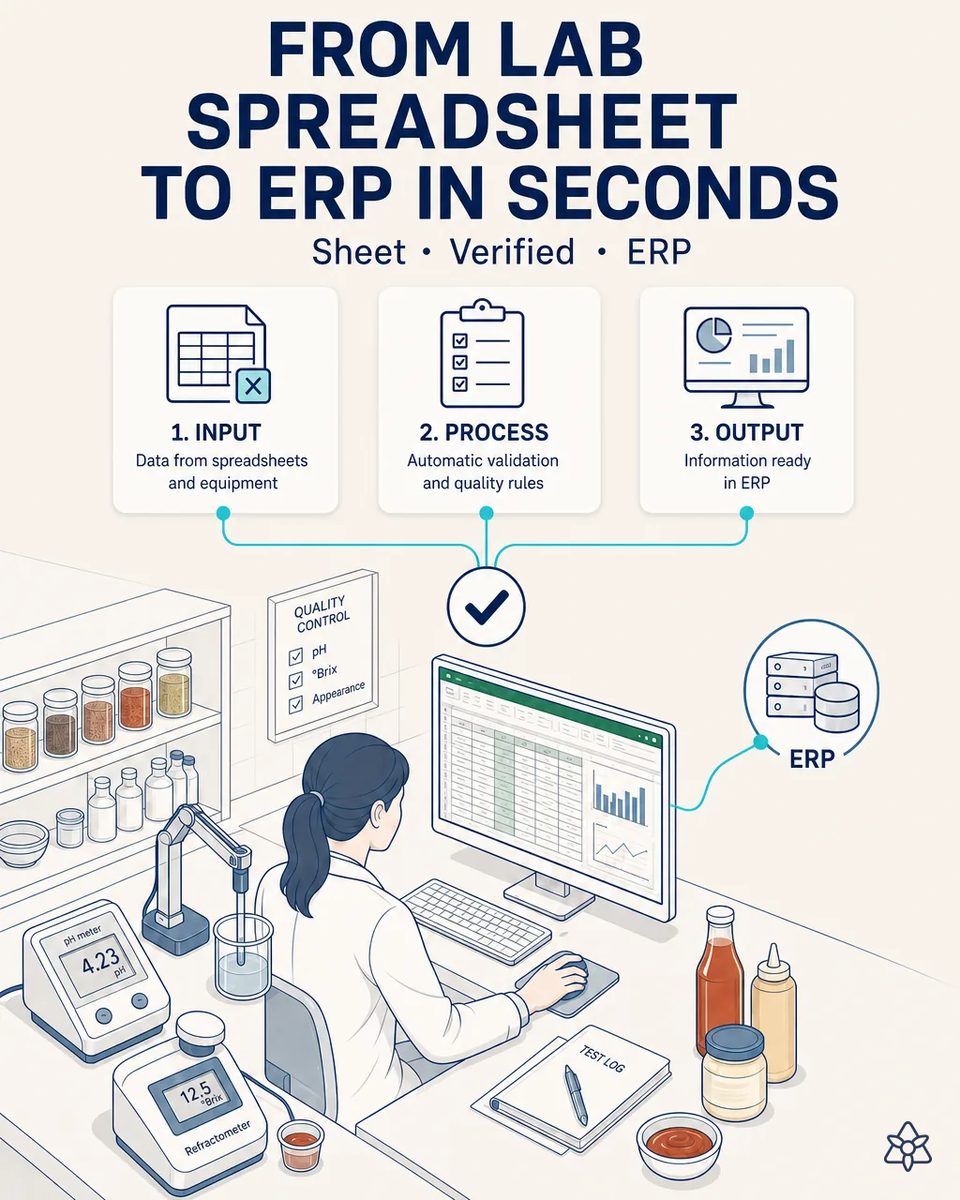
The lab's real numbers live in a file the ERP never sees.
two parallel worlds — the real spreadsheet, where the live data is, and the official ERP, transcribed weeks later by someone spending half a day a month copy-pasting and introducing errors.
- Every batch, the quality lab records pH, Brix, viscosity and salt in a spreadsheet: the readings that say whether the acidification holds and whether the emulsion is in spec.
- The spreadsheet is where the live data is. The ERP is where it is supposed to be, and it gets there weeks later.
- Someone spends half a day a month copy-pasting between the two, and a pH of 4.32 typed as 4.23 is exactly the kind of slip nobody catches.
- Meanwhile several lab staff hold ERP seats only to enter quality data, which is the licensing line finance asks about at every renewal.
Connect listening inward — it watches the shared folder, not the technician.
Connect, "listening inward" mode — it watches the shared folder, not the person. It reads the delta the moment the file is saved, parses it with a grounded model, shows it for verification, and pushes it to the ERP via API once the manager confirms.
The lab keeps its spreadsheet exactly as it is. iLEAN reads the change the moment the file is saved, shows it for verification and pushes it to the ERP through its API. The two worlds stop being two. The technician keeps measuring and saving; the copy-paste day at the end of the month simply disappears.
The lab spreadsheet today versus the spreadsheet connected
| Aspect | Today | With iLEAN Connect |
|---|---|---|
| Lag between lab reading and ERP | Weeks | Zero seconds |
| Monthly copy-paste on sauce and canning lines | Half a day | None |
| pH and acidification per batch | In a file nobody queries | In the ERP against the batch |
| Viscosity of each emulsion | A column in a spreadsheet | A trend per formula and line |
| Transposed digits | Found by chance, if ever | Gone: nothing is retyped |
| Lab seats in the ERP quality module | One per technician | Only the person who verifies |
weeks of lag between real data and ERP data → zero seconds. Half a day a month transcribing → zero.
Impact estimate — to be validated against your real ERP license pricing.
The block below is an estimate to be validated against your plant's actual data. We put it forward so the committee has an order of magnitude; we refine it during the assessment.
- Estimated payback 4-9 months.
- CFO angle: if several lab staff log into the ERP only to enter quality data, with Connect only the person who verifies needs a seat, a typical 50-80% cut in quality and lab module seats.
- The lag between the real reading and the ERP goes from weeks to zero seconds, and half a day a month of transcription goes to zero.
- And pH, Brix and viscosity become queryable per batch the day a customer asks for them.
estimated payback 4-9 months. CFO angle: if several lab staff today log into the ERP just to enter quality data, with Connect only the person who verifies needs a seat — a typical 50-80% cut in the quality/lab module. *Estimate to validate against real vendor pricing.*
And the fair question from the production manager
"What if it misreads a column and sends a wrong pH?" — parsing a spreadsheet whose columns you defined is an anchored task, where the best models stay under 1.5% error [1]. The change still shows up for the quality manager to confirm before it goes to the ERP, and a value outside the physical range for that product, such as a pH no acidified sauce could have, is flagged rather than pushed. Nobody in the lab has to open the ERP to make that happen.
[1] OpenAI paper "Why Language Models Hallucinate", 2025 — on the reliability of AI in anchored tasks.
What people ask about the lab spreadsheet on sauce and canning lines
Does the lab have to change its spreadsheet template on sauce and canning lines?
No. It is read as it is today, merged cells and all. If the template changes later, the new layout is learned. The lab does not have to learn anything new to keep working.
Is it tracking what the technician does on the computer?
No. It watches the shared folder and reads the file when it is saved. Nothing is installed on anyone's workstation to observe them. There is no keystroke logging, no screen capture and no timing of anyone's work.
What about results from an external lab, such as micro counts?
If they arrive as a file in the same folder or by email, they enter the same flow and wait for verification like any other reading. A result that arrives days later is attached to the batch it belongs to, not to the day it arrived.
How realistic is the 50-80% seat cut?
It is a typical range, not a promise: it depends on how many people log in today only to enter quality data and on your vendor's licensing. We estimate it with your numbers. Whatever the final figure, the seat count is based on who verifies, not on who types.
Does it help when a retailer asks for batch quality data?
Yes: pH, Brix, viscosity and salt are already in the ERP against the batch, so the answer is a lookup, not a hunt through monthly files. The same data feeds the certificate of analysis when a customer asks for one.
More cases from this series
- The coder stitched to the ERPBatch, date and allergens travel from the ERP to the coder automatically via API. Zero typing, zero…
- Paperless batch startupThe operator photographs the batch order and formula at startup; the batch already exists in the central…
- The plant manager's headsetThe plant manager dictates incidents while walking the floor; iLEAN listens, structures and pushes back…
- Two-tap line verificationNothing iLEAN captures enters the master ERP without a human confirming it first with two taps on an…
- The retort that finally talksAn external camera digitizes the retort's sterilization curve without touching the equipment or its…
- Delivery note, no typingOne photo of the delivery note and pallet labels is enough for iLEAN to push it to the ERP after a…
Tell us how many people log into your ERP only to enter lab results on sauce and canning lines.
We work on your plant's real data, not ours. Assessment with no commitment.
Request estimated ROI within 48h ‹ See all cases of condiments and sauces See food industry