The coder stitched to the ERP
The coder that prints batch and date on every container usually has an API but sits isolated from the ERP: every change gets typed by hand. With iLEAN, batch, date and allergens travel automatically from the active batch order, with zero manual re-entry.
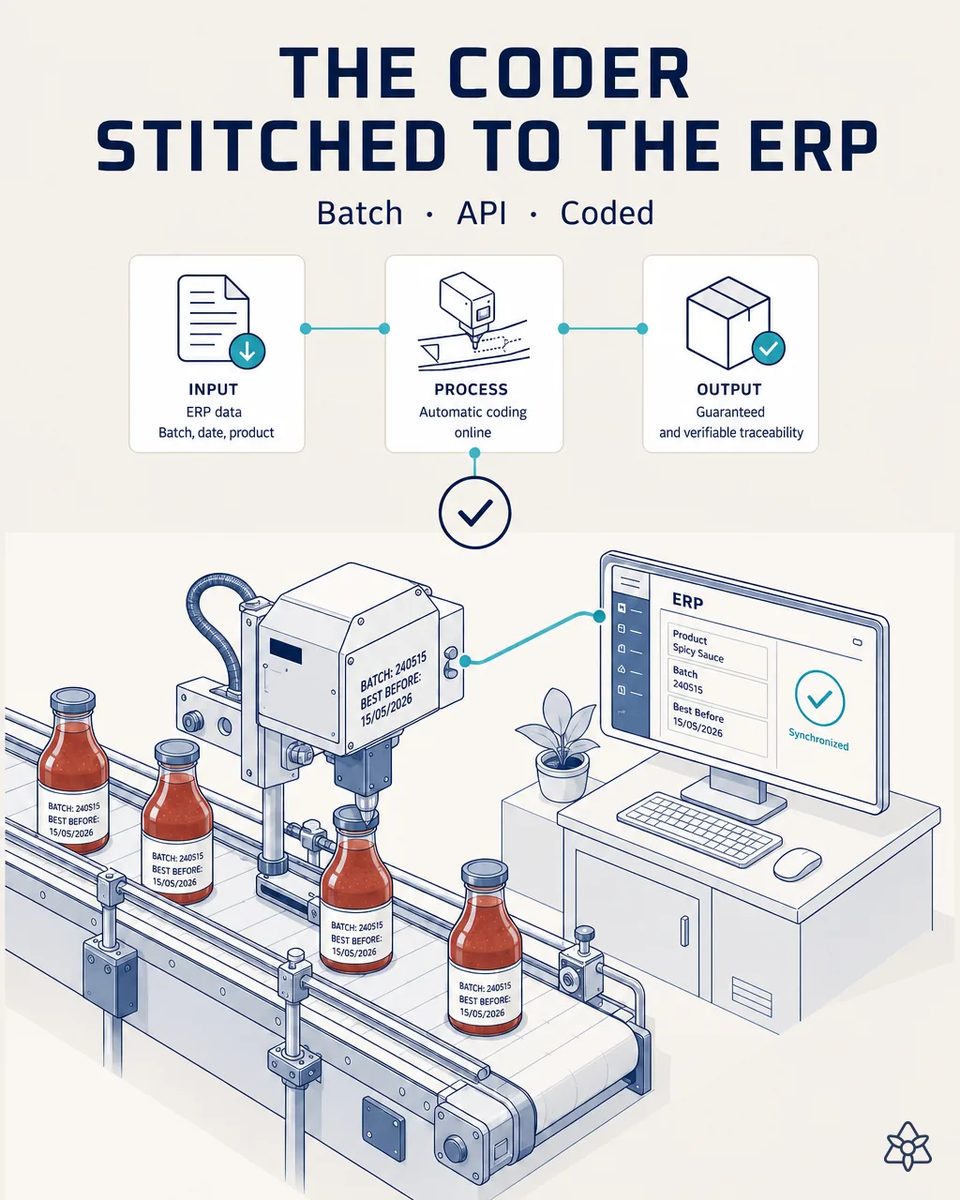
Two modern systems, and a person typing between them.
the coder is the last physical step before the customer. One fat-fingered entry on the panel, especially if the container carries a different allergen than the previous shift, can end in a recall.
- The coder that prints batch and best-before date on every jar, bottle or can usually has an API, and so does the ERP. Yet they do not talk.
- So at every batch order start someone types batch, date and, on some lines, the allergen text into the coder panel.
- The coder is the last physical step before the customer: one wrong digit is a jar the plant can no longer trace.
- The real danger is a changeover from a mustard dressing to a sauce without mustard, or the reverse: a run printed with the previous shift's data can end in a recall.
Connect links ERP and coder through their APIs — no hardware replaced.
Connect stitches the two modern systems together via API. The moment the ERP flags a batch order start, it automatically publishes batch, date and the allergen list to the coder.
The moment the ERP flags a batch order start, iLEAN publishes batch, date and allergen list to the coder. Nobody types. What gets printed is what the batch order says, and the coder's confirmation is stored with the batch. When the line changes from a mustard dressing to a ketchup, the coder changes with it, with nobody at the panel.
Coding by hand today versus coding from the batch order
| Aspect | Today | With iLEAN Connect |
|---|---|---|
| Entering batch and date | Typed at every changeover | Published from the ERP |
| Allergen text on the pack | Copied from the formula sheet | Taken from the active recipe |
| A transposed digit | Periodic, sometimes a recall | Zero human-origin errors |
| Changeover at the coder panel | Minutes of typing and checking | Automatic |
| Proof of what was printed | The operator's memory | Stored against the batch |
| Coder and ERP | Isolated | Both kept, now linked |
periodic typing errors, some triggering recalls → zero human-origin coding error.
Impact estimate — to be validated with your recall and complaint history.
The block below is an estimate to be validated against your plant's actual data. We put it forward so the committee has an order of magnitude; we refine it during the assessment.
- Estimated payback 3-6 months, one of the fastest in the matrix.
- It comes from a drastic drop in recall risk caused by a mislabeled batch, date or allergen.
- Coding errors of human origin go to zero, because no human types the data anymore.
- And changeovers at the coder stop costing minutes of typing and double-checking on every format change.
fast payback, 3-6 months, from a drastic drop in recall risk caused by mislabeled batch, date or allergen. *Estimate to validate.*
And the fair question from the production manager
"What if the ERP sends the wrong batch order?" — then the problem was upstream and it would have been typed wrong too; the difference is that now it is visible. The data moves by API, with no reading or interpretation, so there is no model error on that path. Where a model does take part, extracting the formula from a photo upstream, it is an anchored task with the best models under 1.5% error [1], and a person confirms it at the line tablet before it ever reaches the coder. The one field nobody types anymore is the one a tired hand used to get wrong.
[1] OpenAI paper "Why Language Models Hallucinate", 2025 — on the reliability of AI in anchored tasks.
What people ask about linking the coder and the ERP
How do we know whether our coder has an open API?
Most current inkjet and thermal transfer coders have one. We check the model and firmware with you before committing to anything. If the API is closed, the manufacturer usually offers an option to open it, and we tell you before any commitment.
Is any new equipment needed?
No. The coder and the ERP stay as they are; only the link between them is new. No new coder, no new printer and no change to the ERP's data model. What the project adds is integration work, not equipment.
Is the best-before date calculated automatically?
It is derived from the shelf life defined for that product in the ERP and the production date, so it is never typed. Retailer-specific date formats are set once per customer and applied every time. A product with a shorter shelf life simply carries its own value in the ERP, and the coder follows it.
What if the coder fails to print a container?
The coder's own fault signal and reject still work as today. What changes is that the data it should have printed is always correct. In the record, a missed print and a wrong print are different events, and only the second one used to be a human problem. That distinction matters when a retailer asks what happened to a pallet.
Does it cover cans as well as jars and bottles?
Yes. The format changes the coder settings, not the data flow from the batch order. Cans and glass jars need different print settings; the batch, date and allergens arrive identical.
More cases from this series
- Paperless batch startupThe operator photographs the batch order and formula at startup; the batch already exists in the central…
- The plant manager's headsetThe plant manager dictates incidents while walking the floor; iLEAN listens, structures and pushes back…
- Lab spreadsheet to ERP in secondsiLEAN detects the lab's quality spreadsheet, verifies it, and pushes it to the ERP automatically.…
- Two-tap line verificationNothing iLEAN captures enters the master ERP without a human confirming it first with two taps on an…
- The retort that finally talksAn external camera digitizes the retort's sterilization curve without touching the equipment or its…
- Delivery note, no typingOne photo of the delivery note and pallet labels is enough for iLEAN to push it to the ERP after a…
Tell us the make and model of your batch coder.
We work on your plant's real data, not ours. Assessment with no commitment.
Request estimated ROI within 48h ‹ See all cases of condiments and sauces See food industry