Supplier alert on the fly
Mid-morning, an email arrives from the spice or packaging supplier warning of a delay or a technical-sheet change. It gets read late, once a batch order already scheduled with that input is due to start. With iLEAN Connect, the system reads the alert instantly, cross-checks the ERP, and suggests what to reorder.
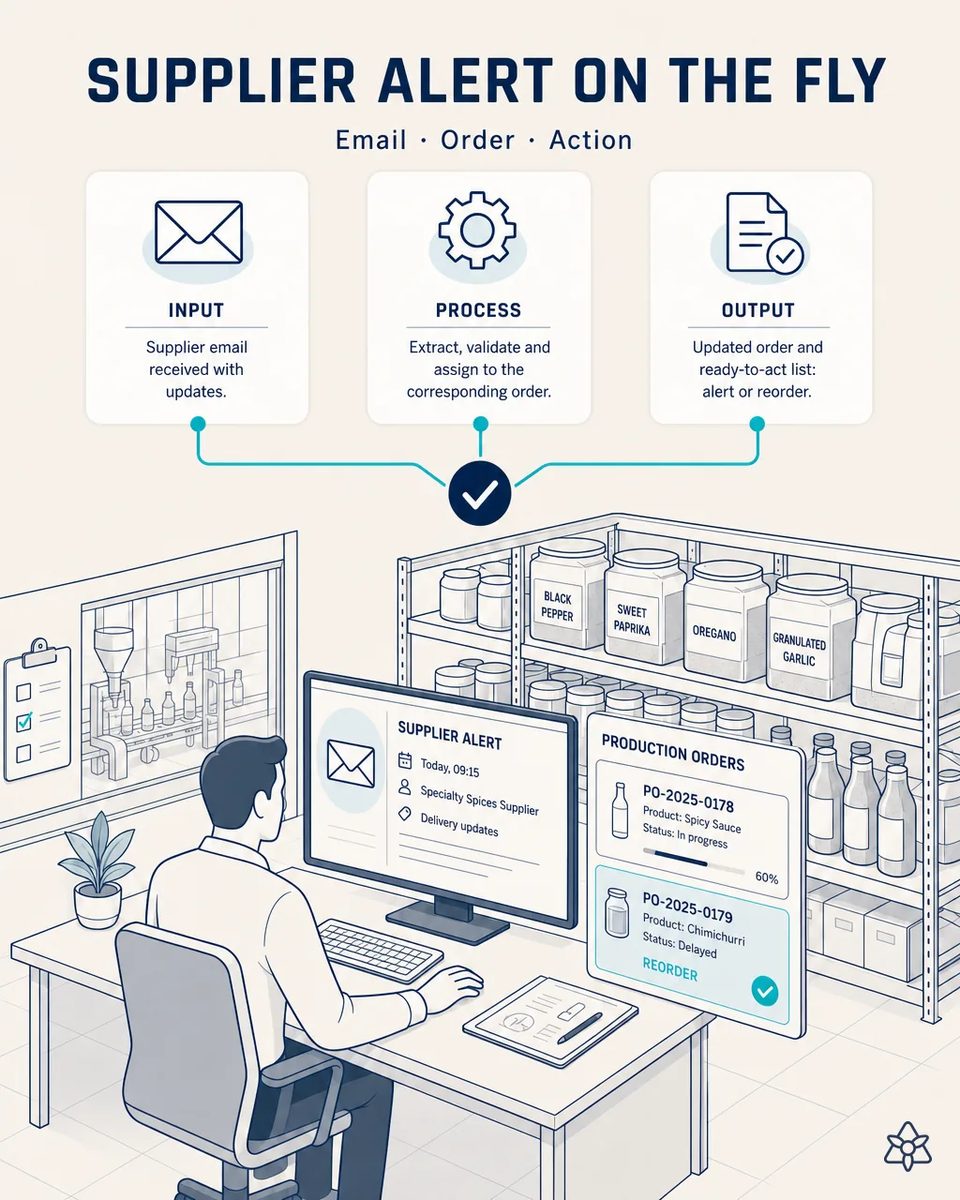
The email that would change the plan is read after the plan has run.
critical supplier alerts arrive by email to people who can't watch their inbox in real time during a production shift. By the time they're read, the line has already been idle for a while waiting on a decision.
- Mid-morning, the mustard seed supplier warns of a two-day delay, or the jar supplier changes the closure specification, or the egg yolk arrives with an amended technical sheet.
- It lands in the inbox of someone who is on the floor during the shift and cannot watch email in real time. It gets read two or three hours later.
- By then the batch order scheduled with that input is due to start, and the filler sits idle while somebody decides what to run instead.
- A technical-sheet change on an ingredient that carries an allergen is worse than a delay: if nobody reads it, the label can stop matching what is in the jar.
Connect in chaotic-sources mode — a dedicated mailbox, read the second it fills.
Connect, "chaotic sources" mode — a dedicated mailbox silently copied in 24/7. A language model extracts intent (delay, technical-sheet change, input non-conformity), identifies supplier and material, cross-checks active batch orders in the ERP, and hands the concrete action to the right role.
Reading the email sooner is half the value. The other half is the cross-check: which active batch orders consume that ingredient or that jar, and who has to move. That is what arrives, already worked out, to the person who can act. Nothing in the purchasing system changes; it simply stops being the last to know.
The supplier email today versus the email cross-checked
| Aspect | Today, in the inbox | With iLEAN Connect |
|---|---|---|
| Time before someone acts | 2-3 hours | Seconds |
| Batch orders using that input | Worked out by hand | Listed from the ERP |
| A changed technical sheet | Filed with the email | Flagged against the declared allergens |
| A filler waiting on a decision | Common on a busy morning | Replanned in time |
| Who receives it on sauce and canning lines | Whoever it was addressed to | Purchasing, planning or quality, by intent |
| Who changes the plan | The planner, late | The planner, with the facts |
2-3 hours of human latency → seconds. Replanning based on real-time data instead of a late-read email.
Impact estimate — to be validated with your record of supplier incidents.
The block below is an estimate to be validated against your plant's actual data. We put it forward so the committee has an order of magnitude; we refine it during the assessment.
- Estimated payback 3-7 months, depending on how often critical supplier alerts occur.
- It comes from the unplanned line stoppages you avoid: the filler stops waiting for a decision that was sitting in an inbox.
- Latency goes from 2-3 hours of human delay to seconds, and replanning starts from real-time data instead of an email read late.
- And a technical-sheet change reaches quality the day it is sent, not the day a claim brings it to light.
estimated payback 3-7 months depending on how often critical alerts occur, from avoided unplanned line stoppages. *Estimate to validate.*
And the fair question from the production manager
"Is iLEAN going to read everyone's email?" — no. It sits in copy on a dedicated mailbox that suppliers already write to, and sees nothing else. Classifying what a supplier email is about, whether a delay, a sheet change or a non-conforming input, is an anchored task where the best models stay under 1.5% error [1]. And it only proposes: the planner decides what runs next. Nothing reaches a supplier from iLEAN without someone in the plant sending it.
[1] OpenAI paper "Why Language Models Hallucinate", 2025 — on the reliability of AI in anchored tasks.
What people ask about reading supplier emails
Do suppliers have to change how they write to us on sauce and canning lines?
No. They keep sending the same emails in the same words. The only change on your side is copying that traffic to a dedicated mailbox. Nobody outside the plant has to learn a new portal or form.
Can it tell a delay from a technical-sheet change?
Yes, and they go to different people: a delay goes to planning, a sheet change on an ingredient that carries an allergen goes to quality. A notice about a non-conforming input lot goes to quality as well, with the batches already produced from earlier deliveries listed.
Does it know which batch orders a delayed jar or cap affects?
When it is connected to the ERP, yes: it lists the active orders that consume that packaging format and when each is due to start. That list is what lets planning decide, in minutes, whether to swap the sequence or wait.
What about alerts that arrive at night or over the weekend?
They are read the same second, and the action is waiting for the first shift instead of sitting in an unopened inbox. Over a weekend, that is the difference between a Monday plan that already accounts for the delay and one that discovers it at seven.
Does it place a reorder with another supplier by itself?
No. It suggests the reorder or the sequence change with the data behind it, and a person approves it. The decision stays with the person who owns the plan; iLEAN only removes the hours spent finding out.
More cases from this series
- The coder stitched to the ERPBatch, date and allergens travel from the ERP to the coder automatically via API. Zero typing, zero…
- Paperless batch startupThe operator photographs the batch order and formula at startup; the batch already exists in the central…
- The plant manager's headsetThe plant manager dictates incidents while walking the floor; iLEAN listens, structures and pushes back…
- Lab spreadsheet to ERP in secondsiLEAN detects the lab's quality spreadsheet, verifies it, and pushes it to the ERP automatically.…
- Two-tap line verificationNothing iLEAN captures enters the master ERP without a human confirming it first with two taps on an…
- The retort that finally talksAn external camera digitizes the retort's sterilization curve without touching the equipment or its…
Tell us which supplier alert stalls your production most often.
We work on your plant's real data, not ours. Assessment with no commitment.
Request estimated ROI within 48h ‹ See all cases of condiments and sauces See food industry