NO BADLY PRESSED CUBE GETS THROUGH
On a high-speed cube press or sachet filler, human visual inspection cannot sustain 100% coverage. Sampling leaves gaps, and deformed or badly pressed cubes, torn wrappers, and sachets with sealing defects reach customers — generating complaints and full-pallet returns.
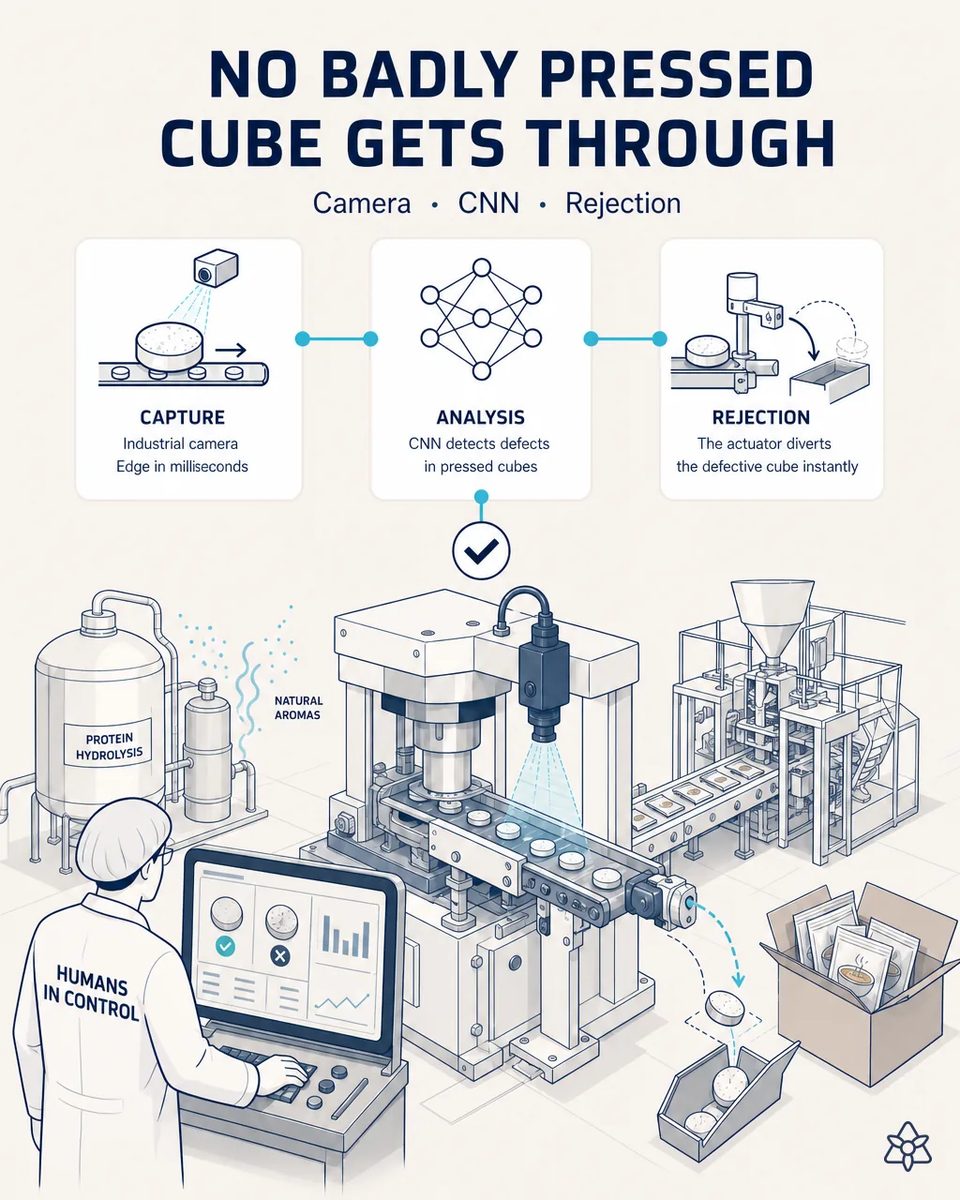
At line speed, sampling is an act of faith.
On a high-speed cube press or sachet filler, human visual inspection cannot sustain 100% coverage. Sampling leaves gaps, and deformed or badly pressed cubes, torn wrappers, and sachets with sealing defects reach customers — generating complaints and full-pallet returns.
- A cube press and a sachet filler running at commercial cadence produce more pieces per minute than any pair of eyes can classify. The eye is not the problem; the arithmetic is.
- Sampling covers 1 to 2% of the run, which means the defect distribution is inferred rather than observed. Everything you believe about your own defect rate comes from that slice.
- Deformed or badly pressed cubes, torn wrappers and sachets with poor seal integrity leave the plant inside sealed cartons, indistinguishable from the rest of the pallet.
- What comes back is not a piece: it is a complaint and a full pallet returned, with the whole run under suspicion and the distributor asking questions.
Edge — every piece classified in milliseconds, on the machine itself.
Edge places a camera over the press or sealer, with a CNN trained on the specific product and format, inferring in milliseconds without sending anything to the cloud, and rejecting the defective piece before cartoning.
Inference runs locally, on the line, with nothing leaving the plant network. A camera over the press is not a data project: the defective piece is ejected before the carton is formed, and that decision never depends on a connection, a cloud service or somebody being awake at three in the morning.
Sampling inspection versus Edge inspection
| Aspect | Today | With iLEAN Edge |
|---|---|---|
| Coverage of the run | 1-2%, by sampling | Every piece, at cadence |
| A crumbling or badly pressed cube | Passes unless somebody is looking | Ejected before cartoning |
| A sachet seal that is weak but closed | Found by the consumer | Classified at the sealing jaw |
| Where the defect is caught | In a complaint | On the belt |
| Full pallets coming back | A recurring cost | Cut off at source |
| Several formats on one line | Each one hides differently | One model per active format |
1-2% sampling → 100% piece inspection. Pressing/sealing complaints → drastic reduction.
Impact estimate — to be validated against your current reject rate.
The block below is an estimate to be validated against your plant's actual data. We put it forward so the committee has an order of magnitude; we refine it during the assessment.
- Estimated payback 5-12 months, depending on the rejection rate you run today and on how many formats share the line.
- Complaints about pressing and sealing fall sharply, and with them the returned pallets that carry freight, rework and an awkward conversation with the distributor.
- Coverage goes from 1-2% of pieces to all of them, which changes what you can honestly tell a distributor when they ask how the product is controlled.
- And the defect distribution stops being an inference drawn from a sample and becomes a measurement per shift, per format and per press.
Estimated payback of 5 to 12 months depending on the current rejection rate, with fewer customer complaints. Estimate to be validated.
And the fair question from the production manager
"What if it starts throwing away good cubes?" — the false positive is the real risk of any vision system, which is why the model is trained on good and bad pieces of your own formats, under that line's lighting, rather than on a generic defect library. Borderline pieces are escalated for a person to judge instead of being rejected blindly, and every judgment goes back into training. On the classification itself, an anchored task with a fixed frame and a short defect catalog, the best models stay under 1.5% error [1]. And the ejection rate is monitored from the first day, so a model that starts being too strict is visible before it costs you product.
[1] OpenAI paper "Why Language Models Hallucinate", 2025 — on the reliability of AI in anchored tasks.
What people ask about vision on the press and the filler
Can it hold the press's real cadence?
Yes. Inference is local and resolves in milliseconds per piece, so the limit stays the machine's mechanics rather than the camera or the network. The press does not slow down for it, and neither does the filler behind it.
How many pieces does it need to learn a format?
Fewer than most people expect, because the defect catalog of a pressed cube or a filled sachet is short and repetitive. What matters is that they are real pieces off your own line, including the bad ones you normally throw away without looking at them.
Does it detect a seal that is weak but closed?
That is the defect worth catching, and the one sampling never finds. It is classified from the seal's appearance at the jaw, before the sachet moves on to cartoning.
Does one camera serve several brands on the same line?
Yes, switching model with the active format. In a plant where brands alternate daily that is the normal operating mode rather than an exception, and the switch follows the production order.
Does anything leave the plant?
No. The model runs on the line and images are not sent to the cloud, which is usually the condition for the case being approved at all when a private label is involved.
More cases from this series
- PAPERLESS RECIPE STARTUPThe operator photographs the order and recipe sheet; the batch and its exact recipe exist instantly.…
- THE CODER STOPS BEING HAND-TYPEDBatch, date and allergens travel from the ERP to the coder automatically. Payback 3-6 months.
- THE DELIVERY NOTE NO LONGER BLOCKS THE TRUCKPhoto the delivery note and batch labels; one-tap validation pushes straight to the ERP. Payback 3-8…
- THE VINTAGE DRYER STARTS TALKINGA camera reads the dryer panel without touching the machine: moisture and temperature digitized per…
- THE LINE SUPERVISOR DICTATES ON THE GOEarpiece + voice AI: the line supervisor logs issues while walking, no keyboard needed.
- NOTHING ENTERS WITHOUT A HUMAN SIGN-OFFEvery iLEAN capture passes through a 2-tap validation tablet before entering the central system.
Tell us how many pallets came back last year over a defective piece.
We work on your plant's real data, not ours. Assessment with no commitment.
Request estimated ROI within 48h ‹ See all cases of bouillon and dehydrated soups See food industry