PAPERLESS RECIPE STARTUP
Every batch startup in a bouillon and soup factory begins with a paper production order and a recipe sheet fixing salt, aromas, starch and fat for that specific format and brand. With several brands sharing the same dosing unit across shifts, both documents can go 4 to 8 hours without being digitized.
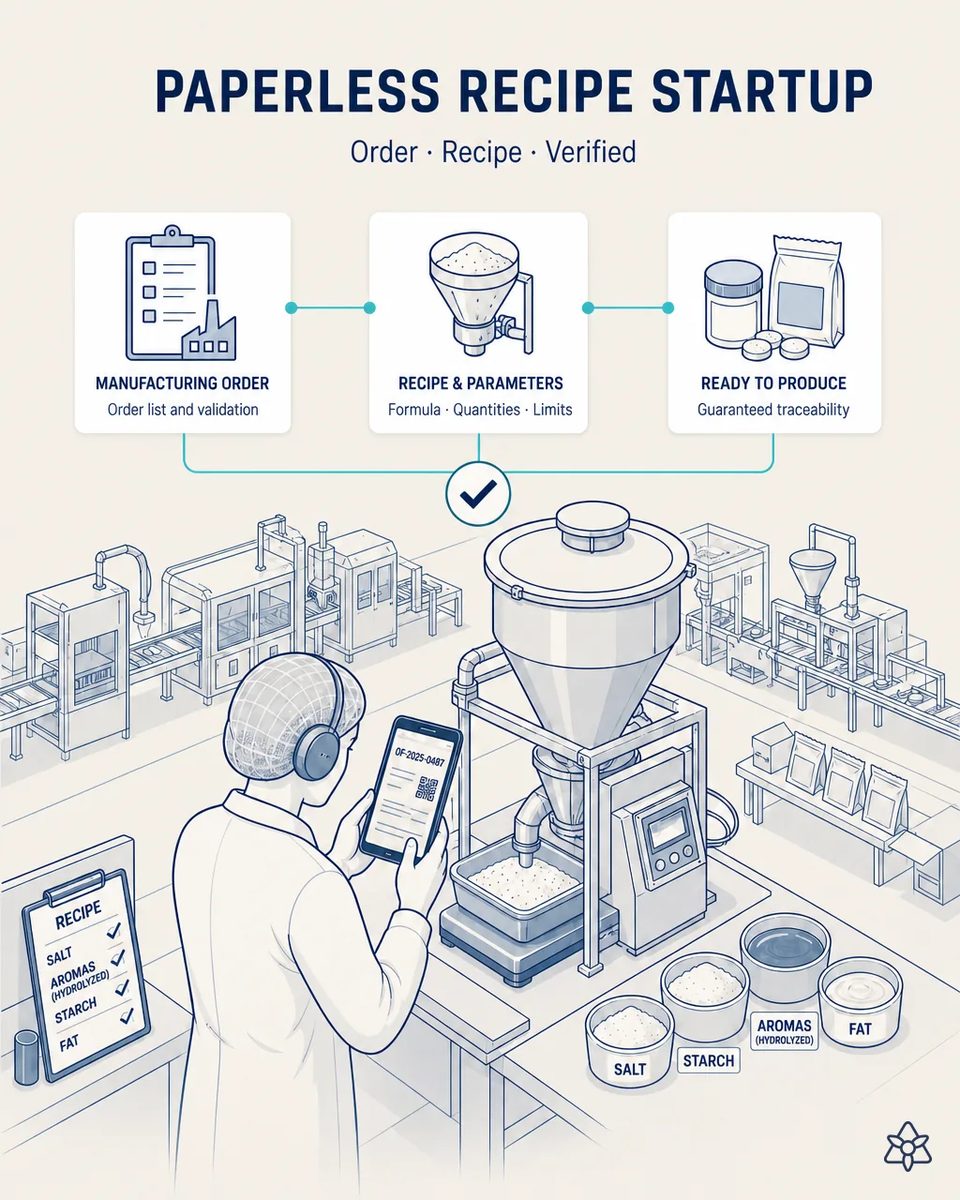
The sheet that fixes salt, fat and starch stays on paper all shift.
Every batch startup in a bouillon and soup factory begins with a paper production order and a recipe sheet fixing salt, aromas, starch and fat for that specific format and brand. With several brands sharing the same dosing unit across shifts, both documents can go 4 to 8 hours without being digitized. If a flavor or texture complaint comes in, reconstructing the exact recipe used for that batch depends on finding the right paper in the dosing supervisor's folder — a slow process exactly when speed matters most.
- The production order and the recipe sheet fix the proportions of salt, aromas, starch and fat for one brand and one format, and both travel to the dosing unit on paper.
- With several brands sharing the same dosing unit across shifts, the two documents can go 4 to 8 hours without being digitized, and over a weekend considerably longer.
- During that window the batch has been blended, pressed, filled and cartoned, but it exists in no system anybody can query, and the run is already on a pallet.
- When a flavor or texture complaint lands, reconstructing the exact recipe means finding the right sheet in the dosing supervisor's folder — slow precisely when speed is what you need, and slower still if the shift that ran it is off that week.
Connect in photo mode — the operator adds a photo to what they already do.
Connect photo mode: the operator takes two phone photos of the order and the recipe sheet at startup. A grounded LLM extracts structured fields (batch, brand, format, recipe proportions, declared allergens) without changing the operator's routine. The data passes through the early human-verification tablet before entering the central system.
Nothing changes in the dosing routine: the same paper, the same signature, one extra photo before the blender starts. That is why this is usually the first of the twelve a plant approves, the fastest to see working, and the one that makes the other eleven credible to the people who have to run them.
The recipe sheet today versus the recipe sheet captured
| Aspect | Today | With iLEAN Connect |
|---|---|---|
| Time to digitize the recipe | 4-8 hours | Zero seconds |
| Salt, fat and starch proportions | Only on the paper sheet | Structured fields on the batch |
| Brand and format of the run | Inferred from the schedule | Read off the order itself |
| Allergens the recipe declares | Written on the sheet | Tied to the batch from the start |
| A flavor or texture complaint | Search the dosing folder | The exact recipe in one lookup |
| Dosing supervisor's transcription | Every batch | None |
4-8 hours of latency before the batch recipe is digitized → the batch exists in the central system in zero seconds, with its exact recipe instantly searchable.
Impact estimate — to be validated with your own batch figures.
The block below is an estimate to be validated against your plant's actual data. We put it forward so the committee has an order of magnitude; we refine it during the assessment.
- Estimated payback 4-9 months, depending on how many batches your dosing unit starts per day.
- The dosing supervisor's transcription time comes back whole: it is the hour that never appears in the shift's cost because nobody bills it to anything.
- From 4-8 hours of latency to a batch that exists, with its exact recipe and its declared allergens, from the moment it starts.
- And answering a complaint stops being an archaeology exercise in a folder: the recipe used is a lookup by batch number, whoever is on shift that day.
Estimated payback of 4 to 9 months depending on daily batch volume, fully recovering the dosing supervisor's transcription time. Estimate to be validated.
And the fair question from the production manager
"What if it reads a proportion wrong and we dose badly?" — extracting fields from a sheet with a fixed structure is an anchored task, and on anchored tasks the best models drop below 1.5% error [1]. The second net is that the extraction never touches the doser and never changes a setpoint: it goes to the line-side tablet as a summary, and the dosing supervisor confirms or corrects it before it crosses into the central system. The recipe that governs the blend is still the paper one in their hand.
[1] OpenAI paper "Why Language Models Hallucinate", 2025 — on the reliability of AI in anchored tasks.
What people ask about capturing the recipe at startup
Do we have to redesign the recipe sheet?
No. It stays exactly as quality issues it today, handwritten corrections included. The model reads the structure of the document you already use, whichever brand's sheet it is, and a new brand's sheet does not need a new template built for it.
Does it pick up a proportion corrected in pen at the dosing unit?
That is the field worth the most, because it is what actually went into the blender rather than what was planned. It is extracted like any other, and a low-confidence value is flagged for the supervisor to confirm instead of being guessed.
What happens when two brands run on the same dosing unit in one day?
Each photo carries its own order, so the batch is born with its brand and format attached. Today that association exists only in the head of whoever ran the shift, and it evaporates the moment they go home.
Does it have to be plugged into the ERP on day one?
No. From the first batch it works against iLEAN's central memory, and the push into the ERP is connected later, once the capture has proved itself on real batches. That order matters: it is what keeps the first phase short.
Does it also cover the allergen list on the sheet?
Yes, and it is the field that matters most downstream: celery, gluten, lactose or mustard declared on the recipe travel with the batch instead of staying in a folder, which is what makes the coder and the audit dossier possible later.
More cases from this series
- THE CODER STOPS BEING HAND-TYPEDBatch, date and allergens travel from the ERP to the coder automatically. Payback 3-6 months.
- THE DELIVERY NOTE NO LONGER BLOCKS THE TRUCKPhoto the delivery note and batch labels; one-tap validation pushes straight to the ERP. Payback 3-8…
- THE VINTAGE DRYER STARTS TALKINGA camera reads the dryer panel without touching the machine: moisture and temperature digitized per…
- THE LINE SUPERVISOR DICTATES ON THE GOEarpiece + voice AI: the line supervisor logs issues while walking, no keyboard needed.
- NOTHING ENTERS WITHOUT A HUMAN SIGN-OFFEvery iLEAN capture passes through a 2-tap validation tablet before entering the central system.
- THE QUALITY EXCEL SHEET STOPS BEING RETYPEDiLEAN absorbs the lab's Excel and pushes it to the ERP after validation. Up to 80% fewer quality…
Tell us how long your dosing unit's paperwork takes to reach a screen.
We work on your plant's real data, not ours. Assessment with no commitment.
Request estimated ROI within 48h ‹ See all cases of bouillon and dehydrated soups See food industry