THE LINE SUPERVISOR DICTATES ON THE GO
The line supervisor spends most of the shift walking between the cube press, the sachet filler and cartoning, coordinating several formats and brands alternating on the same line, hands busy adjusting machines. All the knowledge in his head — more rejects since the fat batch changed, a filler that will need backup — dies at the end of the shift.
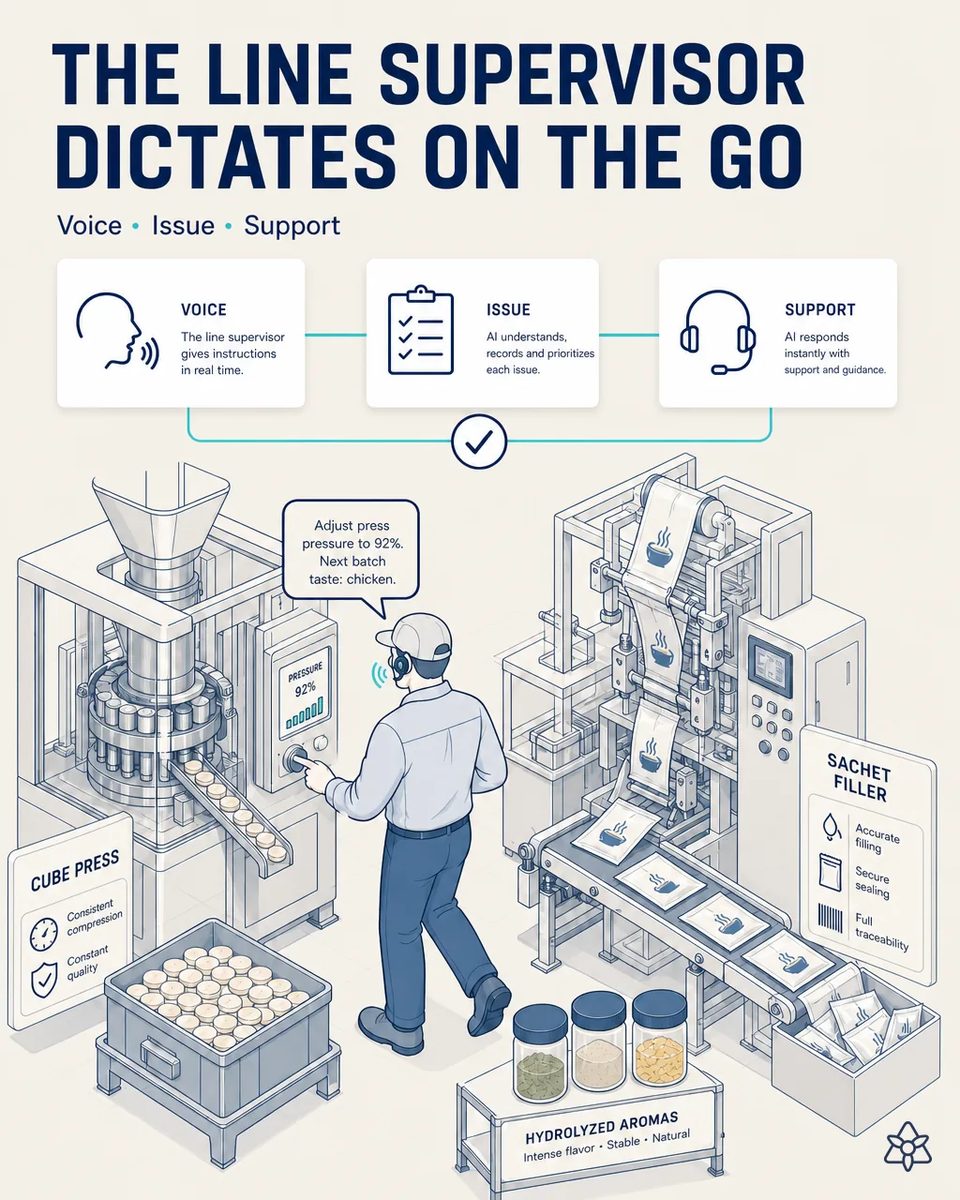
The most valuable information of the shift never gets written down.
The line supervisor spends most of the shift walking between the cube press, the sachet filler and cartoning, coordinating several formats and brands alternating on the same line, hands busy adjusting machines. All the knowledge in his head — more rejects since the fat batch changed, a filler that will need backup — dies at the end of the shift.
- The line supervisor spends the shift walking between the cube press, the sachet filler and cartoning, coordinating formats and brands that alternate on the same line. Nothing they do happens sitting down.
- Their hands are busy adjusting machines, and the nearest keyboard is a walk away in an office they reach at the end of the shift, if at all. Anything that requires sitting down will not be written.
- More rejects since the fat lot changed, a filler that will need backup on Friday, a carton magazine that only jams on one format: all of it lives in their head and nowhere else.
- At handover it is compressed into five verbal minutes with the next supervisor already walking, and the rest dies with the shift.
Connect in voice mode — a wake word, an earpiece and no walk back to the office.
Connect voice mode: with a Bluetooth earpiece and a custom wake word, the line supervisor dictates on the move. The LLM structures the dictation as an issue linked to the active batch and line, and returns support in seconds by voice or as a push to a tablet.
This case is not bought on savings, and presenting it that way would not survive the first question. It is bought because every continuous-improvement plan on the floor depends on a written history of what actually happens on the line, and today that history does not exist anywhere in the plant.
The shift as it is lost versus the shift as it is captured
| Aspect | Today | With iLEAN Connect |
|---|---|---|
| What the supervisor notices | Lost at handover | Written, dated and searchable |
| A jam that only one format causes | Solved again from scratch | Surfaces as a pattern with dates |
| Effort asked of the supervisor | Stop, walk, type | Speak while walking |
| An answer to a question about the batch | Later, from memory | By voice in seconds |
| A new supervisor's first month | Depends who trains them | Backed by the line's own history |
| Ordinary talk on the packing floor | — | Not recorded |
Operational knowledge that dies at the end of the shift → enters the system in real time and gets cross-checked against live data.
Impact estimate — to be validated with your continuous-improvement lead.
The block below is an estimate to be validated against your plant's actual data. We put it forward so the committee has an order of magnitude; we refine it during the assessment.
- No standalone payback: this is an enabling piece. We call it strategic value and puts no months on it, so neither do we.
- What it unlocks is every improvement plan that needs a written history of the line instead of anecdotes recalled in a Monday meeting.
- The recurring problem stops being invisible: three occurrences across two months read as a pattern with dates attached, not as bad luck told twice.
- And the handover stops depending on what the outgoing supervisor happens to remember in the last five minutes of a nine-hour shift on their feet.
Strategic value, hard to monetize upfront: it enables every continuous-improvement plan on the floor. Estimate to be validated with the continuous-improvement lead.
And the fair question from the production manager
"Will it understand anything with the sachet filler running?" — dictation against a known vocabulary of equipment, formats and brands is an anchored task, and the best models stay under 1.5% error [1] on it even in plant noise, because the microphone sits on the earpiece and not in the room. The second net is that the structured note comes back to the supervisor before it is filed, by voice or on the tablet, so a misheard batch number is corrected in the same breath it was spoken. Nothing enters the system that the person who said it has not heard back.
[1] OpenAI paper "Why Language Models Hallucinate", 2025 — on the reliability of AI in anchored tasks.
What people ask about hands-free capture on the line
Is the supervisor being recorded all shift?
No. Nothing is captured until the wake word is spoken, and what gets stored is the structured note rather than ambient audio from the floor. Ordinary conversation between operators is never recorded, and that has to be true for the works council as much as for the supervisor.
Does it cope with the noise of the press and the cartoner?
Yes, because the microphone sits centimeters from the mouth. It is the same reason a phone call works next to a running line while a room microphone picks up nothing usable.
Does it understand our own names for formats and machines?
It is taught them, and that is a first-week task rather than a project. The internal name of a filler, a brand or a format is part of the vocabulary from the start, and it sharpens with use as more of the shift gets dictated.
Does the supervisor have to phrase things in a set way?
No. They talk the way they talk on the line, half-sentences included, and the structuring into batch, line and issue happens afterwards in the system, not in their head.
What do the supervisors get out of it themselves?
An answer back in seconds while walking, and a shift handover written for them instead of by them. That is what makes them keep using it after the second week, which is where most voice projects die.
More cases from this series
- PAPERLESS RECIPE STARTUPThe operator photographs the order and recipe sheet; the batch and its exact recipe exist instantly.…
- THE CODER STOPS BEING HAND-TYPEDBatch, date and allergens travel from the ERP to the coder automatically. Payback 3-6 months.
- THE DELIVERY NOTE NO LONGER BLOCKS THE TRUCKPhoto the delivery note and batch labels; one-tap validation pushes straight to the ERP. Payback 3-8…
- THE VINTAGE DRYER STARTS TALKINGA camera reads the dryer panel without touching the machine: moisture and temperature digitized per…
- NOTHING ENTERS WITHOUT A HUMAN SIGN-OFFEvery iLEAN capture passes through a 2-tap validation tablet before entering the central system.
- THE QUALITY EXCEL SHEET STOPS BEING RETYPEDiLEAN absorbs the lab's Excel and pushes it to the ERP after validation. Up to 80% fewer quality…
Tell us what your packing supervisor knows that nobody else in the plant does.
We work on your plant's real data, not ours. Assessment with no commitment.
Request estimated ROI within 48h ‹ See all cases of bouillon and dehydrated soups See food industry