THE CODER STOPS BEING HAND-TYPED
The coder that prints batch and date on every sachet or cube wrapper is relatively modern — it has an API — but lives isolated from the ERP. When the format or brand on the same line changes, someone hand-types the new batch and allergens on its panel: one mistyped digit contaminates half the run with wrong data.
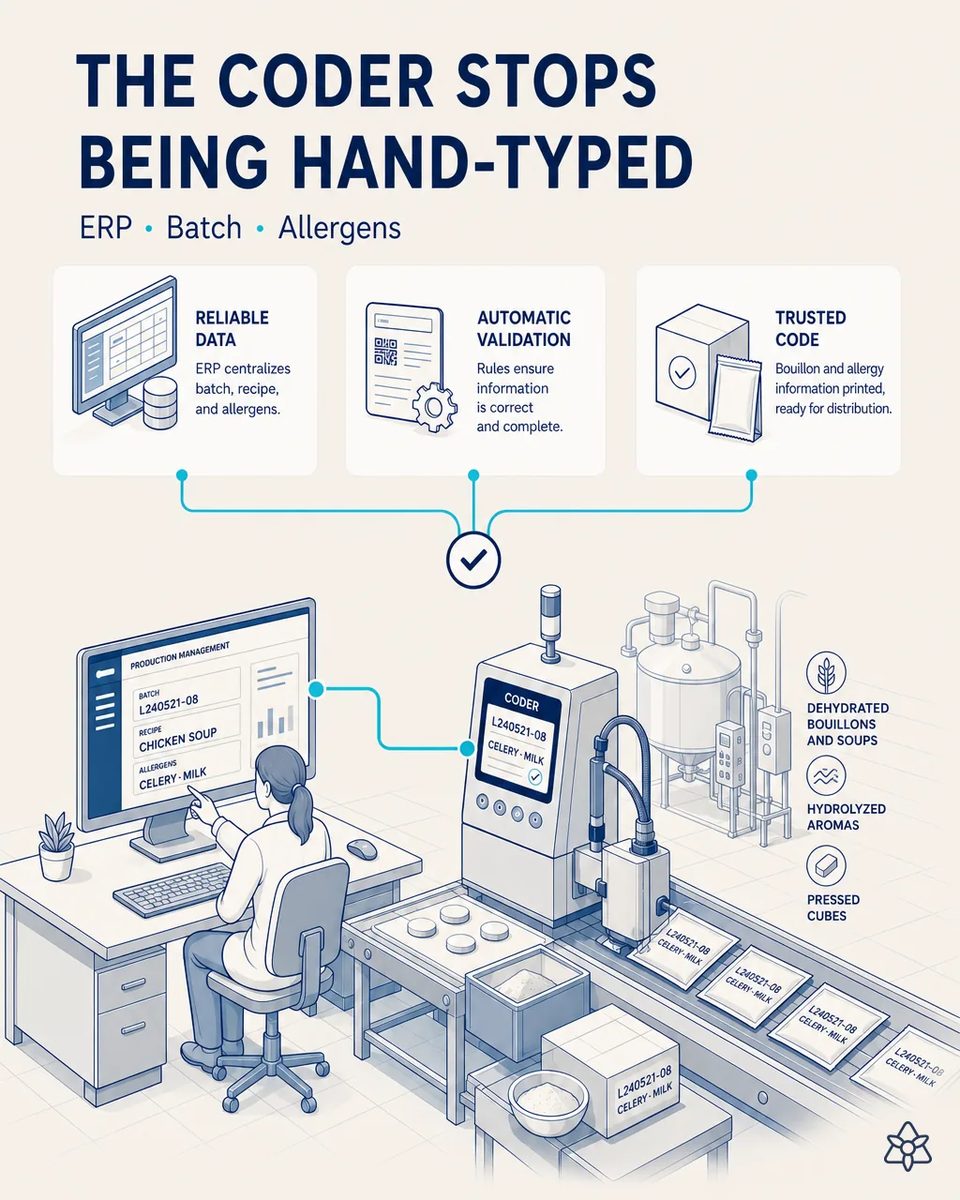
A modern machine, a documented API, and somebody typing into it anyway.
The coder that prints batch and date on every sachet or cube wrapper is relatively modern — it has an API — but lives isolated from the ERP. When the format or brand on the same line changes, someone hand-types the new batch and allergens on its panel: one mistyped digit contaminates half the run with wrong data.
- The coder that prints batch and date on every sachet and cube wrapper is recent equipment with a documented interface, and it sits completely outside the ERP's flow. It was bought connected and installed isolated.
- Every format or brand change on the same line means somebody hand-types the new batch and allergen line on its panel, copying data that already exists three meters away in the production order.
- One mistyped digit contaminates half a run with wrong data, and the run is cartoned, palletized and shrink-wrapped long before anybody notices.
- On a line where brands alternate all day, that exposure repeats at every changeover, all year round, and it only takes one of them to go wrong.
Connect stitches coder and ERP by API — neither system is replaced.
Connect stitches the coder to the ERP via API: when the ERP marks the start of a production order, it automatically publishes batch, date and the active recipe's allergen list to the coder, with no manual typing in between.
What was actually printed comes back to the system as confirmation, not as an assumption. That difference is what turns the printed code into evidence you can put in front of an auditor or a distributor, instead of a well-founded belief about what should have happened on the line.
The isolated coder versus the coder fed by the order
| Aspect | Today | With iLEAN Connect |
|---|---|---|
| Typing batch and date | Once per changeover, by hand | Never |
| The printed allergen line | Whatever was left on the panel | Published from the active recipe |
| A single mistyped digit | Half a run coded wrong | Not possible by construction |
| Changeover time at the panel | Minutes on the critical path | The order start in the ERP |
| Proof of what the sachet carries | Assumed from the panel | Returned by the machine itself |
| The coder and the ERP | — | Both kept exactly as they are |
Monthly typing errors, some tied to recalls → zero human-origin coding errors.
Impact estimate — to be validated with the packing line's own data.
The block below is an estimate to be validated against your plant's actual data. We put it forward so the committee has an order of magnitude; we refine it during the assessment.
- Estimated payback 3-6 months, counting only the panel time recovered across every changeover in the shift.
- Human-origin coding errors go to zero, and with them the most common single cause of a labeling or undeclared-allergen recall.
- The allergen line stops depending on whoever last touched the panel and starts depending on the recipe quality approved, which is where it belonged all along.
- And a run coded with the previous brand's data, allergen line included, stops being something that can happen at all on that line.
Estimated payback of 3 to 6 months, with a drastic reduction in labeling/allergen recall risk. Estimate to be validated.
And the fair question from the production manager
"Isn't a proper integration project cleaner than this?" — it is, the day it reaches the top of the IT list, and that is exactly the problem: this machine has had an API for years and is still fed by hand because the window never came. The stitching replaces neither system and needs no shutdown. And where a value has to be read back from the machine rather than published to it, the task is anchored and the best models stay below 1.5% error [1], with the line tablet behind it as the second net. The case is measured in weeks, not in the quarters an integration project takes.
[1] OpenAI paper "Why Language Models Hallucinate", 2025 — on the reliability of AI in anchored tasks.
What people ask about feeding the coder from the ERP
Does any of this mean buying new equipment?
Neither, and no module is bought. The stitching uses the interface the coder already exposes and the event the ERP already raises when a production order starts, so both keep their own upgrade path untouched.
What happens if a sachet goes through unprinted?
It shows up immediately, because what comes back is confirmation of what was printed. Today that failure raises no signal at all: the system simply assumes the request was honored and the run continues.
Does the allergen line really travel automatically?
Yes, from the active recipe. It justifies the case on its own, because a wrong allergen line is a recall while a wrong date is a complaint, and both come from the same keyboard today.
Does it work when the brand changes but the format does not?
Yes, and that is the dangerous case precisely because it looks like nothing happened: the machine is identical, the sachet is identical, and only the printed data changes. That is exactly where typing errors concentrate, and where an allergen line ends up belonging to the previous brand.
Can the same pattern be used on the cartoner's printer?
Yes. Any modern machine with an interface that is fed by hand fits identically, and the second one is quicker than the first. The coder goes first because it prints what the consumer reads.
More cases from this series
- PAPERLESS RECIPE STARTUPThe operator photographs the order and recipe sheet; the batch and its exact recipe exist instantly.…
- THE DELIVERY NOTE NO LONGER BLOCKS THE TRUCKPhoto the delivery note and batch labels; one-tap validation pushes straight to the ERP. Payback 3-8…
- THE VINTAGE DRYER STARTS TALKINGA camera reads the dryer panel without touching the machine: moisture and temperature digitized per…
- THE LINE SUPERVISOR DICTATES ON THE GOEarpiece + voice AI: the line supervisor logs issues while walking, no keyboard needed.
- NOTHING ENTERS WITHOUT A HUMAN SIGN-OFFEvery iLEAN capture passes through a 2-tap validation tablet before entering the central system.
- THE QUALITY EXCEL SHEET STOPS BEING RETYPEDiLEAN absorbs the lab's Excel and pushes it to the ERP after validation. Up to 80% fewer quality…
Tell us how many times a day somebody types into your coder's panel.
We work on your plant's real data, not ours. Assessment with no commitment.
Request estimated ROI within 48h ‹ See all cases of bouillon and dehydrated soups See food industry