THE VINTAGE DRYER STARTS TALKING
The dryer that turns hydrolyzed liquid into powder or granulate is typically 12 to 20 years old, lives on an isolated network, and shows on its screen the most sensitive variable of the whole process: final outlet moisture, which determines the product's declared shelf life. Replacing it costs several hundred thousand euros and weeks of downtime.
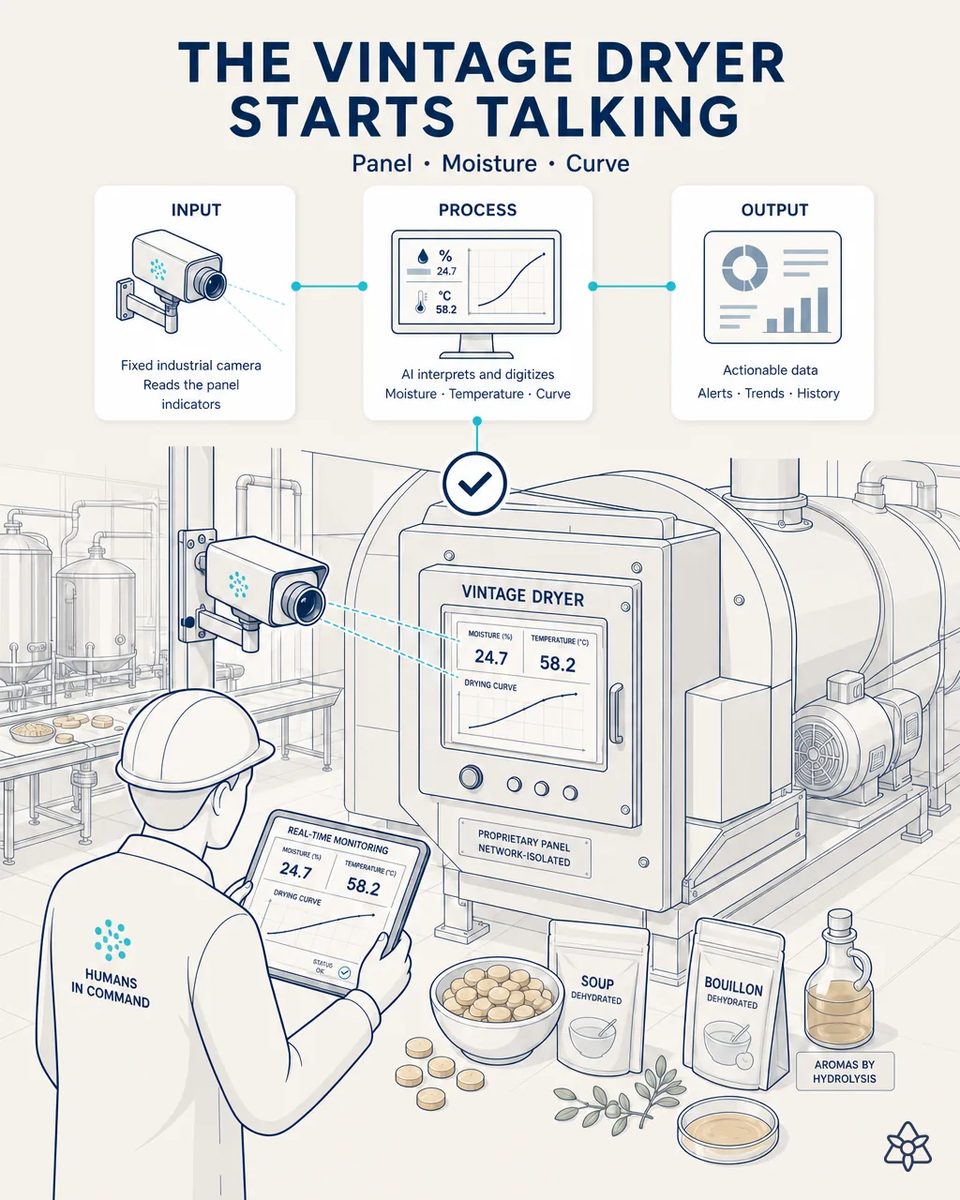
The variable that sets shelf life never leaves the machine room.
The dryer that turns hydrolyzed liquid into powder or granulate is typically 12 to 20 years old, lives on an isolated network, and shows on its screen the most sensitive variable of the whole process: final outlet moisture, which determines the product's declared shelf life. Replacing it costs several hundred thousand euros and weeks of downtime. Today nobody correlates that moisture with texture or shelf-life complaints because the panel's data never physically leaves the machine room.
- The dryer that turns hydrolyzed liquid into powder or granulate is typically 12 to 20 years old and sits on an isolated network by the manufacturer's own design. It works, which is precisely why nobody touches it.
- Its screen shows final outlet moisture — the variable that decides the declared shelf life of the cube and the sachet — and that number goes no further than the glass.
- Replacing the equipment costs several hundred thousand euros and weeks with the line down, so it stays, and the blind spot stays with it, year after year.
- Nobody correlates residual moisture with the caking, texture or shelf-life complaints that come back months later, because there is no series to correlate against: the panel's data never physically leaves the machine room.
Connect in photo mode over the panel — from the outside, without opening the machine.
Connect photo-on-panel mode: a fixed industrial camera points at the proprietary panel without touching the machine or its wiring. Grounded-LLM OCR interprets every frame and structures the moisture and temperature curve per batch, cross-checked against the active ERP recipe.
Nothing is installed on the dryer, no port is opened and no software is revalidated. On a machine the plant cannot afford to stop, and whose manufacturer stopped supporting that control generation years ago, that distinction is the difference between a case maintenance signs in a morning and a project that never starts.
The silent drying tower versus the drying tower being read
| Aspect | Today | With iLEAN Connect |
|---|---|---|
| Outlet residual moisture | A figure on a screen, then gone | A curve stored per batch |
| Drying temperature profile | Watched live, never kept | Time series, batch by batch |
| A caking complaint months later | No series to check it against | Matched to its own drying run |
| Cross-check with the ERP recipe | Manual, if anyone bothers | Automatic on every run |
| The dryer's control and wiring | — | Untouched |
| Replacing the tower | A line in the investment plan | Postponed on evidence |
Zero correlation between moisture and complaints → root-cause analysis per batch in minutes. Dryer replacement indefinitely deferrable.
Impact estimate — to be validated with maintenance and quality.
The block below is an estimate to be validated against your plant's actual data. We put it forward so the committee has an order of magnitude; we refine it during the assessment.
- Estimated payback 5-10 months, with the avoided capex of replacing the drying tower counted inside it, and the waste reduction counted separately.
- Waste falls as soon as moisture can be correlated with the defect it produces, which today is guesswork dressed up as experience.
- Root-cause analysis on a batch goes from impossible to minutes, because the curve of the run is already stored next to the recipe and the extract lot that produced it.
- And a machine that still dries perfectly well gets replaced when the data says so, not when the budget cycle or a supplier's end-of-support letter says so.
Estimated payback of 5 to 10 months, avoiding dryer-replacement CAPEX and reducing waste through moisture-defect correlation. Estimate to be validated.
And the fair question from the production manager
"Can a camera reading a screen be trusted for a shelf-life figure?" — the task is anchored: fixed panel, fields always in the same position and moisture values inside a physically possible band, where the best models stay under 1.5% error [1]. On top of that, any frame with a value outside the band is discarded rather than stored, which is what would otherwise poison the series you intend to use for shelf-life work. What you end up defending is a series built from thousands of readings, not from one.
[1] OpenAI paper "Why Language Models Hallucinate", 2025 — on the reliability of AI in anchored tasks.
What people ask about putting a camera on the dryer
Does the dryer have to be stopped to install it?
No. The camera goes on a bracket in front of the panel and is aligned with the machine running. Nothing is wired into the control cabinet, no cable enters the equipment, and the whole installation fits inside a normal maintenance slot.
Does it void the manufacturer's support?
It cannot: no software is installed on the equipment, no network port is opened and no parameter is written. From the dryer's point of view, somebody is standing there looking at its screen, which is what an operator does anyway.
Do we get the whole curve or only the final moisture?
The whole profile, outlet moisture and temperature through the run, frame by frame. The final figure you already write down in the logbook; what is missing is the shape of how you got there, and that shape is what explains a bad batch when nothing else does.
Can it be tied to the hydrolysis batch being dried?
Yes, through the active ERP order. That link is what lets you ask whether a given extract or fat lot dries differently from the rest, a question nobody can answer today without guessing.
Does the same approach work on the powder blender or the press?
Yes: any panel with a readable screen fits the same way, and the second machine is faster than the first. The dryer comes first because it holds the variable with the most consequences downstream.
More cases from this series
- PAPERLESS RECIPE STARTUPThe operator photographs the order and recipe sheet; the batch and its exact recipe exist instantly.…
- THE CODER STOPS BEING HAND-TYPEDBatch, date and allergens travel from the ERP to the coder automatically. Payback 3-6 months.
- THE DELIVERY NOTE NO LONGER BLOCKS THE TRUCKPhoto the delivery note and batch labels; one-tap validation pushes straight to the ERP. Payback 3-8…
- THE LINE SUPERVISOR DICTATES ON THE GOEarpiece + voice AI: the line supervisor logs issues while walking, no keyboard needed.
- NOTHING ENTERS WITHOUT A HUMAN SIGN-OFFEvery iLEAN capture passes through a 2-tap validation tablet before entering the central system.
- THE QUALITY EXCEL SHEET STOPS BEING RETYPEDiLEAN absorbs the lab's Excel and pushes it to the ERP after validation. Up to 80% fewer quality…
Tell us whether you could match last quarter's complaints to a drying curve.
We work on your plant's real data, not ours. Assessment with no commitment.
Request estimated ROI within 48h ‹ See all cases of bouillon and dehydrated soups See food industry