THE DELIVERY NOTE NO LONGER BLOCKS THE TRUCK
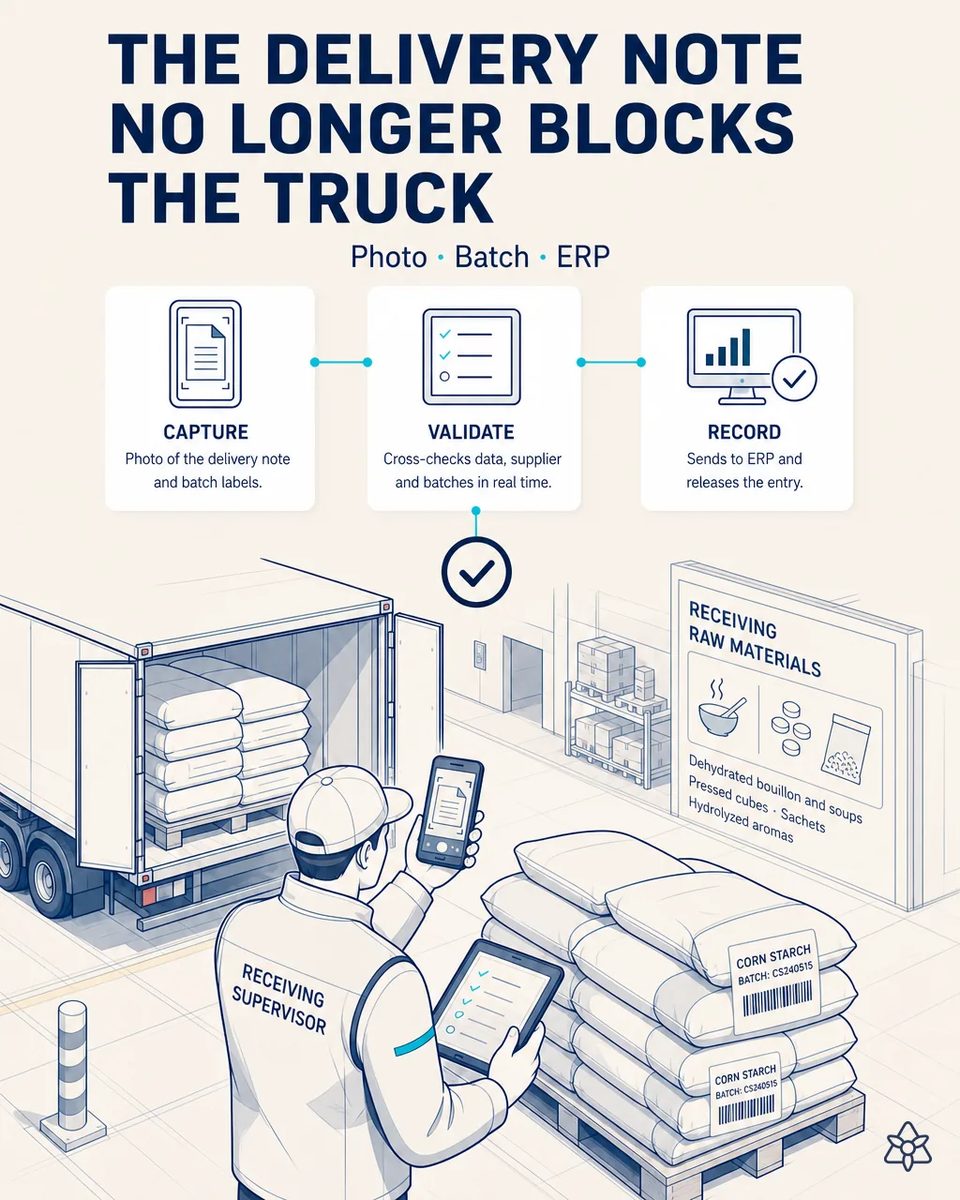
The truck arrives with starch, fat or aromas. The receiving supervisor has the paper delivery note and the labels on each sack or drum. Either the truck waits 45 minutes racking up demurrage while entries are typed line by line into the ERP, or the entry is rushed and a batch ends up poorly traced — something that surfaces weeks later in an allergen alert.
Every traceability chain in the plant starts with typing done in a hurry.
The truck arrives with starch, fat or aromas. The receiving supervisor has the paper delivery note and the labels on each sack or drum. Either the truck waits 45 minutes racking up demurrage while entries are typed line by line into the ERP, or the entry is rushed and a batch ends up poorly traced — something that surfaces weeks later in an allergen alert.
- The truck arrives with starch, fat or aromas, and the receiving supervisor has a paper delivery note plus a label on every sack and drum. The driver is already asking how long this will take.
- Either the truck waits 45 minutes racking up demurrage while lines are typed into the ERP, or the entry is rushed through to get the dock clear. Both options cost money; only one of them shows up on an invoice.
- A rushed entry means a lot wrongly associated with a sack, and that error does not surface at the dock: it surfaces weeks later, inside an allergen alert.
- Which is the worst possible moment to discover that the chain back to the supplier has a hole in it, with a distributor already asking how far the affected product went and how quickly you can tell them.
Connect photo-to-analog — nothing at all is asked of the supplier.
Connect photo-to-analog: one photo digitizes the delivery note and another the batch labels (GS1-128, QR, barcode or plain OCR). The system extracts batch, quantity, expiry and supplier; after one validation tap on the tablet, everything enters the ERP.
Two photos replace 45 minutes of typing, and the note is cross-checked against the sack labels before anything is validated. Nobody performs that cross-check today with a driver waiting at the dock and a line asking for material, which is exactly why the errors get in.
Receiving as it runs today versus receiving by photo
| Aspect | Today | With iLEAN Connect |
|---|---|---|
| Time the truck spends at the dock | 45 minutes | 5 minutes |
| The lot on each sack or drum | Typed line by line | Read from the label, GS1 or plain |
| Layout of the note | A different one per supplier | No template needed for any of them |
| Note against labels | Nobody cross-checks them | Disagreement shown before validating |
| Tracing back from an allergen alert | Rebuilt with gaps | Complete down to the sack |
| Active seats in the receiving module | Two or three | Just the validator's |
45-minute receiving → 5 minutes. Hidden batch errors → zero. Full traceability by photo and GS1, down to the raw-material sack.
Impact estimate — to be validated against what the dock costs you.
The block below is an estimate to be validated against your plant's actual data. We put it forward so the committee has an order of magnitude; we refine it during the assessment.
- 💰 CFO angle: the receiving and warehouse module typically needs two or three active licenses; with Connect only the supervisor validates, without ever opening the ERP — a 50 to 70% reduction, recurring every year.
- Estimated payback 3-8 months, before counting the demurrage that stops being invoiced to you.
- From 45 minutes per truck to 5, on a dock that is usually the plant's first bottleneck of the morning and sets the tone for the whole shift.
- And hidden lot errors go to zero, which is exactly what an allergen alert or a traceability exercise will eventually put to the test.
CFO angle: the ERP's receiving module typically requires 2-3 active licenses; with Connect only the manager validates without opening the ERP — typically 50 to 70% fewer receiving/warehouse licenses. Estimated payback of 3 to 8 months. Estimate to be validated.
And the fair question from the production manager
"Our suppliers' notes are all different — will it cope?" — reading a delivery note is an anchored task even with a different layout per supplier, because the fields you need are always the same handful, and the best models drop under 1.5% error [1]. The second net is the cross-check itself: note against sack labels, with any disagreement raised on the tablet before the supervisor validates the entry. That comparison is something nobody has time to do by hand, so it is new control rather than replaced control.
[1] OpenAI paper "Why Language Models Hallucinate", 2025 — on the reliability of AI in anchored tasks.
What people ask about receiving raw material by photo
Do we have to ask suppliers for a standard note?
No, and that is the point. The ones sending a scanned PDF and the ones handing over a carbon copy at the dock are read the same way, with no per-supplier template to maintain.
Does it read GS1-128 and QR codes as well as plain text?
All of them, and it falls back to OCR when a label carries only printed text. What matters is that the lot ends up attached to the sack it actually arrived on, whatever the supplier printed.
Does it check the expiry on each drum of fat?
Yes, wherever the label carries it. A drum of fat arriving with less shelf life than the specification allows is flagged before it is accepted, rather than weeks later when somebody goes to use it and finds the problem.
What if the note says one lot and the label says another?
The discrepancy goes on screen before validation, with both values side by side. Today that mismatch is discovered weeks later, if it is discovered at all, usually during a traceability exercise.
Can we deploy receiving on its own first?
Yes, and it is a sensible start: it depends on no other case, the dock is easy to instrument, and the result is visible on the first truck of the day.
More cases from this series
- PAPERLESS RECIPE STARTUPThe operator photographs the order and recipe sheet; the batch and its exact recipe exist instantly.…
- THE CODER STOPS BEING HAND-TYPEDBatch, date and allergens travel from the ERP to the coder automatically. Payback 3-6 months.
- THE VINTAGE DRYER STARTS TALKINGA camera reads the dryer panel without touching the machine: moisture and temperature digitized per…
- THE LINE SUPERVISOR DICTATES ON THE GOEarpiece + voice AI: the line supervisor logs issues while walking, no keyboard needed.
- NOTHING ENTERS WITHOUT A HUMAN SIGN-OFFEvery iLEAN capture passes through a 2-tap validation tablet before entering the central system.
- THE QUALITY EXCEL SHEET STOPS BEING RETYPEDiLEAN absorbs the lab's Excel and pushes it to the ERP after validation. Up to 80% fewer quality…
Tell us what demurrage cost you at the dock last quarter.
We work on your plant's real data, not ours. Assessment with no commitment.
Request estimated ROI within 48h ‹ See all cases of bouillon and dehydrated soups See food industry