SUPPLIER ALERT ARRIVES ON TIME
A starch, fat or aroma supplier emails a 48-hour delay warning for the truck expected that same afternoon. The email lands in the purchasing manager's inbox, read mid-morning when a production order is already scheduled to start with that raw material at 2pm. Result: the dosing unit sits idle waiting for a decision.
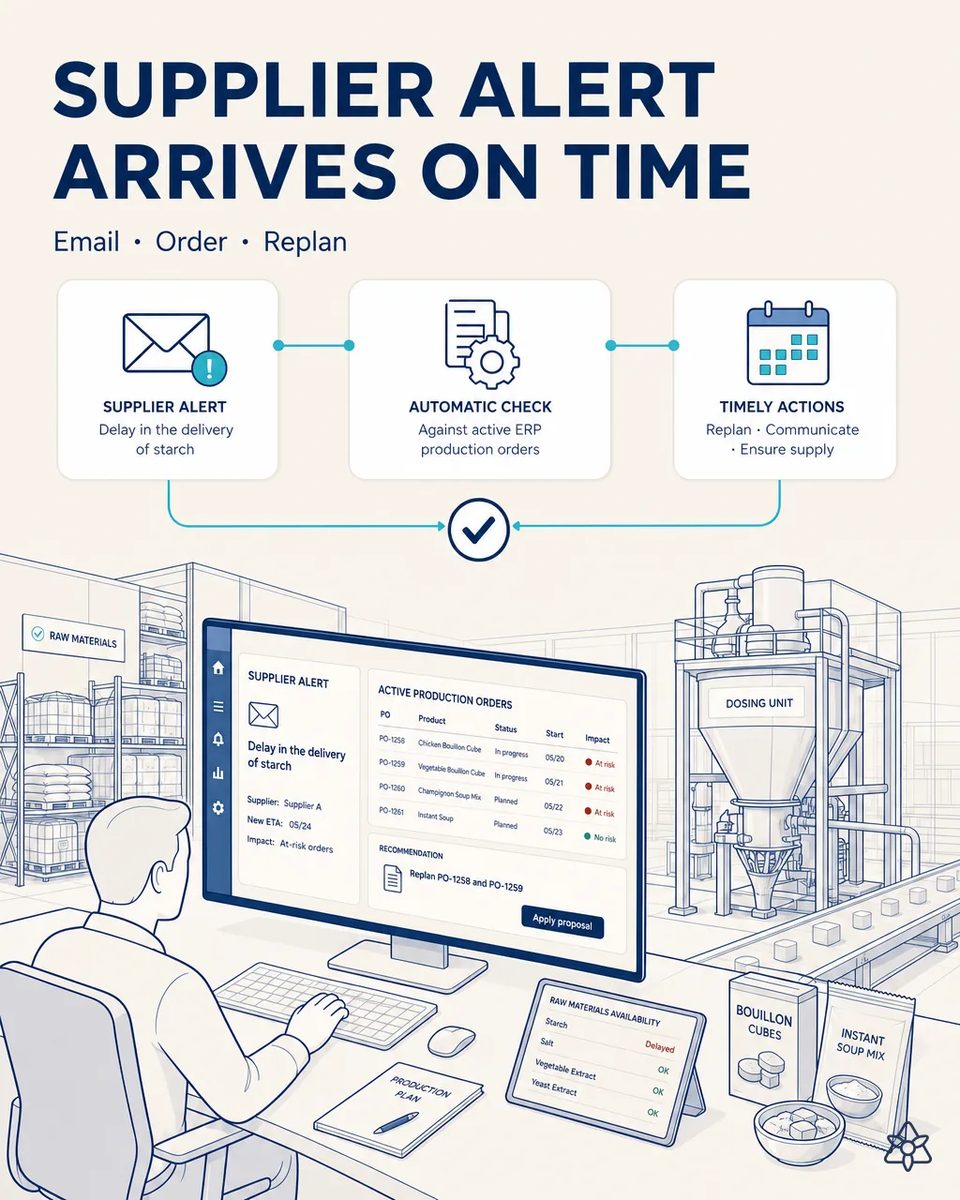
The bad news travels through a channel nobody designed.
A starch, fat or aroma supplier emails a 48-hour delay warning for the truck expected that same afternoon. The email lands in the purchasing manager's inbox, read mid-morning when a production order is already scheduled to start with that raw material at 2pm. Result: the dosing unit sits idle waiting for a decision.
- A starch, fat or aroma supplier warns by email of a 48-hour slip on a truck due that same afternoon. It is a routine message for them and a broken day for you.
- The message lands in the purchasing manager's inbox and gets read mid-morning, when a production order is already scheduled to start on that raw material at 2pm. Nobody on the floor knows yet.
- Between the alert arriving and anybody acting on it there are two or three hours of purely human latency, and in those hours nothing is replanned and nobody downstream is warned.
- The dosing unit ends up idle waiting for a decision that could have been taken before the shift even began, and the press and packing line behind it idle with it. Nobody logs that stoppage as an information failure, because there is no such category.
Connect in chaotic-sources mode — the mailbox is read the second it fills.
Connect chaotic-sources mode: the system sits on 24/7 silent copy on the supplier's mailbox (or WhatsApp Business number). An LLM extracts the alert's intent, cross-checks active ERP production orders, and returns the concrete action to the production manager: which order to reshuffle and which to reschedule.
The system does not decide for anybody. It reads the alert as it lands, works out which orders it touches and puts a concrete proposal in front of the production manager: this order moves, that one runs instead, and this is what it does to the week. The decision stays human; only the delay disappears.
Today's supplier notice versus the notice crossed with the plan
| Aspect | Today | With iLEAN Connect |
|---|---|---|
| Latency before anybody acts | 2-3 hours | Seconds |
| Orders hit by the delay | Worked out at the dosing unit | Named in the alert itself |
| What the manager receives | A forwarded email | Which order to reshuffle, which to reschedule |
| An idle dosing unit | Hours waiting on a decision | Avoided by replanning in time |
| An alert that lands out of hours | Read the next morning | Processed as it arrives |
| The purchasing system | — | Not replaced |
2-3 hours of human latency → seconds. Replanning decisions based on real-time data, not on what was read three hours earlier.
Impact estimate — to be validated with your planning team.
The block below is an estimate to be validated against your plant's actual data. We put it forward so the committee has an order of magnitude; we refine it during the assessment.
- Estimated payback 3-7 months, depending on how often a critical raw-material alert actually reaches you, and on what an idle hour costs on that line.
- Unplanned downtime caused by bad information flow, rather than by a machine breaking, stops being a monthly event on the dosing unit and starts being a rarity.
- Replanning happens on the situation as it is now, not on what somebody happened to read three hours earlier over coffee, when half the decisions had already been taken.
- And the fat or aroma lot that would have gone into the wrong order is caught before the order opens, not after the blender is charged.
Estimated payback of 3 to 7 months depending on critical alert frequency, avoiding unplanned downtime from poor information flow. Estimate to be validated.
And the fair question from the production manager
"Will it confuse routine correspondence with a real alert?" — separating an alert from ordinary email and pulling out date, material and quantity is an anchored classification task, where the best models drop below 1.5% error [1]. And it never reschedules anything by itself: the proposal goes to the production manager with the original message attached, so they can read it in two seconds and decide. A misread costs one discarded suggestion and nothing more, which is a very different exposure from an automatic replan.
[1] OpenAI paper "Why Language Models Hallucinate", 2025 — on the reliability of AI in anchored tasks.
What people ask about catching the supplier notice in time
Does the supplier have to change anything?
Nothing at all. They keep writing to whoever they always wrote to, in the format they always used; the system reads that same channel from a silent copy and changes nothing about the relationship.
Does it know which production orders that material feeds?
Yes, through the live ERP orders. That cross-check is what turns 'the fat is late' into 'these two bouillon orders cannot start on Thursday and this soup format can move up', which is the only version of the news anybody can act on.
Can it read an alert written in another language?
Yes. Imported aromas and hydrolyzed extracts often bring correspondence in English or French, and the alert is extracted the same way, with the same fields.
What about suppliers who call instead of writing?
Those stay outside until somebody writes them down, and that is worth saying plainly rather than promising otherwise. What the system removes is the written alert sitting unread in one inbox for a whole morning, which is the majority of them in most plants.
Does it decide the new schedule on its own?
No. It proposes the reshuffle with the reasoning visible, and the production manager approves or ignores it. Planning authority does not move, which is usually the condition for the case being accepted.
More cases from this series
- PAPERLESS RECIPE STARTUPThe operator photographs the order and recipe sheet; the batch and its exact recipe exist instantly.…
- THE CODER STOPS BEING HAND-TYPEDBatch, date and allergens travel from the ERP to the coder automatically. Payback 3-6 months.
- THE DELIVERY NOTE NO LONGER BLOCKS THE TRUCKPhoto the delivery note and batch labels; one-tap validation pushes straight to the ERP. Payback 3-8…
- THE VINTAGE DRYER STARTS TALKINGA camera reads the dryer panel without touching the machine: moisture and temperature digitized per…
- THE LINE SUPERVISOR DICTATES ON THE GOEarpiece + voice AI: the line supervisor logs issues while walking, no keyboard needed.
- NOTHING ENTERS WITHOUT A HUMAN SIGN-OFFEvery iLEAN capture passes through a 2-tap validation tablet before entering the central system.
Tell us what the last idle afternoon at the dosing unit cost you.
We work on your plant's real data, not ours. Assessment with no commitment.
Request estimated ROI within 48h ‹ See all cases of bouillon and dehydrated soups See food industry