The lab spreadsheet reaches the ERP on its own
Brix of the finished syrup, carbon dioxide volumes, pH, fill level, cap torque, residual chlorine and conductivity of the treated water, caustic concentration in the washer. All of it goes shift by shift into a spreadsheet. These are the numbers that determine whether product ships or not.
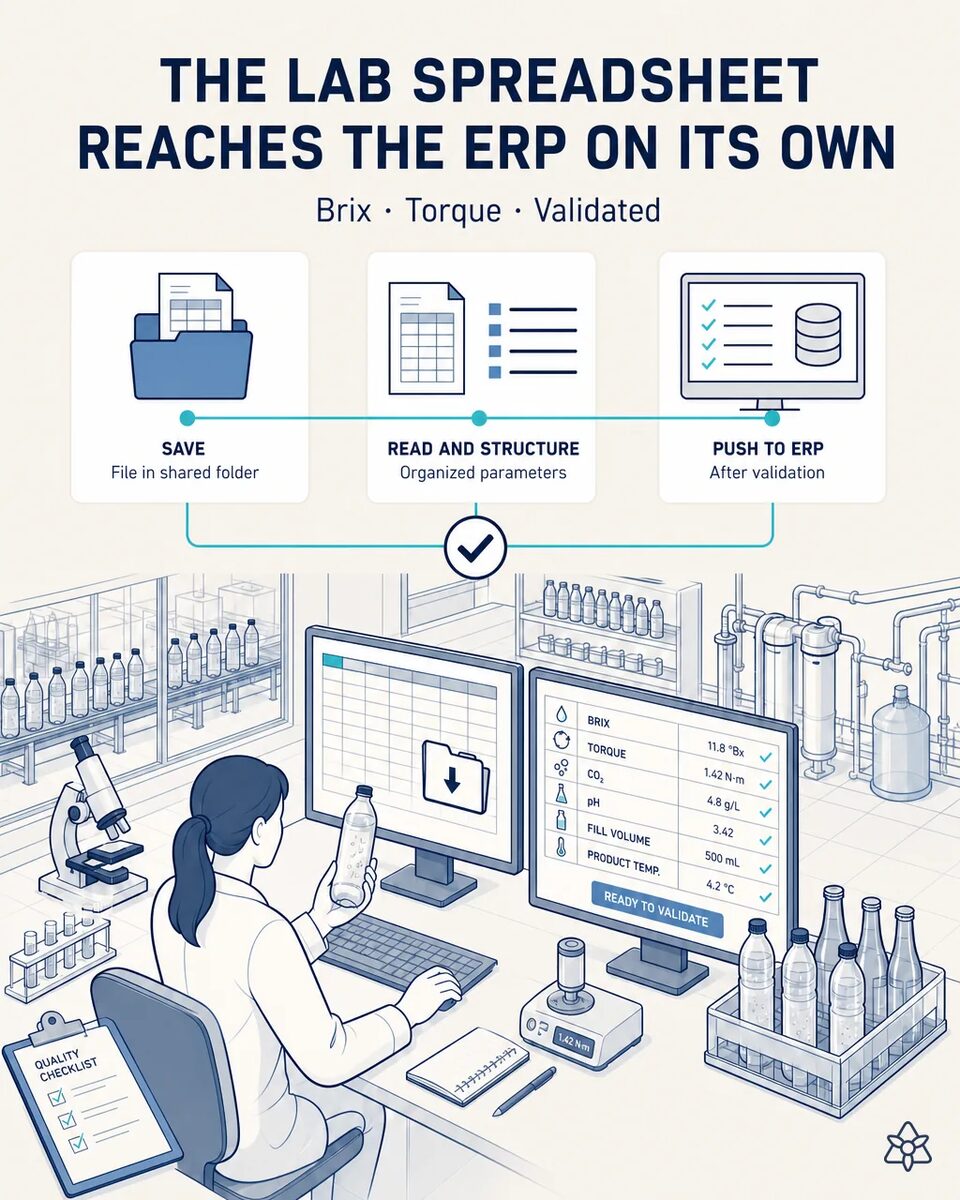
The ERP holds the batch release, but not the series behind it.
The file lives in a shared folder the ERP does not look at. Somebody transcribes it later, late and with errors, or does not transcribe it at all and the ERP holds the batch release without the data series behind it. When a complaint or an audit arrives, sheet and batch have to be matched by hand, and by then several versions of the file exist across the network. Connect in listening-inward mode observes the shared folder and reads the file as soon as it is saved. A grounded model parses it, structures it and links it to batch, line and shift. The lab keeps working exactly as it does today: same sheet, same place, same routine.
- Degrees Brix of the finished syrup, CO₂ volumes, pH, fill level, cap torque, residual chlorine and treated water conductivity, washer caustic concentration. These decide whether the product ships.
- That file lives on a shared folder the ERP never looks at.
- Somebody transcribes it later, late and with errors, or does not transcribe it at all.
- When a complaint or an audit arrives, the sheet has to be cross-referenced with the batch by hand — and by then several versions of the file exist across the network.
Connect in inward listening mode — it reads the file, not the person.
Once validated, it enters the ERP through the API. The quality lead reviews the summary and validates. Only then does iLEAN push the data into the ERP via API, already attached to the batch. The two parallel realities end: the process series stops being invisible and becomes cross-checkable against line rejects, complaints and the washer parameters. CFO angle: fewer ERP licences, year after year. The ERP bills per active user. If five people in lab and quality log into the ERP purely to key in process data, that is five quality module licences. With Connect only the person who validates goes in: one. The typical reduction sits between fifty and eighty percent of that module's licences, and it recurs every single year.
Several versions across the network is the symptom that gives away the underlying problem: when the official figure arrives late, everyone keeps their own copy. With automatic push there stops being a reason to.
Today's laboratory versus the connected laboratory
| Aspect | Today | With iLEAN Connect |
|---|---|---|
| Gap between real data and ERP | Days or weeks | Second zero |
| What the ERP holds | The release, without the series | Both, tied to the batch |
| Sheet ↔ batch cross-check in an audit | Manual | Already done |
| Versions of the file | Several across the network | One, the one being read |
| Manual transcription | Half a day a month | Zero |
| Quality module licenses | Several | One, the supervisor who validates |
Estimated impact — to validate against your actual invoice.
The block below is an estimate to be validated against your plant's actual data. We put it forward so the committee has an order of magnitude; we refine it during the assessment.
- 💰 CFO angle: the ERP bills per active user. Anyone entering the quality module purely to type results stops needing to: 50-80 % reduction, recurring every year.
- Estimated payback 4-9 months.
- Half a day a month of transcription recovered.
- Manual cross-check time that disappears at every audit.
On top of the license saving there is the half day a month lost to transcription and the manual matching at every audit. Estimated payback between four and nine months. Estimate to be validated against your actual ERP invoice for the last financial year.
And the fair question from the production manager
«What if the technician changes the sheet layout?» — that always happens, which is why parsing does not depend on fixed positions: the model interprets the structure tolerating merged cells, margin notes and mixed units. It is an anchored task, where the best models drop below 1.5% error [1], and the quality supervisor validates before anything crosses into the ERP.
[1] OpenAI paper "Why Language Models Hallucinate", 2025 — on the reliability of AI in anchored tasks.
What people ask about connecting the lab spreadsheet
Do we have to standardize the sheet?
No, and it is better not to. Asking the laboratory to change its sheet is the fast route to the system going unused. iLEAN reads the one that exists.
What about the several versions already circulating?
They stop making sense once the official figure arrives at second zero. You define which sheet is the live one and that is the one watched.
Can licenses really be reduced?
It depends on your contract, which is why it is framed as an estimate to validate against last year's invoice. The logic is simple: anyone logging in purely to type stops needing to.
Does it watch the folder or the person?
The folder. The file is read when it is saved; there is no tracking of who opens what or how long they spend on it.
Does it help with batch release?
That is the goal. With the series in the ERP at second zero, release stops being decided against an old snapshot of the quality state.
More cases from this series
- The audit file builds itselfEvery changeover and batch generates its record as it happens: photos, parameters, signatures. Agents…
- Zero variance across plant, distribution centers and routeFour coordinated rings trace product and returnable containers from the plant dock to the route return,…
- The returnable bottle washer starts to talkAn external camera digitises caustic, temperature and contact time from an old returnable bottle washer,…
- Batch and expiry travel from ERP to coder with no typingBatch, packing date and expiry travel from the active order to the coder with no manual typing. Zero…
- Alerts from the depots and haulers become actioniLEAN reads alerts from distribution centers and haulers, cross-checks them against live orders and…
- The dock supervisor speaks and iLEAN listensThe dock supervisor dictates incidents while walking the bays; iLEAN structures them, stores them and…
Tell us how many people log into the ERP today purely to enter lab results.
We work on your plant's real data, not ours. Assessment with no commitment.
Request estimated ROI within 48h ‹ See all cases of beverage bottling See food