Batch and expiry travel from ERP to coder with no typing
The coder that marks batch and expiry on every bottle is among the newest machines on the floor and has a network interface. But it sits outside the flow: at every batch or format change someone types the new code into its panel by hand, with the line waiting.
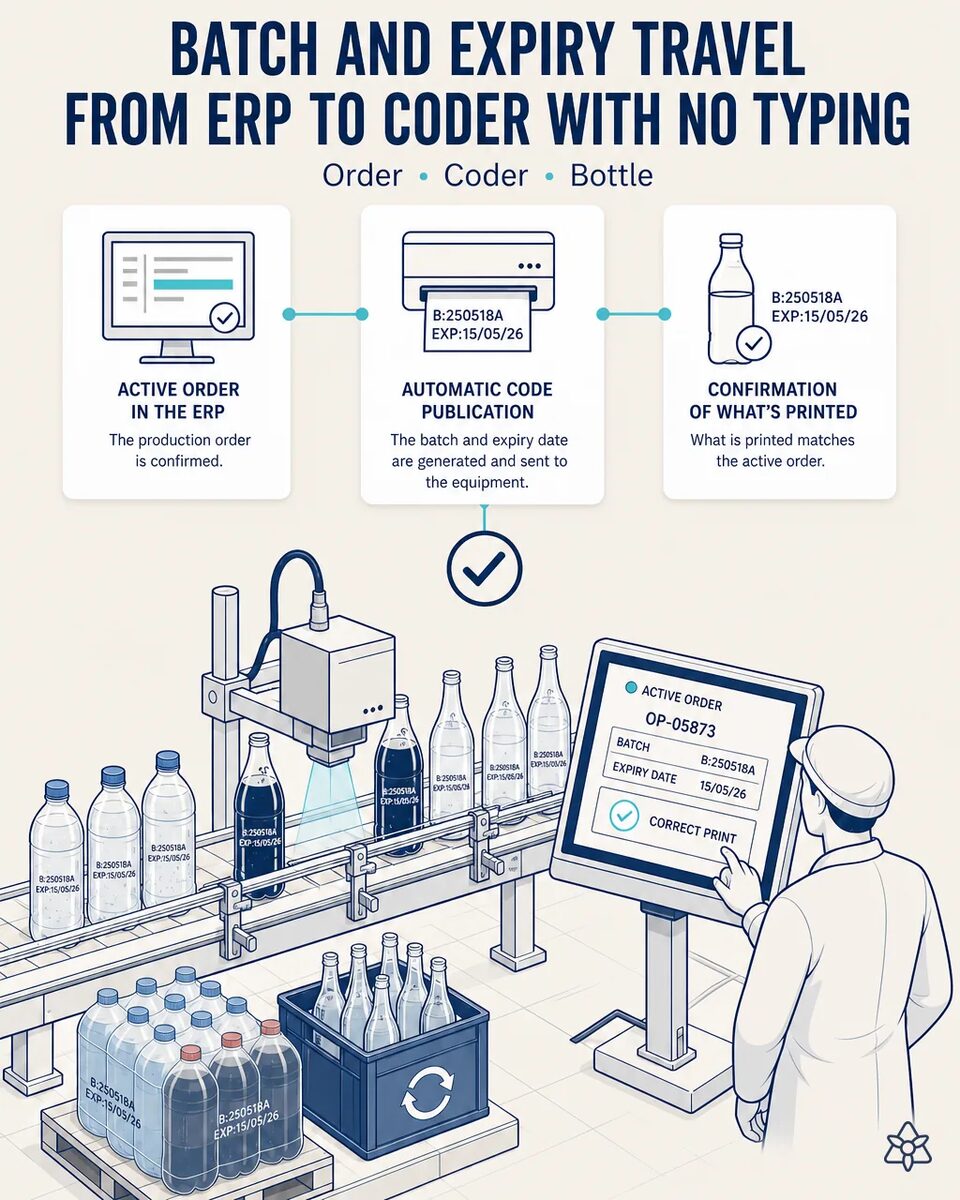
The number one recall cause in this sub-sector is a keystroke.
A wrong expiry date is the number one cause of product recall in this sub-sector, and the hardest to explain to a retail account. The error is not caught on the line: it is caught at the point of sale or in the customer's warehouse, when product is already out there. In a plant with many products and many format changes a day, the exposure is permanent.
- The coder is one of the most modern machines on the floor and has a network interface. But it sits outside the flow.
- At every batch or format change somebody types the new code into its panel, by hand, with the line waiting.
- A wrong expiry is the number one cause of product recall in this sub-sector, and the hardest to explain to a retail customer.
- The error is not caught on the line: it is caught at the point of sale or in the customer's warehouse, when product is already out there.
- With many products and many format changes a day, the exposure is permanent.
Connect stitches the two systems through APIs, replacing neither.
Connect stitches the two systems together via API. Neither system is replaced. When the ERP marks the order as started, iLEAN automatically publishes batch, packing date and calculated expiry to the coder based on that product's shelf life. Changing batch becomes a tap in the ERP instead of typing on the panel. And the coder confirms what it is really printing. The integration runs both ways: the machine returns what it is actually printing, so the system does not assume, it verifies. That signal is also the first ring of the zero-variance flagship case, because it identifies every bottle from the moment it is marked.
The machine returns confirmation of what it actually printed, not of what it was asked to print. That difference is what turns the coding record into evidence instead of an assumption.
The isolated coder versus the stitched coder
| Aspect | Today | With iLEAN Connect |
|---|---|---|
| Keystrokes per batch change | One, with the line waiting | Zero |
| Risk of wrong expiry | Permanent | Eliminated at human origin |
| Where the error is caught | Point of sale or customer warehouse | It does not occur |
| What was actually printed | Assumed | Confirmed by the machine and filed |
| Format change | One more manual step | A tap in the ERP |
| Either system | — | Neither is replaced |
Estimated impact — to validate with your own numbers.
The block below is an estimate to be validated against your plant's actual data. We put it forward so the committee has an order of magnitude; we refine it during the assessment.
- Estimated payback 3-6 months — among the fastest, because the machine already ships an interface and integration effort is low.
- Recall risk from wrong coding disappears: a long-tail cost that is hard to estimate and very high when it lands.
- One manual step removed from the changeover sequence, several times a day.
- And a per-batch record of what the machine confirmed it printed.
The return is fast and comes in two forms: the recall risk from miscoding disappears, a long-tail cost that is hard to estimate but very high when it lands, and one manual step drops out of the changeover sequence, shortening every format change of the day. Estimate to be validated.
And the fair question from the production manager
«Isn't a classic integration cleaner?» — it is the day the project reaches the top of the list, and that is the problem: it competes with producing and never gets there. This stitching replaces neither system and asks for no shutdown window, so it does not join that queue.
[1] OpenAI paper "Why Language Models Hallucinate", 2025 — on the reliability of AI in anchored tasks.
What people ask about connecting the coder
Do we have to replace the coder or the ERP?
Neither. Connect leans on the interface the coder already has and on what the ERP publishes when the order starts. It is stitching, not replacement.
What if the coder fails to print?
It is detected, because what comes back is confirmation of what was actually printed. Today that failure raises no signal: the system assumes what was requested was printed.
Does it cover format changes as well as batch changes?
Yes, and that is where a plant with many products is most exposed: every format change is another chance to mistype.
Can the loop be closed with vision?
Yes, and it is the natural pairing with the in-line vision case: the camera reads what the coder has just printed and checks it against the live order.
How long does it take to deploy?
It is one of the shortest in the pool, precisely because the machine is already prepared and there is no construction or line downtime.
More cases from this series
- The audit file builds itselfEvery changeover and batch generates its record as it happens: photos, parameters, signatures. Agents…
- Zero variance across plant, distribution centers and routeFour coordinated rings trace product and returnable containers from the plant dock to the route return,…
- The returnable bottle washer starts to talkAn external camera digitises caustic, temperature and contact time from an old returnable bottle washer,…
- Alerts from the depots and haulers become actioniLEAN reads alerts from distribution centers and haulers, cross-checks them against live orders and…
- The dock supervisor speaks and iLEAN listensThe dock supervisor dictates incidents while walking the bays; iLEAN structures them, stores them and…
- The lab spreadsheet reaches the ERP on its owniLEAN reads the Brix, CO2, pH and torque spreadsheet as it is saved and pushes it to the ERP once…
Tell us how many times a day a code is typed on your line.
We work on your plant's real data, not ours. Assessment with no commitment.
Request estimated ROI within 48h ‹ See all cases of beverage bottling See food