Zero variance across plant, distribution centers and route
In a bottler with its own distribution network, what costs most is not filler speed. It is the gap between what leaves the plant, what the system says, and what physically sits in each depot and each truck. Product running out at one site while it piles up at the neighbouring one. Expiry that only shows up at the count.
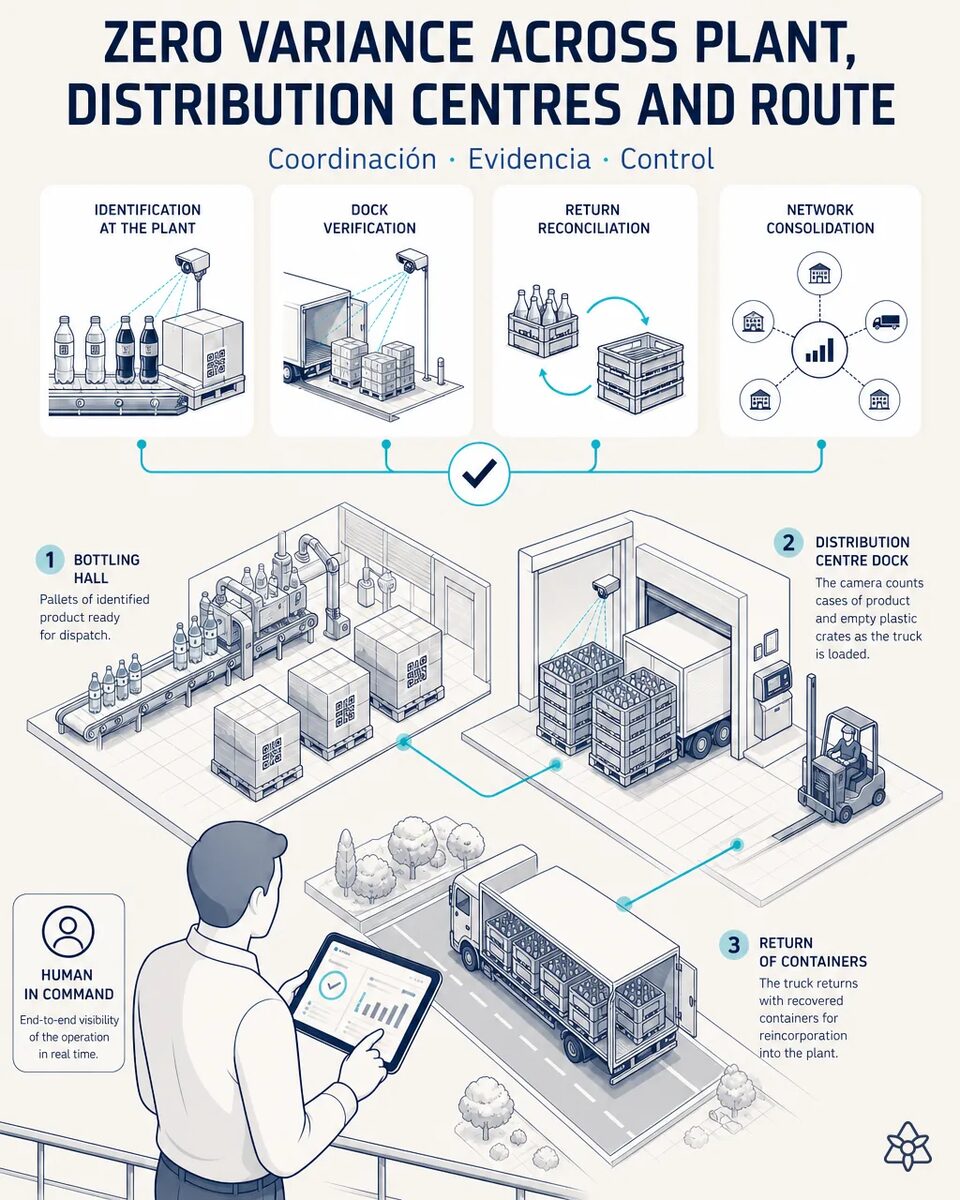
What takes the most money is not the filler's speed.
Glass bottles and plastic crates are working capital with a real replacement value, traveling to the customer and sometimes not coming back. Nobody can explain that variance, because by the time it is detected months have passed and there is no one left to ask. Across dozens of nodes, every blind spot is multiplied by the number of sites. The work order defines batch, format and expiry, and the coder prints exactly that, with no intermediate typing. What gets palletised is identified from second zero. It is the foundation the other three rings rest on: if the origin is ambiguous, nothing downstream reconciles.
- It is the gap between what leaves the plant, what the system says and what is physically in each depot and each truck.
- Product that runs out in one depot while it sits spare in the next. Expiry that shows up in the count.
- Glass bottles and plastic crates are the company's working capital, with a real replacement value, that travel to the customer and sometimes do not come back.
- Nobody can explain that variance, because by the time it is detected months have passed and there is nobody left to ask.
- Across dozens of nodes, every blind spot multiplies by the number of depots.
Four rings — no new pieces, it is all of the above orchestrated.
Ring 2 — On the dock, JIDOKA AI will not release a mismatched load. During loading, vision counts cases of product and empty containers by format and cross-checks them against the load sheet and the ERP order. If they disagree, the dispatch is not released: the tablet shows both figures and the photo, and the supervisor decides. Trucks stop leaving with a variance nobody has seen. Ring 3 — On the return, the difference has an owner. On the way back, the same vision counts what comes off: unsold product and recovered returnable containers. It cross-checks against the route's sales, and the container difference is assigned to route, customer and day instead of piling up until month end. The dock supervisor adds context by voice without stopping work. Ring 4 — Agents sees what no single site can see alone. Every day, Agents reconciles the four rings across all sites and detects patterns invisible from any single node: a route that systematically loses containers, a format that always expires at the same depots, one site overstocked while another runs dry. And it proposes the concrete action: a transfer, forced rotation, or a visit to the customer holding containers. SMED AI speeds up plant format changes so this discipline never costs availability.
It is the only case in the matrix whose return is not argued with an estimate: it is measured with your own ratio of returnable packaging that does not come back, which you already know and which today nobody can explain.
The four rings, and what each one closes
| Ring | Which cases it draws on | What it closes |
|---|---|---|
| 1 · The order is the truth | Shift start (1) + coder (8) | Batch, format and expiry, with no keystroke in between |
| 2 · The dock does not release a mismatch | Vision (9) + dock validation (5) | A dispatch that does not match what was loaded |
| 3 · The network finds out at once | Depot alerts (3) + dock voice (4) | Duplicated decisions and blind spots between depots |
| 4 · The return settles with evidence | Validation (5) + evidence pack (11) | Packaging that leaves and nobody can explain |
Estimated impact — to validate with your own numbers.
The block below is an estimate to be validated against your plant's actual data. We put it forward so the committee has an order of magnitude; we refine it during the assessment.
- Estimated payback 6-12 months.
- Recovering a fraction of the returnable packaging lost today is, across dozens of depots, the largest return of the whole system.
- Reduced write-off from expiry, which today shows up in the count with no assignable cause.
- And variance goes from being detected months later to being assigned the same day.
Recovering a share of the returnable containers lost today and cutting expiry write-offs is, across dozens of distribution centers, the biggest return in the entire system. And it is the only one argued not with a productivity estimate but with a line in the profit and loss account. Estimated payback between six and twelve months. Estimate to be validated against your real container shrinkage and inventory accuracy figures.
And the fair question from the production manager
«Do we have to deploy all twelve cases to get this?» — no, and framing it that way would be the way never to start. The rings are built in layers and each case pays on its own from the first month. With shift start-up and the coder you already have all of ring 1, which is what orders everything else.
[1] OpenAI paper "Why Language Models Hallucinate", 2025 — on the reliability of AI in anchored tasks.
What people ask about the complete system
Where do you start?
With ring 1: shift start-up and the coder. Unless the order is the truth and there is no keystroke in between, the other three rings have nothing to reconcile against.
Does it cover returnable packaging as well as product?
Yes, and that is where the largest return sits: glass bottles and crates are working capital with a replacement value, and today their loss has no assignable cause.
What if a ring flags a false variance?
JIDOKA AI stops on a verifiable discrepancy between sources, not on model uncertainty. When the doubt is the model's, the case is escalated to a person rather than stopping the dispatch.
Does it replace the ERP we already have?
No. Ring 1 rests precisely on the ERP's order being the truth. iLEAN cross-checks those systems against each other and against what actually happens on the dock.
Can the return be measured before committing?
Yes, and here better than anywhere: with your current ratio of returnable packaging that does not come back and its replacement cost, the figure comes out without estimating anything.
More cases from this series
- The audit file builds itselfEvery changeover and batch generates its record as it happens: photos, parameters, signatures. Agents…
- The returnable bottle washer starts to talkAn external camera digitises caustic, temperature and contact time from an old returnable bottle washer,…
- Batch and expiry travel from ERP to coder with no typingBatch, packing date and expiry travel from the active order to the coder with no manual typing. Zero…
- Alerts from the depots and haulers become actioniLEAN reads alerts from distribution centers and haulers, cross-checks them against live orders and…
- The dock supervisor speaks and iLEAN listensThe dock supervisor dictates incidents while walking the bays; iLEAN structures them, stores them and…
- The lab spreadsheet reaches the ERP on its owniLEAN reads the Brix, CO2, pH and torque spreadsheet as it is saved and pushes it to the ERP once…
Tell us how much returnable packaging did not come back last year.
We work on your plant's real data, not ours. Assessment with no commitment.
Request estimated ROI within 48h ‹ See all cases of beverage bottling See food