The returnable bottle washer starts to talk
In a plant running returnable glass, the bottle washer is at once the most critical and the oldest asset on the floor. Fifteen to twenty-five years old, a proprietary panel with no network, and on its screen everything that determines container safety: caustic soda concentration, temperature per zone, contact time, water and steam consumption.
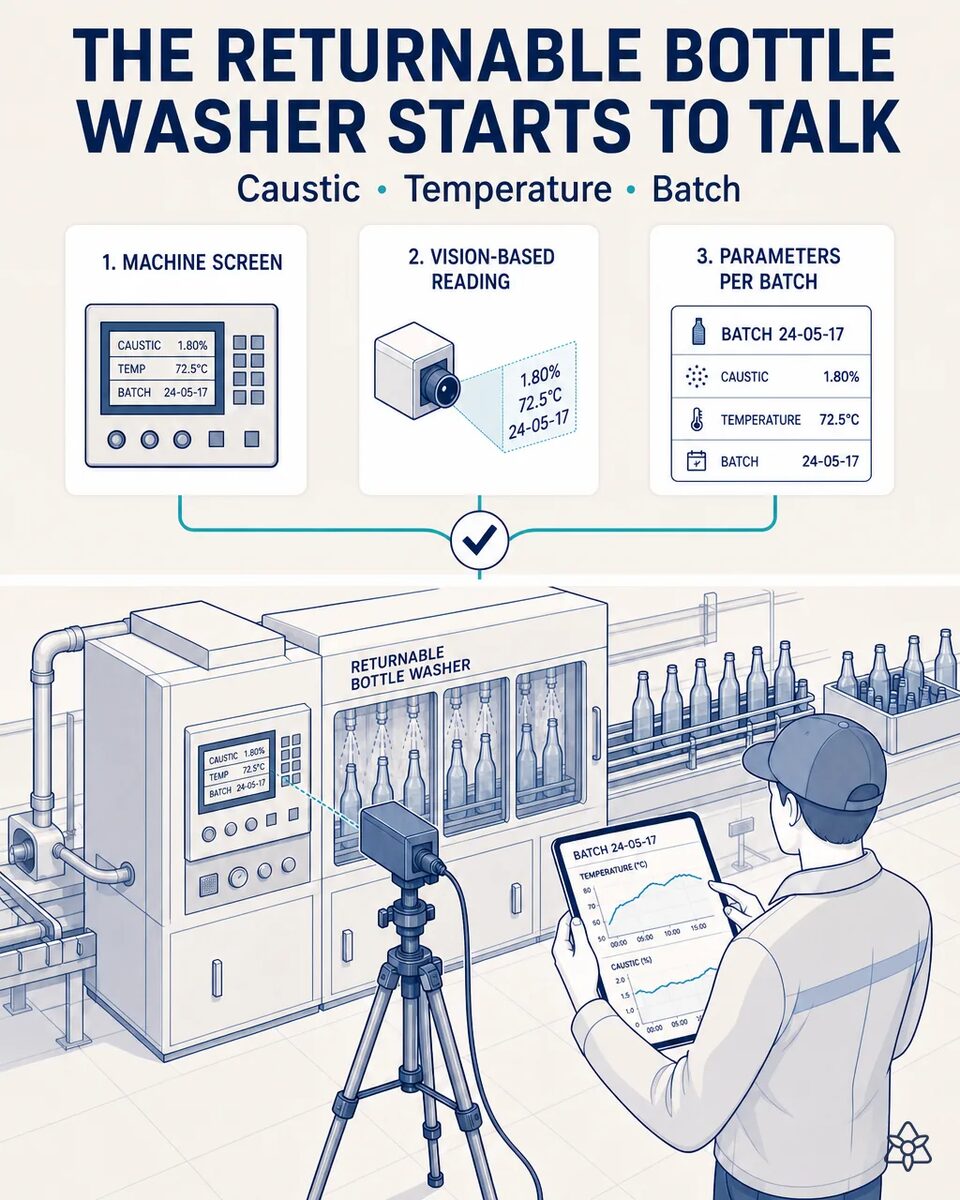
The most critical machine on the floor is also the oldest.
Replacement costs a fortune and weeks of line downtime, so the sensible decision is to keep it. The price of keeping it is that its data vanishes the moment the screen changes. Today someone writes those parameters onto a sheet by hand every couple of hours, which is a very poor sample of a continuous process.
- Its screen holds everything that determines container safety: caustic soda concentration, temperature by zone, contact time, water and steam consumption.
- A proprietary panel with no network, fifteen or twenty-five years old. Replacing it costs a fortune and weeks of line downtime, so the sensible decision is to keep it.
- The price of keeping it is that its data is lost the moment the screen changes.
- Today somebody writes those parameters on a sheet every two hours: a very poor sample of a continuous process, and the only record you can show.
Connect in photo mode on the panel — an external camera and nothing else.
An external camera and nothing else. Connect in panel-photo mode solves this without touching the machine: a fixed industrial camera aimed at the screen, periodic capture, and a grounded language model that reads each frame and structures the time series. No integration, no PLC to touch, no manufacturer warranty to void. The washer stays exactly as it is, but now it talks. And what it says can be cross-checked. iLEAN automatically links each stretch of the series to the batch and format running at that moment. That enables something impossible today: correlating a drop in caustic concentration with empty bottle inspector rejects, or with an off-taste complaint that will arrive days later.
The machine is not touched: no port is opened, nothing is installed on its control system and the warranty stands. That is the difference between a case approved in two weeks and an integration project that never rises up the list.
Replacing the washer versus reading its panel
| Aspect | Replacing it | With iLEAN Connect |
|---|---|---|
| Investment | Hundreds of thousands | Industrial camera and commissioning |
| Line downtime | Weeks | None: installed while running |
| Hygiene record | A note every two hours | Continuous series per batch |
| Correlating rejects with a parameter | Impossible | Direct, batch by batch |
| Water and steam consumption | Shows up on the bill | Attributable to the batch |
| The machine's control system | — | Untouched |
Estimated impact — to validate with your own numbers.
The block below is an estimate to be validated against your plant's actual data. We put it forward so the committee has an order of magnitude; we refine it during the assessment.
- Estimated payback 5-10 months, with three non-overlapping sources of return.
- Replacement capex in the hundreds of thousands deferred indefinitely.
- Reduced bottle rejects attributable to caustic or temperature drift.
- Complaints about poorly sanitized containers cut before they escalate.
The return has three legs: avoiding or indefinitely deferring a replacement CAPEX in the hundreds of thousands, reducing bottle rejects, and cutting container-related complaints before they escalate. Estimated payback between five and ten months. Estimate to be validated.
And the fair question from the production manager
«Does a camera watching a screen count as a hygiene record?» — here the task is anchored: fixed screen, fields in known positions and expected physical ranges, where the best models drop below 1.5% error [1]. And the system discards any frame whose value falls outside the possible range instead of accepting it, which is what would invalidate the series.
[1] OpenAI paper "Why Language Models Hallucinate", 2025 — on the reliability of AI in anchored tasks.
What people ask about reading the washer panel
Does the washer have to be networked?
No, and that is the point. The camera looks at the panel from outside: no ports, no software on the machine and no effect on the manufacturer's warranty.
What if the panel cycles through screens?
That is designed for: capture cadence is set to the rotation and the system identifies which screen it is looking at before extracting any value.
Does it replace the manual hygiene log?
It feeds and extends it. The record goes from a note every two hours to a continuous series, which is what lets you demonstrate the real contact time of each batch.
Does it work for the other old machines on the floor?
Yes: the same pattern serves the pasteurizer, the blow molder or the cooling tunnel. You start with the washer because that is where the food safety risk sits.
How much history is needed?
To investigate a specific batch, having it captured. To detect caustic drift, some weeks — the time the trend takes to draw itself.
More cases from this series
- The audit file builds itselfEvery changeover and batch generates its record as it happens: photos, parameters, signatures. Agents…
- Zero variance across plant, distribution centers and routeFour coordinated rings trace product and returnable containers from the plant dock to the route return,…
- Batch and expiry travel from ERP to coder with no typingBatch, packing date and expiry travel from the active order to the coder with no manual typing. Zero…
- Alerts from the depots and haulers become actioniLEAN reads alerts from distribution centers and haulers, cross-checks them against live orders and…
- The dock supervisor speaks and iLEAN listensThe dock supervisor dictates incidents while walking the bays; iLEAN structures them, stores them and…
- The lab spreadsheet reaches the ERP on its owniLEAN reads the Brix, CO2, pH and torque spreadsheet as it is saved and pushes it to the ERP once…
Tell us how often the washer parameters are written down today.
We work on your plant's real data, not ours. Assessment with no commitment.
Request estimated ROI within 48h ‹ See all cases of beverage bottling See food