Alerts from the depots and haulers become action
Across a network of dozens of distribution centers, what really drives the day never enters the system: it arrives by messaging app and by email. The trailer that did not leave. The delivery that arrived forty cases short. The key account changing tomorrow's order. The depot that ran out of empty containers.
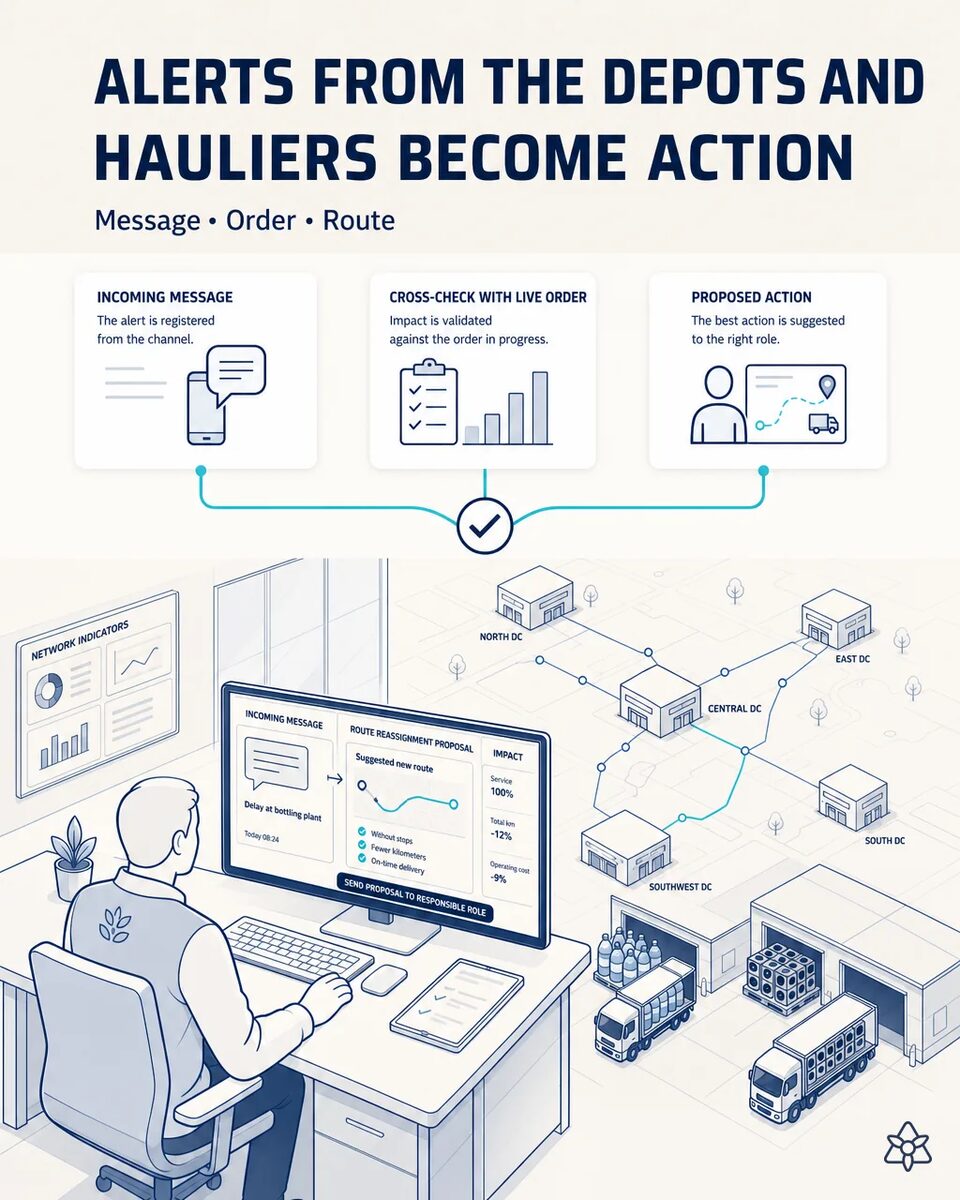
What moves the day does not come through the system.
Each of those messages lands in a group where whoever can read it does, whenever they can. Half get handled late and a good share get handled twice, by two people who did not know about each other. Nobody holds the consolidated picture, and decisions get made on whatever each person managed to read.
- It comes by messaging and email: the truck that did not leave, the order that arrived short by forty cases, the large customer changing tomorrow, the depot out of empty containers.
- Each message lands in a group where it is read by whoever can, whenever they can.
- Half get resolved late. Another part get resolved twice, by two different people who did not know about each other.
- Nobody has the consolidated picture of the network, and decisions are made with whatever each person managed to read.
Connect in chaotic-sources mode — iLEAN in silent copy, twenty-four hours.
iLEAN silently copied in, around the clock. Connect in messy-sources mode puts iLEAN silently on those channels: a dedicated mailbox and a business messaging number in the operational groups. The moment a message lands it extracts intent — shortage, delay, order change, transport incident, container shortfall — and the entities: which depot, which route, which product, what quantity, which customer. It returns the action, not the alert. Cross-checking against live orders and real network inventory turns the alert into a concrete action for the right role. It is not a reminder that a message arrived: it is reassigning the route to the neighbouring depot that does hold that format and does cover today's order. And the incident is recorded, so it still exists tomorrow.
The problem in a network of dozens of nodes is not lack of information: it is that there is too much of it, unconsolidated. What changes is not that it arrives sooner, it is that it arrives once, cross-checked and with a traced decision behind it.
Today's network versus a network with shared memory
| Aspect | Today | With iLEAN Connect |
|---|---|---|
| When an alert is read | When somebody opens the group | At second zero, twenty-four hours |
| Latency to action | 2-4 hours | Seconds |
| What it is checked against | What each person remembers | Live orders and inventory |
| Double resolution | Frequent, by two people | Impossible: the decision is traced |
| Consolidated picture of the network | Does not exist | One |
| Who decides | Whoever reads it first | The manager, with the proposed action in front of them |
Estimated impact — to validate with your own numbers.
The block below is an estimate to be validated against your plant's actual data. We put it forward so the committee has an order of magnitude; we refine it during the assessment.
- Estimated payback 3-7 months.
- Stockouts avoided from lack of coordination between depots.
- Urgent freight that stops being needed.
- From dozens of parallel conversations to a shared memory across the network.
The return sits in the stockouts avoided through better coordination and in the emergency freight that stops happening. The network moves from dozens of parallel conversations to one shared memory. Estimated payback between three and seven months depending on incident frequency and number of nodes. Estimate to be validated.
And the fair question from the production manager
«Are you going to read my team's groups?» — no. iLEAN sits in copy on a dedicated mailbox and a company messaging number: it only sees what is sent to those operational channels. On extraction, classifying the intent of a logistics message is an anchored task and the best models drop below 1.5% error [1] — and the action is executed by a person.
[1] OpenAI paper "Why Language Models Hallucinate", 2025 — on the reliability of AI in anchored tasks.
What people ask about reading network alerts
Does it tell an urgent alert from a routine one?
Yes, and the threshold is deliberately demanding: it only interrupts when crossing the message with orders and inventory produces a concrete action. A system that over-alerts stops being read within a week.
Does it stop two people resolving the same thing?
That is one of the highest-value effects in a large network. The decision is recorded against the alert, so the second person to arrive sees it is already resolved and by whom.
Does it need to be connected to the ERP?
For the full alert, yes, because the value lies in crossing it with live orders and inventory. You can start with extraction and a simple alert while that cross-check is prepared.
What about what arrives by phone?
That is still not captured this way, and it is worth saying so. It can be logged with the voice mode of the dock supervisor case, but this case covers written channels.
Does it work across dozens of depots at once?
That is where it shows most. With one depot, one attentive person covers the gap; with dozens, every blind spot multiplies and no amount of attention is enough.
More cases from this series
- The audit file builds itselfEvery changeover and batch generates its record as it happens: photos, parameters, signatures. Agents…
- Zero variance across plant, distribution centers and routeFour coordinated rings trace product and returnable containers from the plant dock to the route return,…
- The returnable bottle washer starts to talkAn external camera digitises caustic, temperature and contact time from an old returnable bottle washer,…
- Batch and expiry travel from ERP to coder with no typingBatch, packing date and expiry travel from the active order to the coder with no manual typing. Zero…
- The dock supervisor speaks and iLEAN listensThe dock supervisor dictates incidents while walking the bays; iLEAN structures them, stores them and…
- The lab spreadsheet reaches the ERP on its owniLEAN reads the Brix, CO2, pH and torque spreadsheet as it is saved and pushes it to the ERP once…
Tell us how many urgent freights you paid for last quarter.
We work on your plant's real data, not ours. Assessment with no commitment.
Request estimated ROI within 48h ‹ See all cases of beverage bottling See food