The paint defect out before assembly — 100% of chassis inspected
At the line's real rate the human eye tires and lets through fine craters, sags, fish eyes or areas with insufficient coverage on the chassis edge. Those chassis reach assembly and from there the OEM — customer PPM rises and points appear on the scorecard penalizing volume and price. With iLEAN Edge, overhead and side cameras with paint-specific polarized lighting infer in milliseconds per piece and eject the defective chassis before assembly. Pure jidoka AI: the process detects its own defect and reacts.
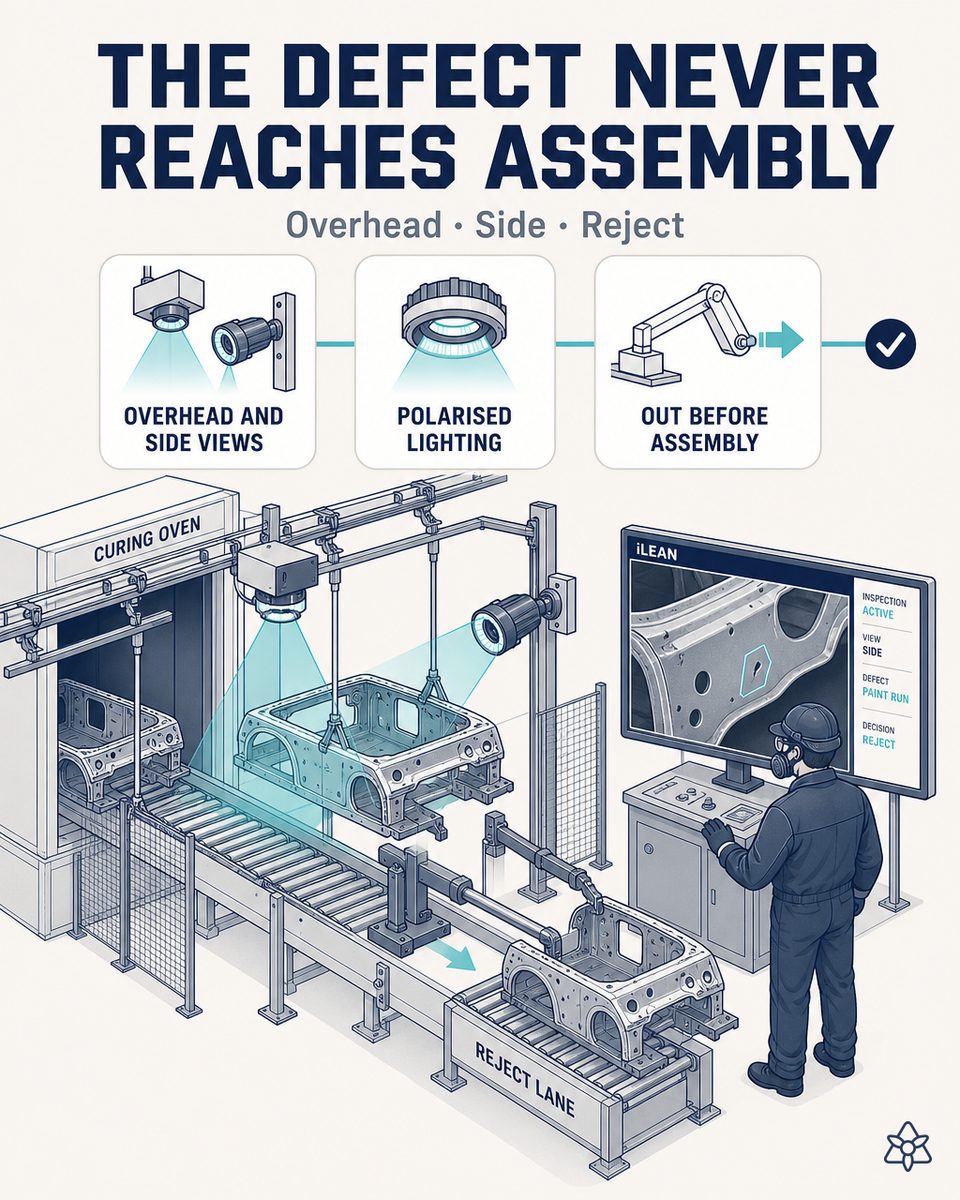
100% human visual control is impossible at real rate.
On an electronics metal chassis paint line, pieces leave the curing oven at a pace no human inspection station sustains shift after shift. At that rate, asking a person to guarantee every chassis's surface is not demanding: it is physically impossible. Attention drops, the fine crater and the fish eye camouflage themselves, and what exists in practice is a 2-5% sampling inspection of the pieces — with two structural problems.
- Standard light does not show the defect — the inspection table's conventional lighting returns a specular gloss that flattens fine relief: the fine crater or the sag on the inner edge generate no contrast and pass even if the inspector is looking at exactly that area. The problem is not only attention: it is the physics of light.
- Sampling leaves gaps — quality checks a minimal fraction of the pieces. The fish eye, the sag and the insufficient coverage on the chassis edge slip through exactly on the pieces nobody looks at. And those gaps are detected by the OEM customers at their receiving — and penalized. In Lean vocabulary: the poka-yoke does not exist, statistical hope does.
The consequence is the worst muda of all: the defective chassis consumed pre-treatment, paint, curing and assembly before being discovered — at the OEM's plant. Customer PPM rises, points appear on the scorecard, and the scorecard is what decides volume and price in the next award. In EMS, the cost of the defect leaving the plant shoots far above the cost of internal rework.
iLEAN Edge — cameras with polarized light, a local CNN and chassis ejection before assembly.
The problem is not judgment — the quality manager tells a fish eye from a settled dust speck perfectly — it is rate, sustained attention and the physics of light, exactly where machine vision wins. iLEAN Edge replicates the veteran inspector's judgment at line speed, piece by piece, without fatigue, and with the lighting that does reveal the relief. It is the poka-yoke sampling could never be.
Edge sees every chassis before assembly. The overhead and side cameras with polarized diffuse lighting reveal the fine relief standard light flattens. The local CNN tells apart crater, fish eye, sag and insufficient edge coverage. The actuator flags or ejects the defective chassis without stopping the line. It works with no cloud and without sending a single image outside the plant. Every camera decision is recorded in the evidence pack, traceable to the batch and the reference.
iLEAN's specific piece for a chassis paint line in an EMS plant:
- Edge — a physical terminal with overhead and side cameras installed over the inspection table, before assembly, with paint-specific polarized diffuse lighting: polarized light removes the specular gloss and reveals the fine relief standard light hides. It carries a local CNN on an Edge GPU, trained with good and bad examples of the site's real chassis and color catalog. It inspects fine crater, fish eye, sag — the inner edge's included — and insufficient coverage on the chassis edge. Inference is local, with zero image sent to the cloud — no latency, no bandwidth cost, no product images outside the plant —: on detecting a defect it triggers the chassis's flagging or ejection before assembly, and every decision is recorded in the evidence pack. Jidoka AI: the process reacts to its own defect in the instant, not at the OEM's receiving.
- Connect — captures the work order, the chassis reference, the color and the batch in progress, whether from the ERP or the MES. Every chassis flagged or ejected by Edge is signed with a timestamp and tied to the batch and the reference, so the traceability the OEM customer demands is automatic, not a manual reconstruction.
- Agent — lives in Central, crossing the Edge history (rejects per hour, by defect type, by shift, by color) with Connect's order and reference. If the fish eye always spikes after a specific color change or with a specific paint batch, it does not send an email at midnight: it presents the already-crossed hypothesis to the quality manager, who validates and decides. The person supplies the judgment; the system does the gemba walk through the data.
Sampling inspection vs. inspection with iLEAN Edge
| Aspect | Sampling inspection | With iLEAN Edge on the line |
|---|---|---|
| Inspection coverage | A 2-5% human sample of the pieces | 100% control of the pieces, at real rate |
| Fine crater / fish eye | Depends on landing in the sample and the inspector's fatigue | A local CNN on every chassis, with polarized light revealing the relief |
| Sag on the inner edge | Invisible under the table's standard lighting | Revealed by the polarized lighting and the angled side cameras |
| Customer PPM for visual defects | The OEM customer detects it at its receiving | Drastic reduction (estimate to be validated) |
| Batch returns for paint defects | Held batch + scorecard points penalizing volume and price | Drastic reduction: the defective chassis is ejected before assembly |
| Evidence before the OEM customer | No per-piece record: the argument is word against word | Every camera decision recorded in the evidence pack, with a timestamp |
Impact estimate for your plant — to be validated with your own numbers.
The block below is an estimate to be validated against your plant's actual data. We put it forward so the committee has an order of magnitude; we refine it during the assessment.
- EMS plant with metal chassis paint and current control by a 2-5% sample on the inspection table, before assembly.
- Edge pilot on the inspection table — overhead and side cameras with polarized lighting + a flagging or ejection actuator before assembly, with no line construction work. First value expected within a few weeks.
- Indicative payback between 5 and 12 months, depending on the OEM customers' current return ratio. Estimate to be validated against your history.
- Expected reduction of customer PPM for visual defects: drastic on going from a 2-5% sample to 100% control of the pieces. (Estimate to be validated with your history.)
- The strategic lever is protecting the customer scorecard: points for visual defects penalize volume and price in the next award, so the impact is multi-year — hard to quantify a priori, but large. It enables business, it does not only save rework.
And the fair question from the quality manager
"What if the AI gets it wrong and lets a crater through?" — hallucination is a problem of free generation, not of anchored tasks. In tasks where the AI merely classifies an image against known patterns (this chassis matches the "good" pattern or the "defect" pattern), the best models brought the error below 1.5% [1]. And even then, nothing is decided in a vacuum: the quality manager sees each shift's history, validates false positives in the Edge interface itself, and retraining enters with every model version documented and approved. The line does not stop while training happens. The person supplies the judgment; the machine keeps the cycle turning.
[1] OpenAI paper "Why Language Models Hallucinate", 2025 — on the reliability of AI in anchored tasks.
What people ask about chassis paint inspection with AI vision
Which specific paint defects does iLEAN Edge detect on the chassis?
The ones that end up on the OEM customer's scorecard. On the surface: fine crater, fish eye and sag, including the inner edge sag standard light does not reveal. In coverage: areas with insufficient coverage on the chassis edge, where the coat thins and the substrate is exposed. The CNN is trained with good and bad examples of the site's real chassis and color catalog, so the acceptance criterion is yours, not a generic one: the defective chassis is flagged or ejected before assembly and every decision is recorded in the evidence pack.
Why polarized lighting and not the inspection table's standard light?
Because the fine paint defect is a defect of relief, not color. Under the table's standard lighting, the painted surface returns a specular gloss that flattens the fine crater or a sag's beginning: the eye — and a camera with conventional light — sees no contrast. The polarized diffuse lighting removes that specular gloss and turns the fine relief into a sharp discontinuity in the image, whatever the piece's color. With the overhead and side cameras, moreover, the chassis edge is seen at a grazing angle, exactly where insufficient coverage hides in a frontal inspection.
At what real rate does Edge inspect without becoming the line's bottleneck?
At the line's own rate. The local CNN infers in milliseconds per piece on an Edge GPU: vision is never the bottleneck — the limit is set by the flagging or ejection actuator, not the model. The decision arrives before the chassis enters assembly, the line does not slow down and no chassis passes uninspected. It is jidoka in its literal definition: the process detects its own defect and reacts without depending on a person's sustained attention.
How is the CNN trained on my plant's own chassis and color catalog?
With real examples of your product, not a generic paint library. The quality manager marks good pieces and pieces with each defect type — crater, fish eye, sag, insufficient edge coverage — of each chassis reference and each color and finish in the site's catalog (smooth, textured, matte, gloss). The CNN learns that piece's visual pattern under that polarized lighting. When a new reference or color enters, it is retrained with the new samples and every model version is documented, validated against a known piece set and approved by quality before entering production, with a record of which version was active on each batch.
Does Edge work with no cloud? I do not want images of my chassis leaving the plant.
Yes — and that is the design case, not the exception. Edge is a physical on-premise terminal with the CNN loaded on an Edge GPU in the device itself: inference is local and no image goes to the cloud, so there is no latency, no bandwidth cost, and no images of your product outside the plant. If the network drops, Edge keeps inspecting every chassis and triggering the flagging or ejection. Every camera decision is recorded locally in the evidence pack with a timestamp and the model version; when the connection returns, the record uploads to cross with the batch's and reference's traceability.
More cases from this series
- A customer audit evidence pack — the OEM scorecard in continuous greenEvery change generates a dossier with photos, log and signatures. Agents organizes it by standard (ISO…
- Early human verification — two taps and the ERP stays cleanNothing iLEAN captures enters the ERP without a human signature on the tablet. Two taps, seconds, the…
- The curing oven now talks — without touching the original SCADAAn external camera reads the tunnel oven’s SCADA panel without touching the machine. A per-batch thermal…
- OEM customer spec change — zero rework from reading lateiLEAN silently copied on the mailbox. When the OEM changes a paint spec, the notice reaches the…
- From the laboratory’s Excel to the ERP at second zeroiLEAN reads the laboratory’s Excel as soon as it is saved, validates and feeds the ERP. Fewer quality…
- Paint receiving into the ERP — no typing, with shielded traceabilityA photo of the delivery note, the CoA and the GS1 labels. One tap and all into the ERP. Truck from 45 to…
Raise your scorecard with your OEM customers — we will send within 48h the estimated ROI of this AI project for your inspection table.
We work on your plant's real data, not ours. Assessment with no commitment.
Request estimated ROI within 48h ‹ See all 12 chassis paint cases See electronics