A color change with visual evidence — no cross-contamination
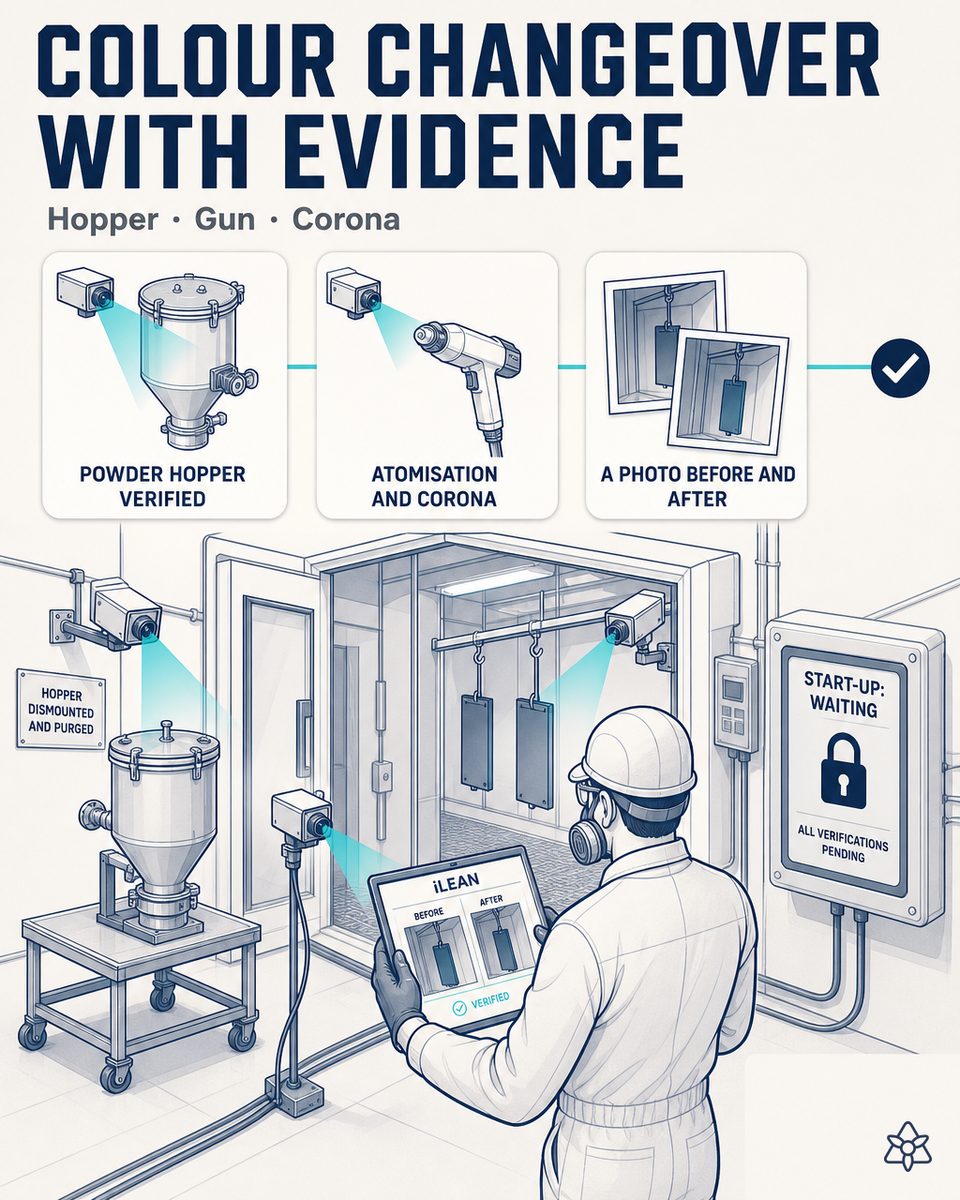
A booth painting white chassis on one shift and black or gray on the next demands total cleaning. One milligram of the previous color contaminates the next batch's first chassis and drags a silent defect until it appears weeks later on the OEM's chassis. Today that release depends on a human signature with no objective visual evidence. With iLEAN Edge, fixed cameras at N critical points compare the real state with the "clean for color X" reference; JIDOKA AI does not let it start until OK + signature. Three safety rings active on every color change.
Cross-contamination gives no warning: it is discovered weeks later, already at the customer.
With the color in steady state, a metal chassis paint booth is stable. The risk concentrates in the color change: going from white to black, from black to gray, from one EMS customer's batch to another's. A minimal residue of the previous color — in the powder hopper, in the liquid circuit, in one gun's atomizer — is enough to seed the defect in the next batch's first chassis. And that defect is silent: it does not jump out in the booth, it travels with the chassis.
- It is detected days or weeks later, already at the customer — the previous color's speck or haze appears when the chassis is already mounted in the OEM's product, and what was a residue in a hopper becomes a claim, rework cost and distrust in the next change.
- The current signature is blind — the technician signs "clean" with no per-point visual evidence: they cannot prove the hopper, the circuit or the corona were really clean, and they remain personally exposed if the defect appears weeks later.
- Fear brakes the business lever — the color change is a lever of flexibility and CTO: the faster and safer it is, the more short batches and color mix the plant can accept. Without objective evidence, every change stretches "just in case" and flexibility is paid in hours of stopped booth.
A badly verified color change translates into the same thing: latent cross-contamination, late claims impossible to trace, technicians signing without backing and a booth changing color slower than the business needs.
Edge gives the OK point by point — JIDOKA AI does not let the booth start until all have said yes.
The color change is not solved with a longer checklist for the booth technician: it is solved by giving the quality manager objective visual evidence of each critical point before they sign the release, and by making the booth physically unable to start the next batch while that evidence is incomplete. That combination is Edge plus JIDOKA AI — verification of the critical point, not of people.
Edge verifies each critical point of the change — powder hopper, liquid paint circuit, each gun's atomizer, electrostatic corona, booth extraction, chassis belt and guides. JIDOKA AI does not release the startup until all the cameras give OK. The quality manager signs on the visual evidence, not on a cleaning nobody can prove.
The iLEAN pieces applied to the color change:
- Edge — fixed industrial cameras at the N critical points where the previous color can survive the cleaning: powder hopper, liquid paint circuit, each gun's atomizer, electrostatic corona, booth extraction and the chassis belt and guides. CNN networks trained to recognize "clean vs. residue of the previous color" for every color pair in the catalog — because the tolerable threshold is not the same going from gray to black as from black to white.
- JIDOKA AI — receives each camera's verdict and acts as the startup gate: while a single critical point is not OK, the next batch stays held. It is not an alert someone can ignore under schedule pressure; it is an active block on the startup until the evidence is complete.
- The manager's electronic signature on evidence — when all the cameras give OK, the quality manager receives the summary with each critical point's photo and signs the change's release. The signature remains human and mandatory — what changes is that it is no longer blind: it is given on structured visual evidence point by point, and the technician stops being personally exposed.
- Pre/post photos in the evidence pack — each critical point is documented with its image before and after the cleaning, attached to the next batch's evidence pack. If weeks later someone asks about that color change, the answer is not memory: it is the photo, the Edge verdict and the signature, ready for the customer or the audit.
Signing blind vs. signing on visual evidence per booth critical point
| Aspect | Classic color change | With iLEAN Edge + JIDOKA AI |
|---|---|---|
| Detecting the cross-contamination | Days or weeks later, already on the customer's chassis | In the booth, before starting the next batch |
| Evidence "clean" is signed on | A blind human signature, no per-point record — the technician exposed | A signature based on per-point visual evidence, with archived pre/post photos |
| Verification of hopper, guns and corona | By eye, per checklist, with no objective record | A CNN per point compares with the color pair's "clean for color X" reference |
| Confidence in a fast color change | Low — every change stretches "just in case" | High — the fast, safe change becomes a CTO flexibility lever |
| A camera failing or with no reading | Assumed OK if nobody says otherwise | Block held — absence of data is not a green light |
| Analysis when a defect appears | Reconstruction from memory — nobody can prove anything | An event documented in the evidence pack: pre/post photo + Edge verdict + signature |
Impact estimate for your plant — to be validated with your own numbers.
The block below is an estimate to be validated against your plant's actual data. We put it forward so the committee has an order of magnitude; we refine it during the assessment.
- Metal chassis paint booth at an EMS plant with frequent color changes: powder and liquid, several color pairs in the catalog, batches from different customers sharing the same booth.
- Edge + JIDOKA AI pilot on the change's N critical points (cameras + startup gate + integration with the quality manager's signature and the first chassis's validation). First value expected within 4 weeks.
- Estimated payback of 6 to 12 months, depending on the color change frequency and the cross-contamination claim history. Estimate to be validated.
- Return levers: the elimination of late cross-contamination claims — the most expensive, because they arrive with the chassis already mounted — and a reduction of stopped-booth time, because the change stops stretching "just in case" when each point has objective evidence. Estimate to be validated.
- The conversion of the color change into a CTO lever: the faster and safer, the more short batches and color mix the plant can accept without risk. Estimate to be validated.
And the fair question from the quality manager
"What if the camera gives OK to a hopper still holding the previous color's powder, or the other way round, blocks the booth for no real reason?" — hallucination is a problem of free generation, not of anchored tasks. In tasks where the AI merely compares a critical point's current image against its previously validated "clean for color X" reference — which is exactly what Edge does here —, the best models brought the error below 1.5% [1]. And even then, the critical is not decided alone: JIDOKA AI holds the startup, the batch's first chassis confirms and the quality manager signs, seeing the evidence behind each point. iLEAN's three safety rings are there precisely for this — the AI proposes, the manager decides.
[1] OpenAI paper "Why Language Models Hallucinate", 2025 — on the reliability of AI in anchored tasks.
What people ask about the color change with Edge and JIDOKA AI
What exactly is JIDOKA AI and how does it block the next batch's startup?
JIDOKA AI is the orchestration layer turning the Edge cameras' verdict and the quality manager's signature into a block on the booth's startup. It takes its name from the classic jidoka principle — stopping at the anomaly instead of letting it advance — applied by AI to the color change: until it receives the OK from all the cameras at their critical points and the manager's electronic signature on that evidence, JIDOKA AI keeps the next batch's startup held. The gate does not open because the production schedule is tight or because the cleaning "has always been done this way"; it opens when the structured visual evidence of the clean booth is complete and signed.
How many cameras are needed and where in the booth are they placed?
One fixed camera is installed per critical point where the previous color can survive the cleaning: powder hopper, liquid paint circuit, each gun's atomizer, electrostatic corona, booth extraction and the chassis belt and guides. Each camera learns its point's "clean for color X" reference — for every color pair in the catalog, because going from white to black is not the same as from black to light gray — and compares against it on every change, not once per shift. The final number of points comes from your booth's critical point study: the N cover the elements whose residue turns the next batch's first chassis into a silent defect.
What happens if a camera fails or loses its reading during the cleaning?
The system is designed to fail closed, not open. If a camera stops giving a valid reading — paint mist on the lens, a connection failure or framing drift — JIDOKA AI does not interpret the silence as OK: it records "point without valid reading — block held" and keeps the startup held until the camera is repaired or the quality manager validates that point manually with their signature. Absence of data never translates into a green light; in a color change it translates into more verification, not less.
How does the CNN tell a residue of the previous color the human eye cannot see?
Because it does not look like an eye: it compares pixel by pixel each point's current image with its "clean for color X" reference, captured under controlled lighting conditions and previously validated for each color pair in the catalog. A haze of white powder in a hopper about to load black, or a trace of dark pigment in the atomizer before a light batch, produce texture and tone deviations the CNN detects even when they are below the human visual perception limit in a booth's half-light. The per-color-pair training matters: the tolerable residue threshold is not the same in a gray-to-black change as in a black-to-white one, and the model applies the specific pair's threshold.
Is the quality manager's signature still required with Edge running?
Yes, always. Edge does not replace the human signature or the first chassis's validation: it reinforces them. iLEAN keeps three safety rings active in parallel — Edge visual verification of each of the booth's critical points, validation of the incoming batch's first chassis and the quality manager's electronic signature on that evidence. Edge's contribution is that the signature stops being blind: the manager no longer signs "clean" without being able to prove it, they sign on structured visual evidence point by point, with each point's pre/post photo captured at the change's moment and archived in the batch's evidence pack. No ring depends on another to exist.
More cases from this series
- A customer audit evidence pack — the OEM scorecard in continuous greenEvery change generates a dossier with photos, log and signatures. Agents organizes it by standard (ISO…
- Early human verification — two taps and the ERP stays cleanNothing iLEAN captures enters the ERP without a human signature on the tablet. Two taps, seconds, the…
- The curing oven now talks — without touching the original SCADAAn external camera reads the tunnel oven’s SCADA panel without touching the machine. A per-batch thermal…
- OEM customer spec change — zero rework from reading lateiLEAN silently copied on the mailbox. When the OEM changes a paint spec, the notice reaches the…
- From the laboratory’s Excel to the ERP at second zeroiLEAN reads the laboratory’s Excel as soon as it is saved, validates and feeds the ERP. Fewer quality…
- Paint receiving into the ERP — no typing, with shielded traceabilityA photo of the delivery note, the CoA and the GS1 labels. One tap and all into the ERP. Truck from 45 to…
Shield your color changes — ask us for the critical point study.
We work on your plant's real data, not ours. Assessment with no commitment.
Request estimated ROI within 48h ‹ See all 12 chassis paint cases See electronics