The paint superintendent in command — voice, hands-free, CMMS
The paint maintenance superintendent spends the day walking between pre-treatment, booths, robots, curing oven, inspection table and the spare parts warehouse, hands busy. The operational knowledge in their head — that nozzle 3 is losing flow, that the sacrificial filter has 220 hours against the recommended 200, that robot A2 has a squeal — dies at the end of the shift. With iLEAN Connect in voice mode, an industrial Bluetooth earpiece turns every observation into a structured work order in the CMMS.
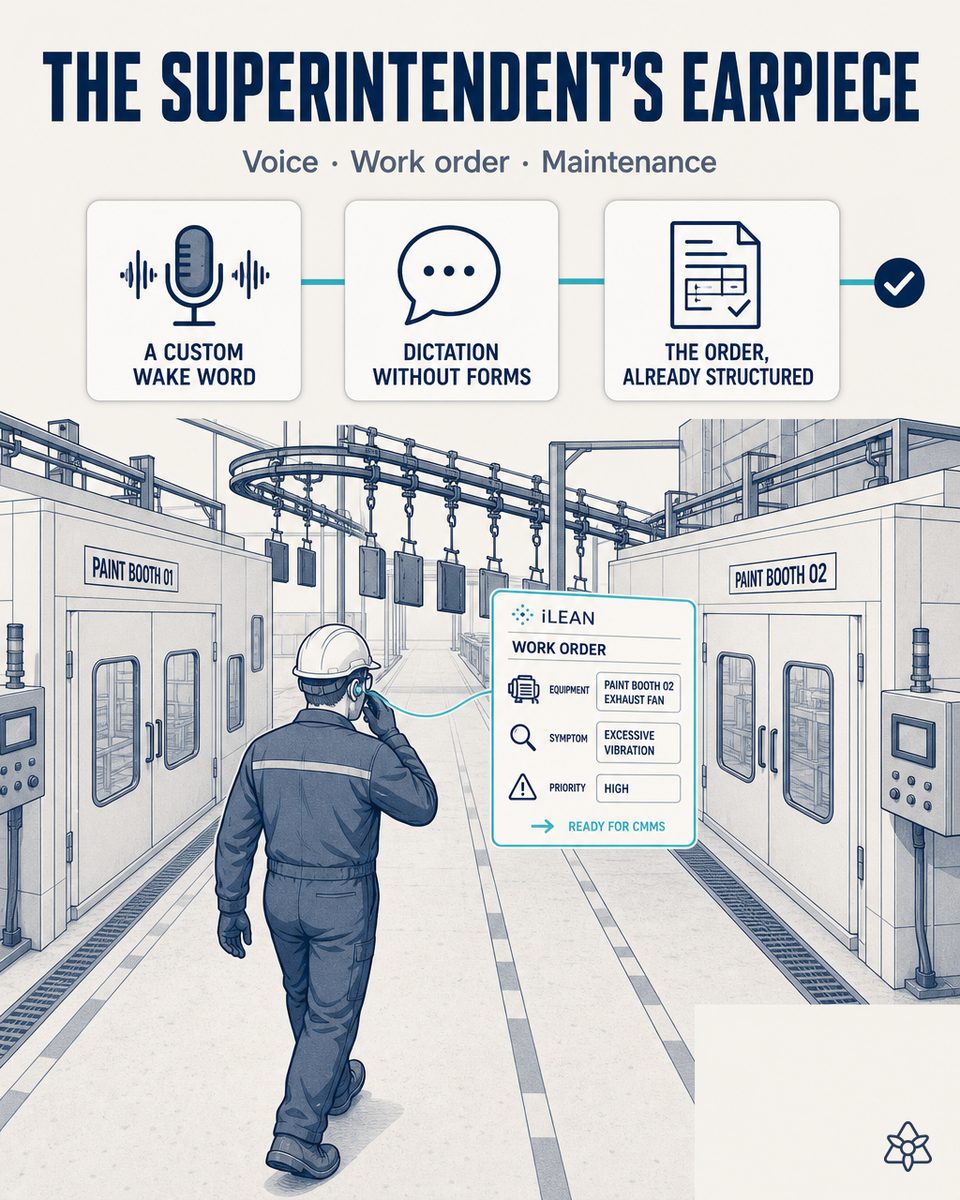
Operational knowledge dies at the end of the shift — and the CMMS never finds out.
On an EMS plant's metal chassis paint line, the maintenance superintendent is not sitting in front of a screen: they are walking — pre-treatment, booths, application robots, curing oven, inspection table, spare parts warehouse — hands busy, all day. They cannot type while walking between machines, and nobody asks them anything because they are out of the office. They are the person who first sees what no sensor reports:
- Nozzle 3 is losing flow — a behavior change they notice in the spray cloud long before it shows as a defect on the inspection table.
- The sacrificial filter has 220 hours against the recommended 200 — a consumable-life data point that today lives in their head or, with luck, in a notebook.
- Robot A2 has a squeal — the early signal of a mechanical problem that has not yet triggered any formal alarm.
All that critical information about the equipment's state and life dies at the end of the shift or degrades to whatever gets remembered into a notebook. And the structural consequence is worse: the preventive and predictive plans run by calendar, not by real observation, because the observations persist structured in no system.
Connect in voice mode with an earpiece — the superintendent dictates and the CMMS receives the structured order.
The earpiece is not a system recording the superintendent during the shift: it is a tool they activate voluntarily when they want to note something on their round of the paint line. They decide when to speak and what to dictate. Connect structures it, ties it to the plant's active context and creates the order in the CMMS with traceability.
The superintendent says "iLEAN, note this". They dictate the observation in their own words, without stopping walking. Connect structures it as a work order or incident tied to the active equipment, work order and shift, and creates it in the site's CMMS. Seconds later, the return arrives by voice on the earpiece or as a push to the leader's tablet.
How Connect operates in earpiece mode on a chassis paint line:
- A personalized wake-word — the superintendent opens the dictation with their own phrase ("iLEAN, note this") pronounced deliberately. Outside that phrase, the earpiece transcribes and sends nothing.
- Free dictation, no forms — they speak in their own words, just as they would tell their technician: "nozzle 3 in booth 1 is losing flow, have it checked before the color change".
- The LLM structures the order — Connect turns the dictation into a work order or incident with clear fields, automatically tied to the equipment, work order and shift active at that moment, without the superintendent reciting those data.
- Integration with the site's CMMS — the order is created directly in the system the plant already uses — SAP PM, FIIX or Infor EAM, among others — with full traceability of who dictated it, when and on which equipment.
- A return in seconds — the confirmation arrives by voice on the same earpiece or as a push to the leader's tablet: "order created, supplier confirmed, shall I tell you when it arrives?". The superintendent keeps walking, with the order already in the system.
Knowledge that dies at the end of the shift vs. work orders created in the instant
| Aspect | Knowledge dying at shift end | With Connect voice + CMMS |
|---|---|---|
| Operational knowledge captured | A residual fraction, whatever gets remembered into a notebook | Complete, structured and tied to equipment, order and shift |
| Work orders | Remembered at the end of the shift, if at all | Created in the CMMS at the instant of the observation |
| Consumable life (filters, nozzles) | Estimated from memory, changed late or too soon | Recorded by real hours and condition, machine by machine |
| MTBF / MTTR | Calculated on partial data | Calculated on real, rich data |
| Preventive / predictive plan | Triggered by calendar, blind to what is observed | Fed by the gemba's real observation |
| Shift handover | A rushed conversation and a notebook by the booth | The incoming shift inherits structured, dated orders |
Impact estimate for your plant — to be validated with your own numbers.
The block below is an estimate to be validated against your plant's actual data. We put it forward so the committee has an order of magnitude; we refine it during the assessment.
- EMS plant with a metal chassis paint line — pre-treatment, booths, robots, curing oven — and a maintenance superintendent walking most of the day, hands busy and with no practical keyboard access.
- Connect voice pilot on the paint line — without changing the superintendent's role, without adding administrative tasks.
- The main return is not a countable hour saving: it is that the CMMS finally reflects the equipment's real state — every order created in the instant, tied and traceable — instead of the fraction surviving the end of the shift.
- There is an expected operational return too: the early detection of degradations — the nozzle losing flow, the filter past its hours, the robot's squeal — before they become a stoppage or a finish defect. That improvement is an estimate to be validated with the plant's maintenance manager, not a generic figure invented here.
And the fair question from the plant director
"Doesn't this end up being a system recording everything my superintendent says?" — no. It is exactly the other way round: the earpiece listens to nothing until the superintendent activates it with their wake-word. There is no background recording, no continuous transcription, nobody listening to their conversation with a painter or the oven technician. The only thing entering the system is what they decide to dictate — because they want it recorded, not because someone above asked. And the second doubt, "what if the AI invents half a work order?": for anchored tasks like this — structuring a dictation against the active equipment, order and shift — the AI's reliability is very far from free generation's hallucination problem [1], and even so every order stays signed by whoever dictated it and reviewable before triggering any intervention.
[1] OpenAI paper "Why Language Models Hallucinate", 2025 — on the reliability of AI in anchored tasks.
What people ask about the superintendent's earpiece on a chassis paint line
Does the earpiece listen the whole shift or only when the superintendent activates it?
Only when they activate it. The system uses a personalized wake-word ("iLEAN, note this") the superintendent pronounces deliberately to open the dictation, and closes it with a pause or a closing phrase ("done"). Outside that interval, the earpiece transcribes and sends nothing: there is no continuous listening or background recording, and a normal conversation with a painter or the oven technician does not become a record. It is a tool the superintendent decides to use to take notes during their round — they choose when to dictate and what — not a system monitoring what they do or say during the shift.
Does it work with the noise of the paint booths and extraction equipment?
It is designed exactly for that environment. The earpiece is compatible with the paint area's PPE, the proximity microphone sits next to the mouth and the voice model is trained on real plant conditions: booth extraction running, the pre-treatment tunnel, compressors and the curing oven in the background. When the transcription's confidence drops below a threshold, Connect does not invent the missing word: it asks for a short voice confirmation ("did you say nozzle 3 or nozzle 13?") before structuring anything. Better one extra question than a work order created on the wrong machine.
How does the work order reach the plant's CMMS?
The LLM turns the free dictation into a work order or incident with clear fields — equipment, symptom, priority, spare part if any — automatically tied to the equipment, work order and shift active at that moment. Connect connects to the CMMS the site already uses — SAP PM, FIIX or Infor EAM, among others — and creates the order there, with full traceability: who dictated it, when, on which equipment and in what production context. The return arrives in seconds by voice on the same earpiece or as a push to the leader's tablet: "order created, supplier confirmed, shall I tell you when it arrives?".
Who can later consult what the superintendent dictated?
What is dictated does not remain as free audio anyone can listen to out of context: it is structured as a work order or incident tied to equipment, order and shift, and access is defined by the plant according to its org chart and procedures — maintenance sees its equipment's orders, quality the product incidents and the TPM manager sees the aggregate feeding the indicators. It is the record of the observation the superintendent themselves decided to note, with their name because they sign the data, just as they would sign an order opened by hand in the office. It is not a record of their activity during the shift.
How does this enable predictive maintenance and a TPM plan?
Predictive maintenance needs rich, continuous data on the equipment's real state, and today the plan runs by calendar precisely because the observations — the sacrificial filter with 220 hours against the recommended 200, the nozzle losing flow, the robot's squeal — persist structured nowhere. With each dictation tied to its equipment, the history enriches shift by shift: MTBF and MTTR are calculated on real data, not partial, and interventions can be prioritized by observed condition on top of date. It is the enabling piece of any ambitious TPM plan; the improvement's magnitude is an estimate to be validated at each plant.
More cases from this series
- A customer audit evidence pack — the OEM scorecard in continuous greenEvery change generates a dossier with photos, log and signatures. Agents organizes it by standard (ISO…
- Early human verification — two taps and the ERP stays cleanNothing iLEAN captures enters the ERP without a human signature on the tablet. Two taps, seconds, the…
- The curing oven now talks — without touching the original SCADAAn external camera reads the tunnel oven’s SCADA panel without touching the machine. A per-batch thermal…
- OEM customer spec change — zero rework from reading lateiLEAN silently copied on the mailbox. When the OEM changes a paint spec, the notice reaches the…
- From the laboratory’s Excel to the ERP at second zeroiLEAN reads the laboratory’s Excel as soon as it is saved, validates and feeds the ERP. Fewer quality…
- Paint receiving into the ERP — no typing, with shielded traceabilityA photo of the delivery note, the CoA and the GS1 labels. One tap and all into the ERP. Truck from 45 to…
Give your superintendent an earpiece — ask us for the demo. Tell us your case and we will show you how their knowledge enters the CMMS without them stopping walking.
We work on your plant's real data, not ours. Assessment with no commitment.
Ask us for the demo ‹ See all 12 chassis paint cases See electronics