Paperless paint batch startup — the batch is born digital at second zero
In an EMS plant painting server chassis, the operator starts every batch with a printed work order and a handwritten shift report. Those two documents define the batch and the conditions under which it was painted — if the OEM returns a chassis with a defect three weeks later, they are the only source of traceability. Today they disappear into the office until the end of the shift. With iLEAN Connect, two photos with the phone are enough for the batch to exist in the central system at second zero, without changing the routine.
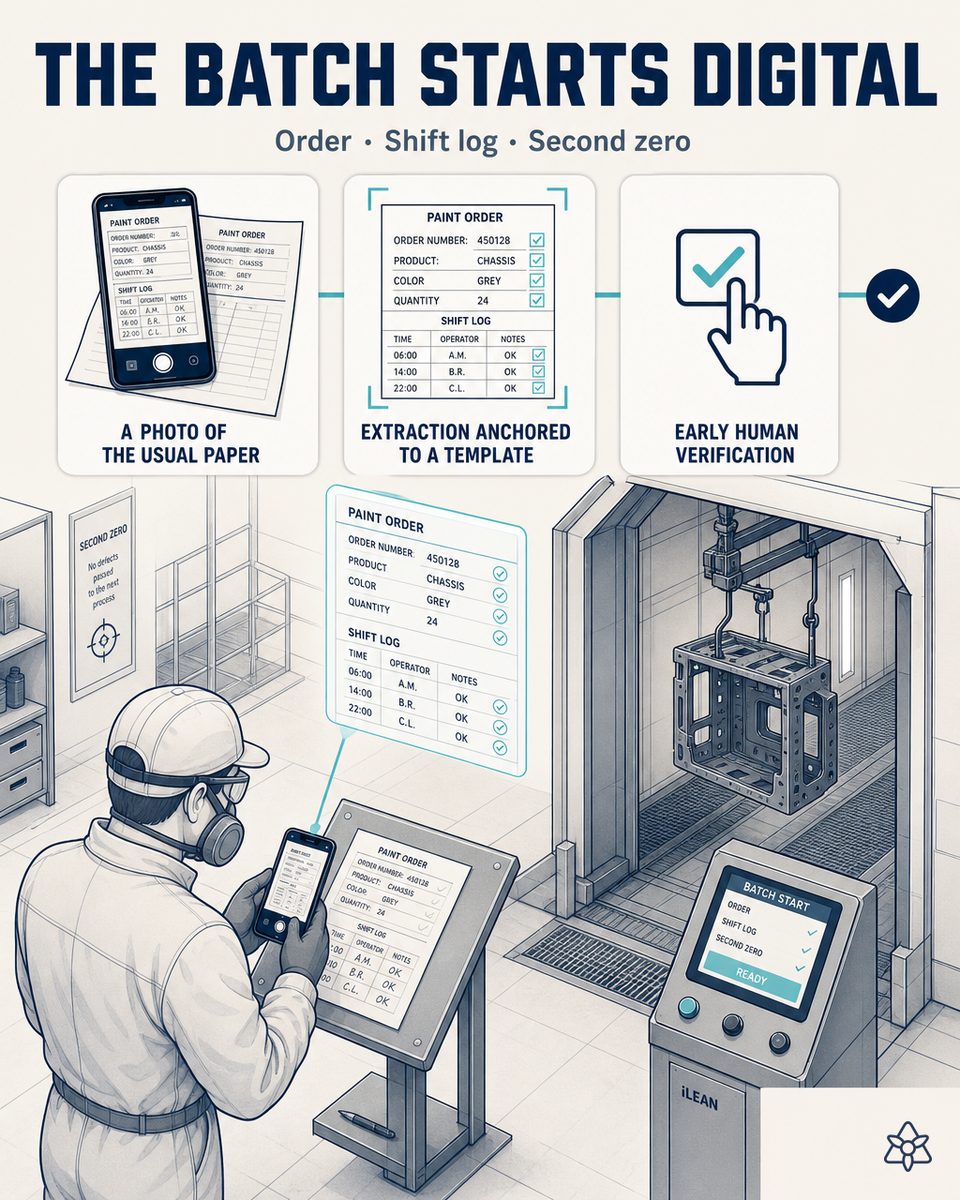
The paint work order and the shift report define the batch — and live in the office until the end of the shift.
In an EMS plant painting server and desktop chassis in a CTO flow, the paint work order is printed from the ERP and the shift report is filled in by hand — by internal rule. Between the two documents everything that matters about the batch is defined: color, destination customer, quantity, target thickness, booth pressure, paint viscosity, gun distance and angle. The painting process is stable; the gap lies in what happens to those papers afterwards:
- Late digitization — the typical latency until transcription is six to ten hours. In that stretch, what the booth's paper says and what the system says do not match, and the batch does not exist for anyone off the line.
- Paper lost, illegible or badly transcribed — the traceability of the painting conditions depends on the paper arriving, being read right and being typed right. Each of those three steps fails often enough that nobody trusts the data when they really need it.
- OEM claims without a picture of the startup — when the OEM detects a defect three weeks later — a crater on the cover, poor edge coverage, color cross-contamination — the investigation starts by hunting that shift's work order and report in a filing cabinet. If the paper does not appear or cannot be understood, the batch's conditions are guesswork.
Nobody sees that gap until the OEM's return or a customer audit arrives, and the batch's history has to be reconstructed from papers rescued from the office. That is where a routine record turns into days of investigation.
Connect in photo mode — two photos at batch startup, and the batch exists in the central system at second zero.
The batch startup needs no new MES and no forcing the operator to type at the booth. It needs the information that already exists on paper — the printed paint work order and the handwritten shift report — to reach the central system at second zero, without anyone transcribing it at the end of the shift. That is what Connect in photo-on-paper mode is for.
The operator photographs the work order and the shift report with the phone or the tablet at batch startup and gets on with their work. Connect extracts the fields with an anchored LLM, normalizes them against the ERP's master and leaves them in iLEAN's central memory, queryable at second zero by batch, by customer, by work order and by shift.
How Connect photo operates at batch startup in an EMS chassis paint plant:
- A photo over the usual paper — the operator starts the batch exactly the same and takes two photos: the printed ERP work order and the handwritten shift report. Zero routine change, zero fields to type.
- Extraction anchored to the real templates — an LLM anchored to the house's formats extracts the structured fields: work order number, color, customer, quantity, target thickness, paint type, pressure, viscosity, distance, angle and observation. It generates no free data; it recontextualizes what is already written, handwriting included, and normalizes it against the ERP's master.
- Early human verification — the confirmation arrives on the tablet at the booth, in the moment: two taps and the fields are validated. If a data point arrives doubtful — an ambiguous digit, a crossing-out — it is held until a person confirms it. The doubtful data point never crosses alone.
- Central memory at second zero — the validated fields stay in iLEAN's central memory, timestamp-sealed and linked to each document's original image: the startup's picture exists from the batch's minute one.
- A batch queryable by whoever needs it — quality searches by batch or by customer when an OEM claim arrives, planning queries by work order, and the line leader reviews their shift without transcribing anything: the query is web-based and instant.
Paper batch startup vs. startup digitized with Connect
| Aspect | Classic paper startup | With iLEAN Connect photo |
|---|---|---|
| Work order and shift report → central system latency | 6-10 h until the end-of-shift transcription | Second zero — two photos and the central system |
| Traceability on an OEM return | Reactive: find and read a weeks-old paper | An instant web query by batch, customer, order or shift |
| Line leader's time transcribing | Hours every week | Zero — extraction is automatic and validated in two taps |
| Risk of lost, illegible or badly transcribed paper | Present on every batch | Original image linked + fields normalized against the ERP |
| A customer audit | Rebuilding the history from filing cabinets | The batch's history available on the spot, with timestamps |
| The booth operator's routine | The same paper — and someone else's late transcription | The same paper — plus two photos with the phone |
Impact estimate for your plant — to be validated with your own numbers.
The block below is an estimate to be validated against your plant's actual data. We put it forward so the committee has an order of magnitude; we refine it during the assessment.
- EMS plant painting server and desktop chassis in a CTO flow, several batches per shift, a printed ERP paint work order and a handwritten shift report by internal rule.
- Connect photo pilot on batch startup — the phone or tablet already in the plant, without changing the operator's routine or touching the painting process. First value expected within a few weeks.
- Indicative payback between 4 and 9 months, depending on the plant's batch volume per day. Estimate to be validated.
- Direct recovery of the hours the line leader spends every week transcribing work orders and shift reports — they return to the line. Estimate to be validated with your data.
- The additional lever is the drastic reduction of OEM claim investigation time — from days hunting papers to a query in seconds — and a stronger position at every customer audit: the batch's history exists, complete and timestamped, from second zero. Estimate to be validated.
And the fair question from the operations director
"What if the model misreads the operator's handwriting or confuses the shift report's viscosity?" — hallucination is a problem of free generation, not of anchored tasks. In tasks where the AI limits itself to recontextualizing a specific data point from one medium to another (reading the printed work order and the handwritten shift report, and extracting their fields against the house's real template), the best models brought the error below 1.5% [1]. And even then, nothing critical is decided alone: the doubtful data point is held and a person confirms it on the tablet at the booth before the record counts in the central system. The three safety rings are there precisely for this.
[1] OpenAI paper "Why Language Models Hallucinate", 2025 — on the reliability of AI in anchored tasks.
What people ask about batch startup in an EMS chassis paint plant
Why does batch startup traceability fail today in an EMS chassis paint plant?
Because the two documents defining the batch are born outside the system: the printed ERP paint work order and the handwritten shift report the internal rule requires. Between the two they fix color, destination customer, quantity, target thickness, booth pressure, paint viscosity, gun distance and angle. Today they disappear into the office until the end of the shift and take six or ten hours to be transcribed — if they are not lost, they arrive illegible or get typed wrong. When the OEM returns a chassis with a defect three weeks later, the traceability of the conditions it was painted under depends on finding and reading those papers.
Does the booth operator's routine have to change?
No. The operator starts the batch exactly the same: the same printed ERP work order and the same handwritten shift report the house's internal rule requires. The only thing added is two photos with the phone or the line tablet, and they get on with their batch. Human verification arrives early and at the booth: two taps on the tablet to confirm the extracted fields, without typing anything. Since the change to the standard is minimal — two photos and two taps — the habit holds after the pilot without auditing discipline.
How does an anchored LLM read the handwritten shift report?
The model does no generic OCR and generates no free text: it is anchored to the plant's real templates — the ERP's paint work order format and the house's shift report format. It knows what data to expect in each box (work order number, color, customer, quantity, target thickness, paint type, pressure, viscosity, gun distance and angle, observation) and extracts the handwritten note against that template, normalizing each field against the ERP's master. It generates no data; it recontextualizes what is already written. And if a field arrives doubtful — an ambiguous digit, a crossing-out — it is held until a person confirms it on the tablet: the doubtful data point never crosses alone into the central system.
Does it work with several colors and several OEM customers in the same shift?
Yes — it is the normal day of an EMS plant with a CTO flow: server chassis for one OEM in one color, desktop chassis for another OEM in another. Each photo stays linked to its work order number, and the model extracts the color and the destination customer against the ERP's master: it does not mix batches or drag data from the previous one. If the shift report's work order number does not match the order's, the system holds it and a person resolves it. That is precisely what cuts the risk of a color cross-contamination documented late: each batch has its own record, with its conditions, from second zero.
How is the batch queried when the OEM returns a chassis with a defect?
Through the iLEAN central system's web, searching by batch, by customer, by work order or by shift. In seconds the conditions it was painted under appear — target thickness, booth pressure, viscosity, gun distance and angle, the operator's observations — next to the original image of the work order and the report, each field with its timestamp. The investigation of a crater on the cover, poor edge coverage or a cross-contamination suspicion stops depending on finding a three-week-old paper: the quality team answers the OEM with data, and at a customer audit the batch's history is available on the spot.
More cases from this series
- A customer audit evidence pack — the OEM scorecard in continuous greenEvery change generates a dossier with photos, log and signatures. Agents organizes it by standard (ISO…
- Early human verification — two taps and the ERP stays cleanNothing iLEAN captures enters the ERP without a human signature on the tablet. Two taps, seconds, the…
- The curing oven now talks — without touching the original SCADAAn external camera reads the tunnel oven’s SCADA panel without touching the machine. A per-batch thermal…
- OEM customer spec change — zero rework from reading lateiLEAN silently copied on the mailbox. When the OEM changes a paint spec, the notice reaches the…
- From the laboratory’s Excel to the ERP at second zeroiLEAN reads the laboratory’s Excel as soon as it is saved, validates and feeds the ERP. Fewer quality…
- Paint receiving into the ERP — no typing, with shielded traceabilityA photo of the delivery note, the CoA and the GS1 labels. One tap and all into the ERP. Truck from 45 to…
Start with your first paint line — the paperless batch startup, with your real work order and shift report.
We work on your plant's real data, not ours. A pilot with a real paint work order, with no commitment.
See how we would apply it in your plant — demo with a real paint work order ‹ See all 12 chassis paint cases See electronics