Cleaning between products stops being signed for and starts being proven
Product changeover is the most dangerous moment in a chemical blending plant: between an aromatic solvent and a food-grade blend, the only thing separating a good batch from a contaminated one is that the purge and the cleaning were done properly. Today that gets signed. With Edge it also gets verified: cameras at the critical points compare against the reference state and the line does not start until they all pass and the manager signs on that evidence.
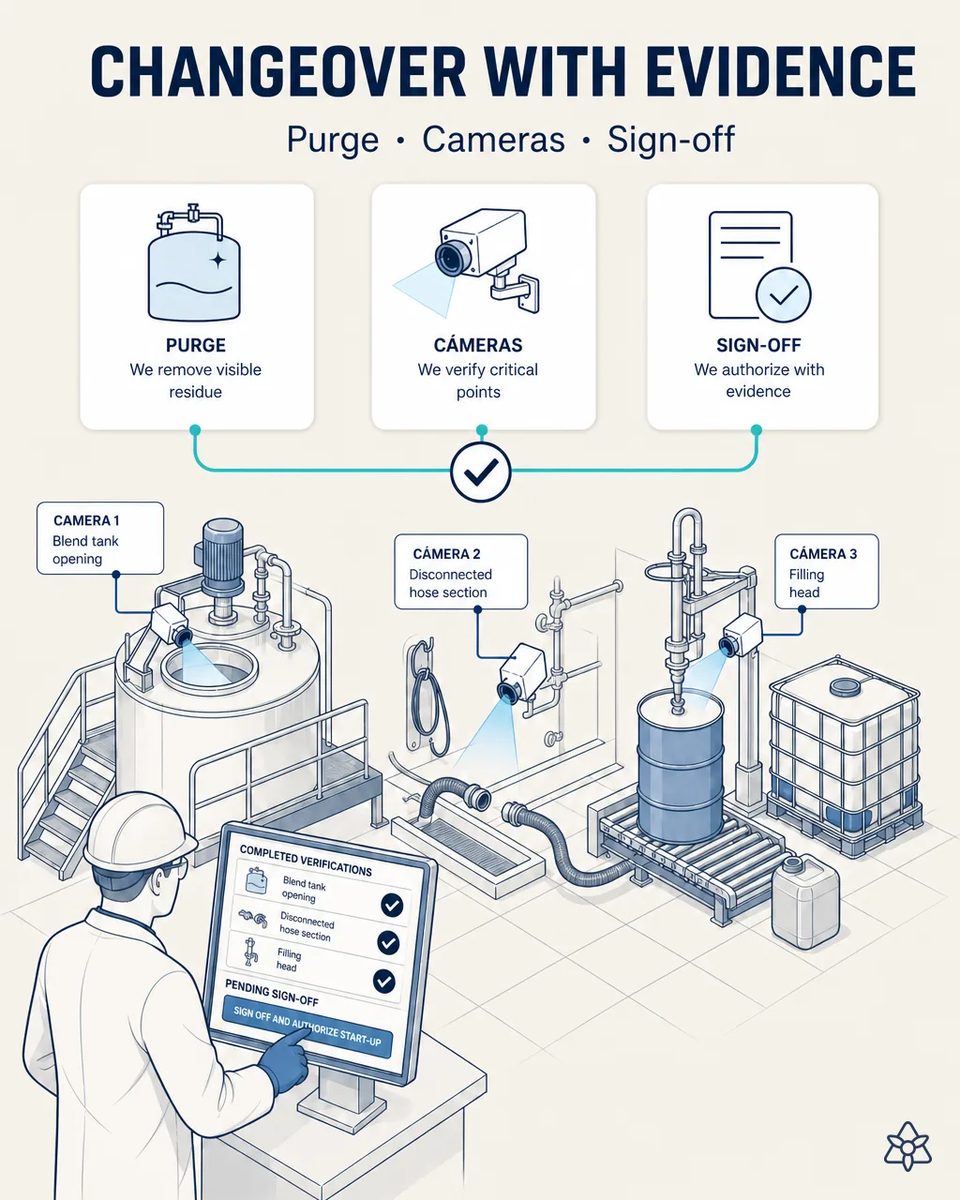
Cross-contamination is caught in the lab or at the customer, never at start-up.
Cross-contamination is not caught at start-up. It is caught when the lab analyzes the first container, or when the customer finds it. By then there is a whole batch to rework or destroy, and if the contaminated product was going to a food-grade or high-purity customer, there is also a conversation that can cost the account. The current barrier is one person's declaration: somebody signs that the line is clean, with no objective evidence for each point. It is a real barrier, but a fragile one, and it leaves no trace an auditor can use. And there is a silent cost the plant pays every day: every changeover ties the line up for one to three hours, and that time stretches out of caution. Without objective evidence, everyone would rather over-rinse.
- Between an aromatic solvent and a food-grade or high-purity blend, the only thing separating a good batch from a contaminated one is that the purge and the cleaning were done properly. Today that is signed, not shown.
- The signature is one person's declaration with no objective evidence per point. It is a real barrier, but a fragile one, and it leaves nothing an auditor or a customer can use.
- When the contamination is found — by the lab on the first container, or by the customer — there is a whole batch to rework or destroy and, if the customer was food-grade, an account at risk.
- And a silent cost every day: each changeover ties the line up for one to three hours, and the time stretches out of caution. Without evidence, everyone prefers to over-rinse.
Multi-point Edge with JIDOKA AI and SMED AI — the line protects itself, then speeds up.
multi-point Edge + JIDOKA AI + SMED AI.
Each camera compares its critical point with the purged-and-clean reference for the incoming product family: visible residue, remaining color, deposits, the right filling head. While any camera withholds approval, the line does not start. When all pass, the quality manager signs on evidence instead of on judgment, and the over-rinsing that caution was adding becomes unnecessary. The result is a changeover that is both safer and shorter, which is the combination nobody believed possible while it was signed by hand.
- Edge cameras at the critical changeover points: blend tank opening, pump, hose section, filling head and drip tray.
- Each camera compares the current state with its "purged and clean" reference: visible residue, remaining color, deposits, and the correct head for the new product family.
- While any camera withholds approval, the line does not start. That is JIDOKA AI: the line protects itself.
- When they all pass, the quality manager signs on the evidence rather than on judgment, and that evidence files itself.
- With cleaning demonstrated, over-rinsing becomes unnecessary: SMED AI cuts changeover time without lowering the guarantee.
Today's changeover versus the proven changeover
| Aspect | Today | With iLEAN Edge |
|---|---|---|
| What the signature rests on | A declaration | Photographic evidence of every point |
| Contaminated batch | Found in the lab or at the customer | Start-up blocked before the first liter |
| Blend tank, pump, hose, head, tray | Checked by eye, if at all | Compared with the reference state |
| Wrong head for the product family | Discovered on the first drum | Detected before start-up |
| Changeover time | 1-3 h, inflated by caution | Tightened, with a guarantee |
| Trace for the auditor | A ticked checklist | Evidence filed by changeover |
from a signature without evidence to a signature on photographic evidence of every point · from contaminated batches caught in the lab or at the customer to start-ups blocked before the first liter · from changeover times inflated by caution to times tightened with a guarantee.
Impact estimate — to be validated with your numbers.
The block below is an estimate to be validated against your plant's actual data. We put it forward so the committee has an order of magnitude; we refine it during the assessment.
- Estimated payback 6-12 months, depending on changeovers per day.
- At least 30 % less changeover time, because over-rinsing stops being the only way to feel safe. On a line that changes product twice a day, that is capacity.
- Virtual elimination of batches reworked or destroyed for cross-contamination, which is the cost that never fits in a spreadsheet until it happens.
- And the first liter of the new product is no longer born under suspicion: it is released against evidence, not against a signature.
at least 30% less changeover time and the virtual elimination of batches reworked for cross-contamination. Estimated payback of 6 to 12 months depending on changeovers per day. *Estimate to validate.*
And the fair question from the production manager
“What if a camera blocks the line for no reason?” — that is the right objection, because the changeover sits on the shift's critical path. Comparing a critical point with the reference state for that specific product family is an anchored task where the best models drop below 1.5% error [1], and in case of doubt the system does not block silently: it escalates the image to the quality manager, who signs on what they see. It stops on a verifiable residue, not on model uncertainty.
[1] OpenAI paper "Why Language Models Hallucinate", 2025 — on the reliability of AI in anchored tasks.
What people ask about proving the changeover
Which points are checked?
Blend tank opening, pump, a section of hose, the filling head and the drip tray, as a starting set. The points are defined at commissioning with your process and quality team, and they can differ by product family. A food-grade family usually adds a point or two; a solvent-to-solvent change may need fewer.
Does it detect residue you cannot see?
No, and it should not be framed that way. It detects what a camera can see: visible residue, remaining color, deposits, the wrong head. Analytical rinse checks stay where they are; what changes is that the visible failures stop reaching them.
Doesn't it make the changeover longer?
The check takes seconds per point. What lengthens the changeover today is the margin added for lack of evidence, and that margin is exactly what SMED AI removes once cleaning is proven.
Can it be skipped in a hurry?
An exception can be defined with a quality manager's signature, and it is recorded as such. What cannot happen is a start-up with no trace of who decided to skip the check.
Does the evidence go anywhere?
Yes: every changeover files its photos, measurements and signature by batch and by period, which is what the evidence pack of case 11 draws on when an auditor asks.
More cases from this series
- No liter should lose its identity between the tank and the customerFour coordinated verification rings from receiving to the branch: not one mis-identified drum, not one…
- The audit stops being a two-week projectEvery changeover, release and shipment leaves its evidence; Agents sorts it by standard and the auditor…
- From a paper blending order to a live batch at second zeroTwo photos, at start-up and at close, and the blending order and packaging log are in the central system…
- The shift supervisor's knowledge stops dying at handoverThe supervisor talks while walking with gloves on and hands busy: iLEAN listens, structures, stores and…
- The laboratory releases batches without anyone retyping into the ERPiLEAN reads the lab sheet as it is saved, drafts the certificate of analysis and, once validated, posts…
- Modern machines still worked by hand: closing the last connectionThe ERP publishes product, batch and pictograms to the labeler, and the scale returns the real weight of…
Time your next three changeovers and tell us how long each one took.
We work on your plant's real data, not ours. Assessment with no commitment.
Request estimated ROI within 48h ‹ See all cases of chemical distribution See chemicals