No data enters the system unseen by a human: the gate is at the transfer
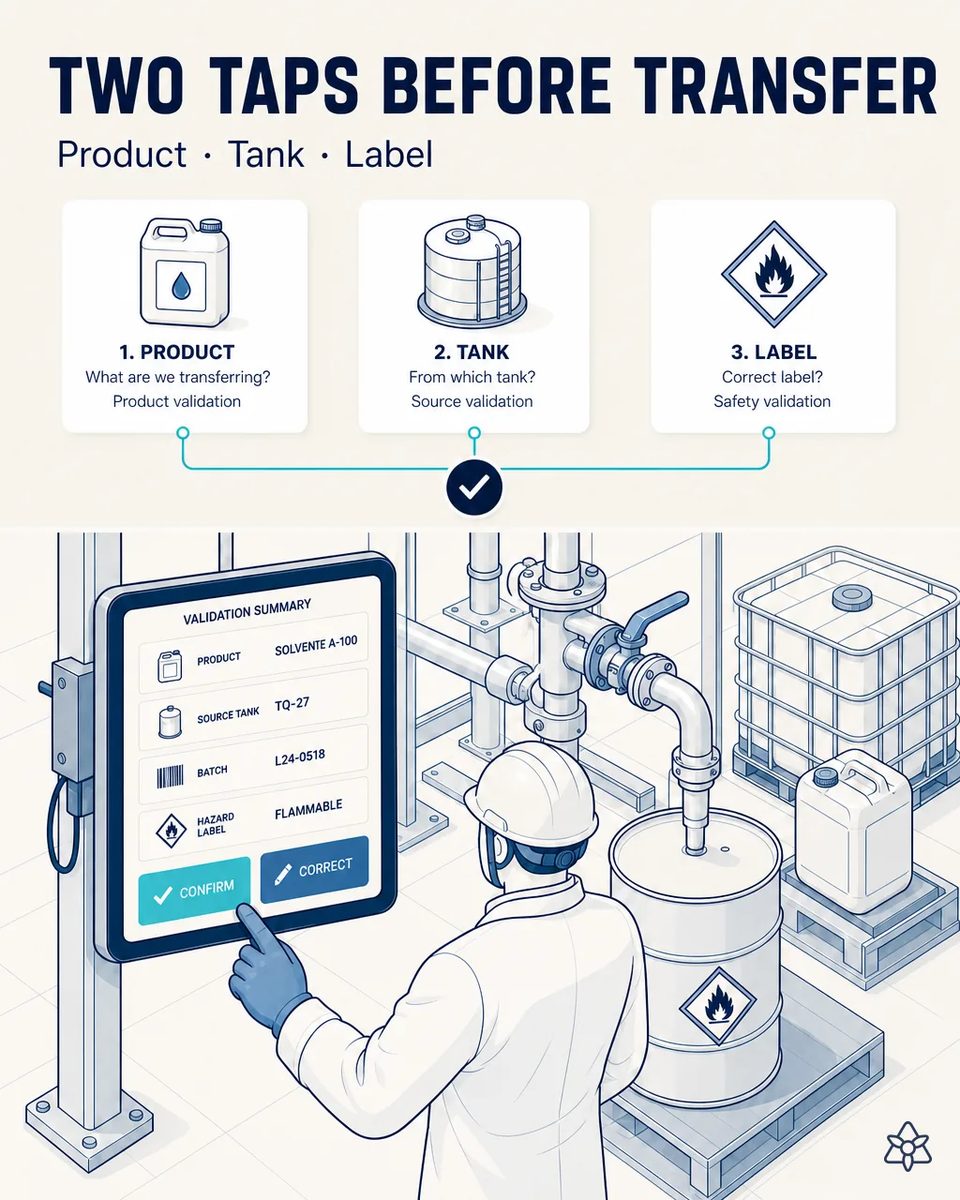
Before the transfer valve opens, four things have to match: the product on the order, the tank being pumped from, the container waiting below and the hazard label it will carry. iLEAN has already captured all four and shows them together on the line tablet. The operator confirms with two taps or corrects. And only then does the data cross into the central system. Seconds of cost, and a human gate exactly where an error becomes expensive.
The most expensive errors in the plant are born at the transfer.
The transfer is where the plant's most expensive errors concentrate: pumping from the wrong tank, packaging a product with the previous label, assigning the previous run's batch number. Any of the three produces a drum that goes out into the world saying something untrue. Today's barriers are the operator's judgment and a paper signature nobody retrieves. There is no automatic cross-check between what the order says and what is physically on the line. And there is a practical constraint that kills most controls people try: any verification that costs the operator a minute per container is abandoned within two weeks. It has to cost seconds or it will not be used.
- Pumping from the wrong tank. Packaging a product under the previous run's label. Assigning the batch number of the blend before. Any of the three produces a drum that goes out into the world saying something untrue, with a GHS hazard label to match.
- Today's barriers are the operator's judgment and a paper signature nobody retrieves. There is no automatic cross-check between what the blending order says and what is physically hooked up on the line.
- Every control the plant has tried so far cost the operator a minute per container, and every one was abandoned within two weeks. It has to cost seconds or it will not be used.
- When a customer returns a mis-identified container, the conversation is not about that drum: it is about every drum from that shift, and about the credentials that let you sell to them.
Connect with early human verification — two taps at the transfer line.
Connect in "early human verification" mode.
The system does not ask the operator to fill in a form. It shows the cross-check already done — product, source tank, batch, pack size, the hazard label that applies — and asks for two taps or a correction. It is the piece that guarantees nothing enters master data without a human gesture, and it is what makes the other eleven approvable. Two taps is the price; a drum that says the truth is what it buys.
- Industrial tablet mounted at the transfer line.
- iLEAN presents the cross-check already done — product, source tank, batch, destination pack size and the hazard label that applies — not a blank form.
- The operator confirms with two taps, or corrects the failing field with one.
- Only then does the data cross into the central system, signed with who and when.
- That signature later feeds the auditable evidence pack (case 11).
This is what separates an IRIS system from an autonomous agent: the AI proposes and captures, the human validates, and nothing enters master data without that gesture.
Today's transfer versus the validated transfer
| Aspect | Today | With iLEAN |
|---|---|---|
| Cross-check order vs. line | The operator's memory | Presented on the tablet, already done |
| Cost per container | A signature nobody retrieves | Two taps |
| Wrong source tank | Found at the customer | Blocked before the valve opens |
| Hazard label | Whatever was printed | Checked against the product's SDS |
| Who enters the data | Whoever types it later | Whoever stood at the line, by name |
| Evidence for an audit | A filing cabinet | Searchable by transfer |
from data entering unreviewed to zero data without a human signature · from an unrecoverable paper signature to traceability searchable by transfer · from controls that would cost minutes to a control that costs seconds.
Impact estimate — to be validated with your numbers.
The block below is an estimate to be validated against your plant's actual data. We put it forward so the committee has an order of magnitude; we refine it during the assessment.
- Estimated payback 4-9 months, heavily dependent on what a single mis-identified container returned by a customer cost you last time.
- The dominant value here is not productivity, it is risk: the product identity error is blocked at the point where it is born, not discovered at a branch.
- An audit evidence base at no extra effort: every transfer carries who confirmed it, when, and what they corrected.
- And a control that costs seconds is a control that is still in use in month six, unlike the ones that cost a minute per container.
reduced risk of product identity error at the point where it is born, plus an audit evidence base at no extra effort. Estimated payback of 4 to 9 months, heavily dependent on the cost of a single mis-identified container returned by a customer. *Estimate to validate.*
And the fair question from the production manager
“If a person confirms in the end, what is the AI saving?” — the work is not in deciding, it is in assembling. Today nobody cross-checks order, tank, container and label with a drum waiting under the nozzle. Assembling that summary from the order, the tank map and the product's SDS is an anchored task, where the best models drop below 1.5% error [1], and the operator only confirms or corrects. Every correction is stored with its author: the system learns where its extraction fails, and the plant keeps a trail.
[1] OpenAI paper "Why Language Models Hallucinate", 2025 — on the reliability of AI in anchored tasks.
What people ask about the transfer gate
How long does it take the operator per container?
Seconds. The summary is already assembled when they walk up to the tablet, and it is resolved with two taps or one correction. Anything slower would be abandoned, and the design starts from that constraint. The tablet is mounted where the operator already stands, at the transfer line, not in an office.
Can the system open the valve or start the pump on its own?
No, and it is not configurable: it is the architecture. The AI proposes and captures, the human validates, and the physical action stays with the operator.
What if the operator corrects the AI?
The correction is stored with its author and its timestamp. It works both as an audit trail and as feedback, so the extraction improves at that specific point.
Does it check the hazard label against the safety data sheet?
Yes. The pictograms and precautionary statements that apply to the product on the order are part of the cross-check, so a label from the previous product cannot be confirmed by mistake. If the SDS record changes, the next transfer of that product shows the new label set.
Is this mandatory before the other cases?
In practice, yes: it is the gate through which what Connect captures crosses into the management systems. Without it, nobody signs off on AI writing into the ERP.
More cases from this series
- No liter should lose its identity between the tank and the customerFour coordinated verification rings from receiving to the branch: not one mis-identified drum, not one…
- The audit stops being a two-week projectEvery changeover, release and shipment leaves its evidence; Agents sorts it by standard and the auditor…
- From a paper blending order to a live batch at second zeroTwo photos, at start-up and at close, and the blending order and packaging log are in the central system…
- The shift supervisor's knowledge stops dying at handoverThe supervisor talks while walking with gloves on and hands busy: iLEAN listens, structures, stores and…
- The laboratory releases batches without anyone retyping into the ERPiLEAN reads the lab sheet as it is saved, drafts the certificate of analysis and, once validated, posts…
- Modern machines still worked by hand: closing the last connectionThe ERP publishes product, batch and pictograms to the labeler, and the scale returns the real weight of…
Tell us what your last mis-identified container cost you.
We work on your plant's real data, not ours. Assessment with no commitment.
Request estimated ROI within 48h ‹ See all cases of chemical distribution See chemicals