Receiving is where a liter gets its identity: do not let it be mistyped
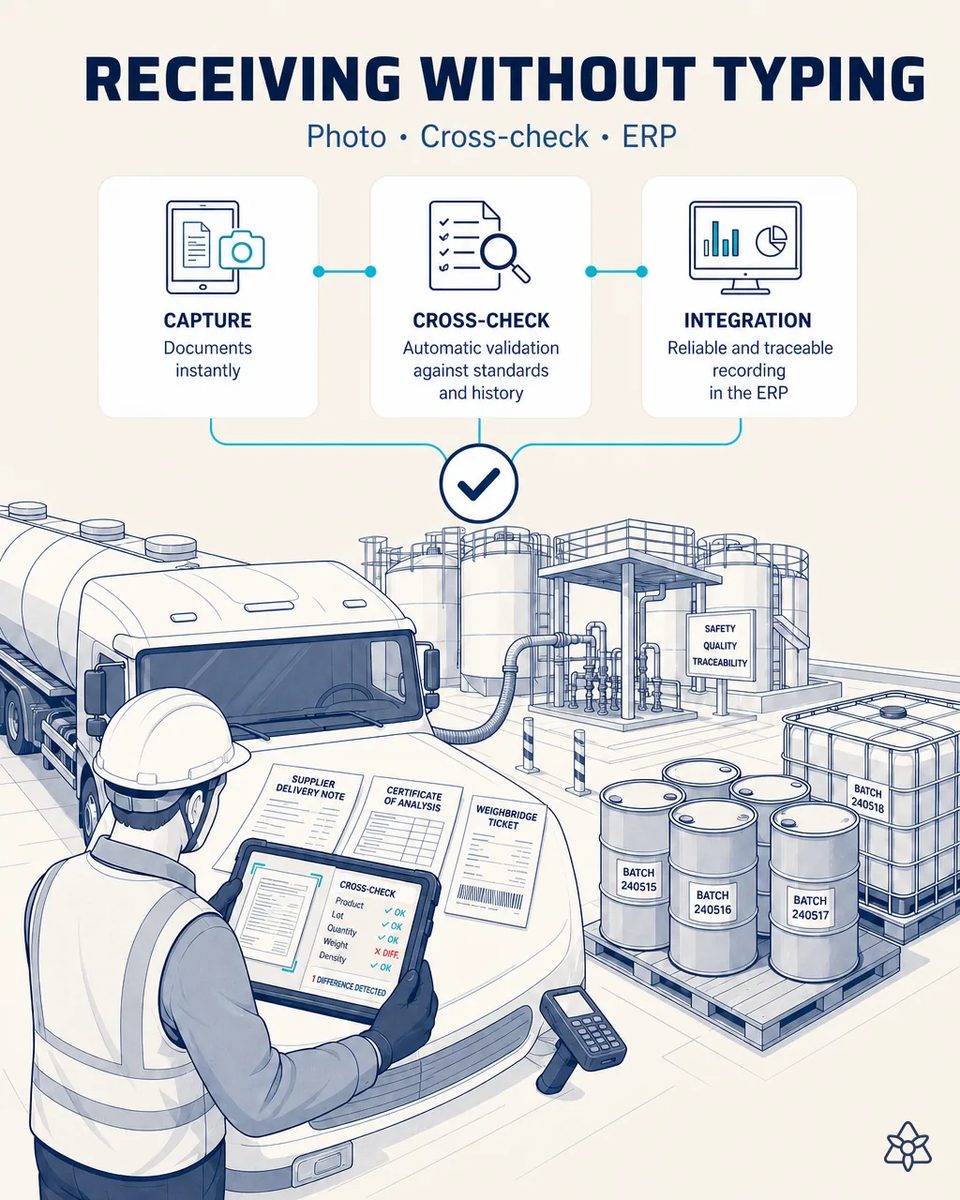
The tanker arrives and the receiving supervisor has in front of them the supplier delivery note, the certificate of analysis of the source batch, the hazardous goods transport paperwork and the weighbridge ticket. They have to sign all of it and then key it into the ERP line by line: either the carrier waits and charges demurrage, or it gets typed in a hurry and the batch is badly traced. With Connect they take the photos, validate with one tap and it all goes in.
Traceability is founded on typing with a truck waiting.
Receiving is the moment a liter enters the house and is given its identity. If that identity is keyed in wrong or keyed in late, everything downstream — the tank it is unloaded into, the blend it goes into, the drum that leaves for the branch — inherits the error. And the window to do it properly is exactly the one the carrier is willing to wait. Thirty or forty-five minutes of a stopped truck is billed as demurrage, so the pressure is always to type fast. A traceability error is not paid for on the day it happens: it is paid for weeks later, when a customer complains and someone has to say with certainty which tank and which source batch their product came from. If that chain is broken, the conversation happens without data.
- The tanker is on the weighbridge and the receiving supervisor holds the supplier delivery note, the COA of the source batch, the hazmat transport paperwork and the weighbridge ticket. All of it has to be checked, signed and keyed into the ERP line by line.
- The window to do it properly is exactly the one the carrier is willing to wait. Thirty to forty-five minutes of stopped tanker is billed as demurrage, so the pressure is always to type fast.
- A source batch keyed in wrong is inherited by everything downstream: the tank it is unloaded into, the blend it goes into, the drum that leaves for the branch. The error costs nothing today and everything in six weeks.
- When a customer complains, someone has to say with certainty which tank and which supplier batch their product came from. If the receipt was typed in a hurry, that conversation happens without data.
Connect in photo mode with ERP posting — delivery note, COA, paperwork and labels, no supplier changes.
Connect in "photo of the analog" mode with ERP posting.
The COA stops being a sheet stapled to the delivery note and becomes linked to the supplier batch from the first second. That is what turns the tank-to-customer genealogy into a query instead of a reconstruction, and it is done in the time the driver takes to connect the hose. The supervisor's job stops being typing and becomes checking a cross-check somebody else already did.
- Photos of the supplier delivery note, the source certificate of analysis, the transport paperwork and the weighbridge ticket.
- Photos of the batch labels on drums and totes: the AI reads plain text, barcodes and two-dimensional codes.
- Automatic cross-check against the purchase order and the weighbridge figure, with differences flagged on screen.
- The receiving supervisor validates with one tap, or corrects what does not match.
- Posting to the ERP receiving module: quantities, source batch, linked certificate and real net weight.
Today's receiving versus captured receiving
| Aspect | Today | With iLEAN Connect |
|---|---|---|
| Tanker at the bay | 30-45 minutes | Minutes |
| Source batch and COA | Keyed in, filed apart | Photographed, cross-checked, linked |
| Weighbridge figure vs. delivery note | Nobody checks with a truck waiting | Difference flagged on screen |
| Drum and IBC labels | Read by eye | Text, barcode and 2D code read |
| Carrier demurrage | On every freight invoice | Eliminated |
| Receiving-module licenses | Three or four | One: the supervisor who validates |
from 30-45 minutes of a waiting truck to minutes · from keyed-in source batches to photographed and cross-checked batches · from claims with no reconstructable traceability to origin documented from the first second.
Impact estimate — to be validated with your numbers.
The block below is an estimate to be validated against your plant's actual data. We put it forward so the committee has an order of magnitude; we refine it during the assessment.
- Estimated payback 3-8 months, depending on receipts per day.
- 💰 CFO angle: the receiving module typically carries three or four named users per site; with Connect only the supervisor validates. Typical ratio 4 down to 1, 50-70 % less, recurring.
- Carrier demurrage avoided, billed by the hour, out of the same result and visible on the next freight invoice.
- And an origin documented from the first second, which is what holds up when a customer asks which tank and which supplier batch their drum came from.
recurring saving on receiving-module licenses — typical ratio of 4 licenses down to 1 per receiving site, between 50% and 70% less — plus carrier demurrage avoided, billed by the hour out of the same result. Estimated payback of 3 to 8 months depending on receipts per day. *Estimate to validate.*
And the fair question from the production manager
“Does it read every supplier's delivery note and every carrier's paperwork?” — yes, and without asking any of them to change a thing: the model extracts the document structure without a per-supplier template, and labels are read by barcode or 2D code where present and by text recognition where not. It is an anchored task, where the best models drop below 1.5% error [1], and the receiving supervisor validates on the tablet before anything posts to the ERP, with differences against the purchase order and the weighbridge already highlighted.
[1] OpenAI paper "Why Language Models Hallucinate", 2025 — on the reliability of AI in anchored tasks.
What people ask about receiving without typing
Is the source COA linked to the batch?
Yes, and it is the part that adds most: its values end up on the supplier batch in the ERP, so proving where a drum's product came from stops being a search through a filing cabinet.
What if the weighbridge figure and the delivery note disagree?
The difference is shown on the tablet before the supervisor validates. Today that cross-check is not done because the truck is waiting; with the figures side by side it takes one look.
Does it handle drums and IBCs as well as bulk?
Yes. Photos of the labels on drums and totes are read for text, barcodes and 2D codes, and cross-checked against the purchase order line by line. A drum whose label does not match the delivery note is flagged on the tablet before it comes off the truck.
Do we need handheld scanners?
Not necessarily: a phone or an industrial tablet is enough. If the receiving bay already has scanners that work well, they integrate just the same. What changes is not the device, it is that nobody types what the photo already contains.
Can we start with receiving alone?
Yes, and it is a good starting point: the result is visible on the first tanker, and it does not depend on any of the other cases being deployed. It is also the case that pays back most visibly, because demurrage is an invoice line everyone can see.
More cases from this series
- No liter should lose its identity between the tank and the customerFour coordinated verification rings from receiving to the branch: not one mis-identified drum, not one…
- The audit stops being a two-week projectEvery changeover, release and shipment leaves its evidence; Agents sorts it by standard and the auditor…
- From a paper blending order to a live batch at second zeroTwo photos, at start-up and at close, and the blending order and packaging log are in the central system…
- The shift supervisor's knowledge stops dying at handoverThe supervisor talks while walking with gloves on and hands busy: iLEAN listens, structures, stores and…
- The laboratory releases batches without anyone retyping into the ERPiLEAN reads the lab sheet as it is saved, drafts the certificate of analysis and, once validated, posts…
- Modern machines still worked by hand: closing the last connectionThe ERP publishes product, batch and pictograms to the labeler, and the scale returns the real weight of…
Tell us how long a tanker waits at your bay today, from weighbridge to ERP receipt.
We work on your plant's real data, not ours. Assessment with no commitment.
Request estimated ROI within 48h ‹ See all cases of chemical distribution See chemicals