The late tanker, resolved before the packaging line stops
A chemical distributor's operation is woven from external alerts: the carrier rescheduling the tanker, the supplier changing a specification, the customer pulling a tote forward. All three arrive through informal channels into different inboxes and get read too late. With Connect in chaotic-sources mode, iLEAN reads the message at second zero, cross-checks it against active orders and branch stock, and sends the planner the concrete action, not a notification.
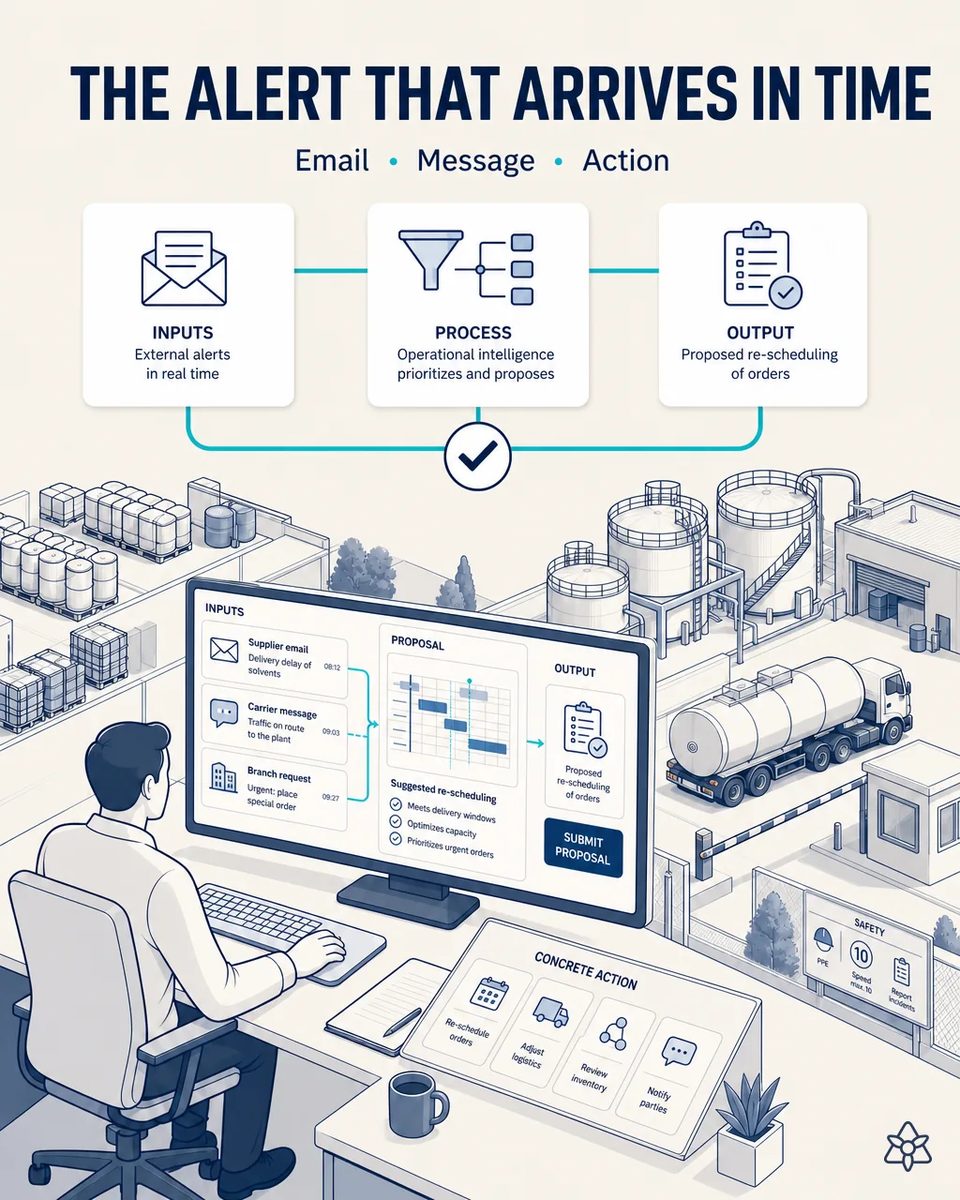
The information exists; it is not where the decision is made.
The critical information in this operation is not in the ERP: it is in emails and messages reaching specific people. The carrier says the tanker will come tomorrow. The supplier sends the certificate of a batch with a slightly different specification. A customer asks their branch salesperson to bring a delivery forward. Each of those messages changes the day's schedule, and none of them reaches the scheduler in time. By the time they are put together, the packaging line has already been planned without them: either the work is undone or the hit is taken, usually a stopped line waiting for product or an emergency inter-branch freight to plug a gap. The problem is not missing information. It is that the information exists and is not where the decision is made.
- The carrier writes at seven in the morning that the tanker of solvent will arrive tomorrow instead of today. The message lands on the buyer's phone, and the packaging line is planned at eight without it.
- The supplier sends the COA of a batch whose specification is slightly different from the last one. It sits in an inbox until quality opens it, after the blend has been formulated on the old numbers.
- A branch salesperson asks for a customer's IBC order to be pulled forward, by message, to the person they know best. Every one of those messages changes the day, and none reaches the scheduler in time.
- The hit is always the same: a stopped packaging line waiting for product, or an emergency inter-branch freight to plug the gap. Both are paid for because a message was read two hours late.
Connect in chaotic-sources mode — silently copied in, around the clock.
Connect in "chaotic sources" mode.
Reading the message sooner is only half of it. The value is in the cross-check: which blending orders depend on the late tanker, which tank still has enough to cover them, which branch has the IBCs in stock. That is what comes back, to the role that has to act, with the decision still in human hands. The carrier does not need to know anything changed: they keep writing to the same address they always used.
- A dedicated mailbox and messaging number, silently copied in around the clock.
- As soon as a message lands, the model extracts intent (delay, specification change, order pull-forward, non-conformity) and entities: supplier, material, batch, quantity, committed date.
- Cross-check against live management data: active blending orders, committed orders and branch stock.
- Return to the relevant role with the proposed action: which order to bring forward, which tank to draw from while the tanker is late, which branch can cover the order from its own stock.
The decision is always human; what changes is that it arrives with the proposal made and with room to act on it.
Today's alert versus the cross-checked alert
| Aspect | Today, in an inbox | With iLEAN Connect |
|---|---|---|
| When the delay is read | When the recipient opens the phone | Second zero |
| What the planner receives | A forwarded message | The action: which order, which tank, which branch |
| Re-planning | After the line has stopped | Before it stops |
| Spec change on a supplier COA | Found after formulating | Flagged against the active blend |
| Branch pull-forward | Whoever was asked remembers | Cross-checked with branch stock |
| The record of alerts | Scattered across inboxes | One searchable history |
from 2-4 hours of human latency to seconds · from re-planning after the problem to re-planning before it · from alerts scattered across inboxes to a single searchable record.
Impact estimate — to be validated with your numbers.
The block below is an estimate to be validated against your plant's actual data. We put it forward so the committee has an order of magnitude; we refine it during the assessment.
- Estimated payback 3-7 months, depending on how often a critical alert lands.
- Packaging line stoppages for lack of product avoided: the late tanker becomes a tank swap or an order resequence instead of an idle crew.
- Emergency inter-branch freight not paid, because the branch that can cover the order from stock is identified before the truck is booked.
- Human latency from 2-4 hours to seconds, with a single searchable record of what each carrier and supplier announced and when.
packaging line stoppages avoided for lack of product and emergency inter-branch freight not paid. Estimated payback of 3 to 7 months depending on the frequency of critical alerts. *Estimate to validate.*
And the fair question from the production manager
“Are you going to read my team's email?” — no. iLEAN sits in copy on a dedicated operations mailbox and a company messaging number, so it only sees what carriers, suppliers and branches send to those channels. Classifying the intent of a message — delay, spec change, pull-forward, non-conformity — is an anchored task where the best models drop below 1.5% error [1], and the proposed action is executed by the planner, never by the system.
[1] OpenAI paper "Why Language Models Hallucinate", 2025 — on the reliability of AI in anchored tasks.
What people ask about reading supplier and carrier alerts
Does it tell a delayed tanker from a routine delivery confirmation?
Yes, and that is the whole point: a delay that affects an active blending order goes to the top of the planner's list, while a confirmation that changes nothing interrupts nobody. The same goes for a COA whose values sit inside the spec: it is filed against the batch and nobody is disturbed.
Does it really know which tank to draw from?
When it is cross-checked with the management system, yes. It proposes the tank with product of the same specification and enough volume to cover the order, and the planner confirms or picks another.
What if the carrier writes in another language or sends a voice note?
Intent extraction does not depend on the language of the message, and voice notes are transcribed first. Cross-border carriers are the normal case in this sector, not the exception.
Does it replace the purchase order or the shipping notice in the ERP?
No. The formal document stays where it is. This case covers what arrives by hand, outside the ERP, which is exactly what breaks the day and what no system reads.
Who receives the action?
The role that must act: planning for a delayed tanker, quality for a changed COA, branch logistics for a pull-forward. Not the inbox the message happened to land in. And the record of who was told what, and when, stays searchable when the branch asks why the order was moved.
More cases from this series
- No liter should lose its identity between the tank and the customerFour coordinated verification rings from receiving to the branch: not one mis-identified drum, not one…
- The audit stops being a two-week projectEvery changeover, release and shipment leaves its evidence; Agents sorts it by standard and the auditor…
- From a paper blending order to a live batch at second zeroTwo photos, at start-up and at close, and the blending order and packaging log are in the central system…
- The shift supervisor's knowledge stops dying at handoverThe supervisor talks while walking with gloves on and hands busy: iLEAN listens, structures, stores and…
- The laboratory releases batches without anyone retyping into the ERPiLEAN reads the lab sheet as it is saved, drafts the certificate of analysis and, once validated, posts…
- Modern machines still worked by hand: closing the last connectionThe ERP publishes product, batch and pictograms to the labeler, and the scale returns the real weight of…
Tell us how many times a month a late-read message stopped a line or cost you an emergency freight.
We work on your plant's real data, not ours. Assessment with no commitment.
Request estimated ROI within 48h ‹ See all cases of chemical distribution See chemicals