From the shared folder to the ERP, no re-typing
The quality lead fills in a spreadsheet for every batch with pH, density, active-ingredient concentration and bioassay results. That sheet lives in a shared folder the ERP never sees.
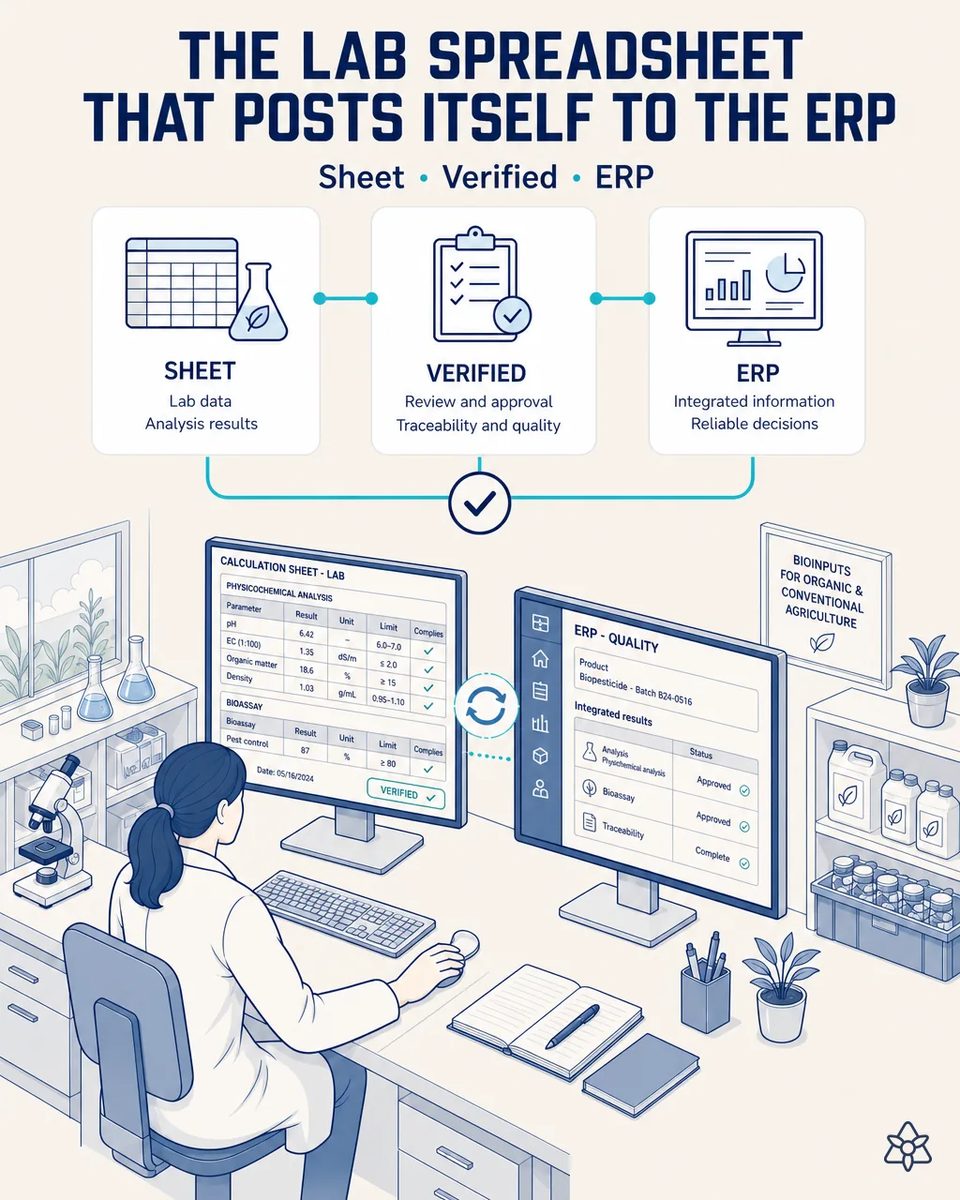
The batch is released on a spreadsheet the ERP never sees.
The quality lead fills in a spreadsheet for every batch with pH, density, active-ingredient concentration and bioassay results. That sheet lives in a shared folder the ERP never sees. The official ERP receives that data weeks late, hand-transcribed by someone who spends time every month copying and pasting — and sometimes gets it wrong.
- The quality lead fills in a spreadsheet for every batch: pH, density, active-ingredient concentration, CFU count, viability and the result of the efficacy bioassay.
- That sheet lives in a shared folder. It is the real source of truth for whether a biopesticide or a biostimulant can be released, and the one quality trusts most, because it is where the analyst actually works.
- The official ERP receives the same data weeks late, transcribed by hand by someone who spends hours every month copying and pasting — and sometimes gets a decimal wrong. On a CFU count, a misplaced exponent is the difference between a compliant batch and a useless one.
- And because the ERP charges per active user, several lab staff hold a license only to type data in, which is the most expensive way to keep the same record in two places at once, and neither of them is fully reliable.
Connect in listen-inward mode — the sheet is read on save, not retyped.
iLEAN Connect in 'listen inward' mode reads the file when it's saved, parses each cell with a grounded LLM, validates it on screen with the lead, and posts it to the ERP via API.
The lab keeps working in the spreadsheet it trusts. iLEAN reads the file the moment it is saved, checks each cell against the expected range, shows it to the quality lead for validation and posts it to the ERP. Only one person needs a license to do that, and nobody has to learn a new screen.
The lab sheet in a shared folder versus the lab sheet posted to the ERP
| Aspect | Today | With iLEAN Connect |
|---|---|---|
| Delay between sheet and ERP | Weeks | Minutes after saving |
| Bioassay and CFU results in the ERP | Typed by hand, sometimes wrong | Parsed cell by cell and validated |
| Out-of-range value | Noticed when someone looks | Flagged before posting |
| Users logging in just to type | Several licenses | Only the validating lead |
| Monthly copy-and-paste | Hours of a qualified analyst | None |
| The lab's working tool | The spreadsheet | The same spreadsheet |
Today the ERP charges per active user: if several lab staff log in just to enter data, that's several licenses. With Connect, only the validating lead needs to log in — a typical 50 to 80% reduction in quality-module licenses. Estimated payback 4 to 9 months.
Impact estimate — to be validated against your actual ERP invoice.
The block below is an estimate to be validated against your plant's actual data. We put it forward so the committee has an order of magnitude; we refine it during the assessment.
- Estimated payback 4-9 months.
- A typical 50-80% reduction in quality/lab-module ERP licenses, because only the lead who validates needs to log in.
- Release data reaching the ERP in minutes instead of weeks, which is what lets planning ship a batch as soon as the bioassay clears, instead of holding it until the ERP catches up.
- And the transcription errors that surface at the worst moment — an inspection, a field complaint, a registration renewal — stop being produced, because nobody transcribes.
Estimated payback 4-9 months · typical 50-80% reduction in quality/lab-module ERP licenses.
And the fair question from the production manager
“And if it reads a CFU value in the wrong column?” — parsing a spreadsheet whose structure the lab uses every day is an anchored task where the best models drop below 1.5% error [1]. On top of that, every value is checked against its physical and specification range, and the quality lead validates the screen before anything is posted. A value outside its range is never posted silently: it waits for a decision.
[1] OpenAI paper "Why Language Models Hallucinate", 2025 — on the reliability of AI in anchored tasks.
What people ask about posting the lab spreadsheet to the ERP
Do we have to change the lab's spreadsheet template?
No. The model learns the sheet as it is, including merged cells and the bioassay block. If the template changes later, it is relearned, not reprogrammed. Analysts keep their formulas, colors and habits.
Does it handle CFU counts written in scientific notation?
Yes. Counts written as powers of ten are read and normalized to the unit the ERP expects, and anything that looks implausible for that strain or product is flagged before it reaches the quality lead.
How many licenses can actually be cut?
A typical 50 to 80% in the quality or lab module, depending on how many people log in today only to enter data. It is checked against your real invoice before anything is promised, user by user.
Does it replace a LIMS if we plan to buy one?
No. It solves the gap between the spreadsheet and the ERP now; if a LIMS arrives later, the same connector reads from it instead, and the ERP side does not change.
Is the file read automatically or on request?
Automatically when it is saved in the agreed folder. Nothing is posted until the quality lead validates the summary, and every validation is logged with name and time.
More cases from this series
- Zero typing error on the final labelNo manual typing: the coder receives batch, expiry and registration number straight from the active work…
- Same reactor, now it talksAn external camera reads the reaction curve of a 15-20 year old reactor without touching it, for…
- Humans in command, in two tapsNothing iLEAN captures enters a bioinput manufacturer's ERP without a human validating it first.
- The batch exists in the system from second zeroHow a bioinput manufacturer digitizes the work order with a phone photo, without changing the operator's…
- Talk to the AI without stopping to walkAn earpiece and iLEAN voice capture the plant lead's operational knowledge while he walks, without…
- The truck no longer waits on the ERPPhoto the delivery note and batch labels: biological raw-material receiving traced in minutes, with…
Tell us how many people log into your ERP only to type lab results in biosolutions.
We work on your plant's real data, not ours. Assessment with no commitment.
Request estimated ROI within 48h ‹ See all cases of agricultural biosolutions See chemicals