Same reactor, now it talks
The synthesis reactor or formulation tank is 15 to 20 years old, with a proprietary panel that isn't networked. Replacing it means months of downtime and a huge investment.
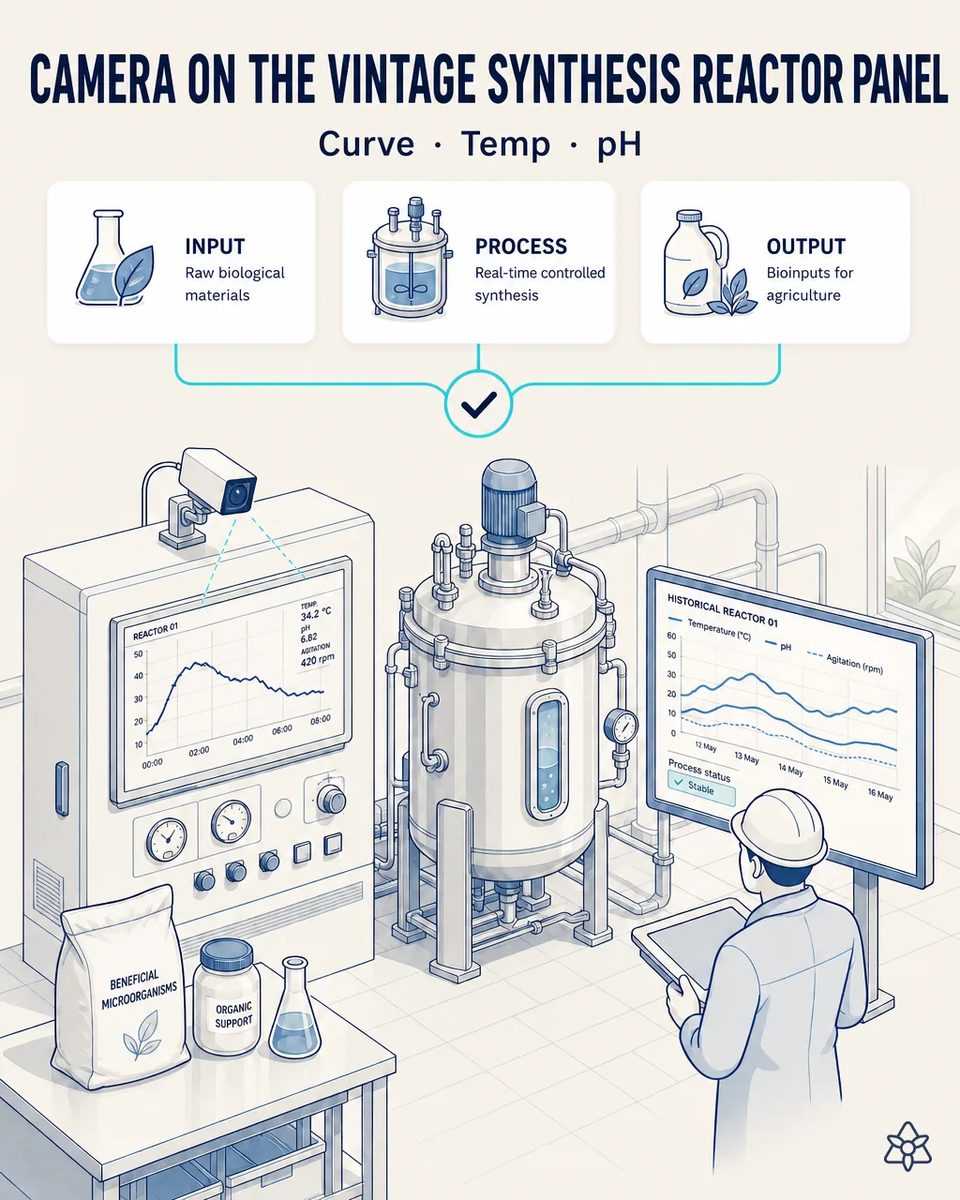
The curve that explains a batch's efficacy scrolls off the screen.
The synthesis reactor or formulation tank is 15 to 20 years old, with a proprietary panel that isn't networked. Replacing it means months of downtime and a huge investment. That screen shows the temperature curve, pH and agitation speed every few seconds: exactly what would correlate reaction conditions with the bioinput's final efficacy. Today nobody logs it.
- The fermenter or synthesis reactor is 15 to 20 years old and runs on a proprietary panel that was never networked. Replacing it means months of downtime and a very large investment.
- That screen shows temperature, pH and agitation speed every few seconds — exactly what determines whether a Bacillus or Trichoderma culture reaches the CFU count and viability the product promises.
- Nobody logs it. At best, an operator notes a reading per shift on a sheet, which says nothing about a temperature excursion in the middle of the night. A culture can recover its curve and still lose viability, and the sheet will show nothing unusual.
- So when a bioassay comes back low, the question everyone asks — what happened in the fermenter during that batch? — has no answer. The batch is reworked or discarded, and the same profile can repeat next month without anyone recognizing it.
Connect in photo mode on the panel — the fermenter keeps its original control.
iLEAN Connect places a fixed industrial camera pointed at the panel. OCR with a grounded LLM interprets each frame and builds the historical curve batch by batch, without touching the original control.
Nothing is wired into the fermenter and nothing is installed on its controller: a camera looks at the screen the operator already looks at. For a vessel whose control nobody dares to touch, that is the difference between a project that gets approved and one that never starts. And it costs a fraction of the replacement that keeps being postponed.
The fermenter panel unread versus the fermenter panel digitized
| Aspect | Today | With iLEAN Connect |
|---|---|---|
| Temperature, pH and agitation | Visible for seconds, then gone | A continuous curve per batch |
| Night-time excursion | Nobody sees it | Stored with its time and duration |
| Curve versus bioassay result | Zero correlation | Crossed batch by batch |
| Root cause of a low-CFU batch | Guesswork in a meeting | Minutes |
| The fermenter's controller | — | Untouched, no rewiring |
| Vessel replacement | On the investment plan | Deferrable indefinitely |
Before: zero correlation between the curve and bioassay results. After: when a batch is out of spec, root-cause analysis takes minutes. Estimated payback 5 to 10 months, and reactor replacement can be deferred indefinitely.
Impact estimate — to be checked against your fermentation records.
The block below is an estimate to be validated against your plant's actual data. We put it forward so the committee has an order of magnitude; we refine it during the assessment.
- Estimated payback 5-10 months.
- Batch-by-batch reaction curve traceability without replacing the fermenter, whose replacement can be deferred indefinitely.
- When a batch is out of spec, root-cause analysis goes from impossible to a matter of minutes, because the curve is there to be crossed with the bioassay.
- And, over time, the history shows which fermentation profile produces the best viability — knowledge that today lives only in the most experienced operator's head and leaves the plant with them.
Estimated payback 5-10 months · batch-by-batch reaction curve traceability without replacing the reactor.
And the fair question from the production manager
“Can I trust a camera reading a screen that old?” — the task is anchored: same panel, values always in the same position and physically bounded ranges, and there the best models drop below 1.5% error [1]. Any frame whose reading falls outside the possible range — a pH that cannot exist, a jump no culture produces — is discarded and flagged, not stored as data. The curve is built only from readings that make physical sense, and gaps are shown as gaps rather than filled in.
[1] OpenAI paper "Why Language Models Hallucinate", 2025 — on the reliability of AI in anchored tasks.
What people ask about reading an old fermenter panel
Does the fermenter's supplier have to intervene?
No. Nothing is connected to the controller or its software, so there is no warranty or support conversation to have. The camera is mounted outside the cabinet, on a bracket, and can be removed without leaving a trace on the vessel.
Which variables does it read?
Whatever the panel shows: typically temperature, pH, agitation speed and, if the screen displays them, dissolved oxygen or elapsed time. The curve is rebuilt from each frame.
How is a curve tied to a specific batch?
By crossing it with the work order active on that vessel. Each batch ends up with its own full fermentation profile, from inoculation to harvest, which is what is later laid next to its CFU count and its bioassay.
What if the panel cycles through several screens in biosolutions?
The model recognizes which screen is showing and reads each one with its own layout, so a page change does not corrupt the series. Alarm pop-ups are also recognized and stored as events on the batch timeline.
Is it worth it for a formulation tank as well as a fermenter?
Yes, the pattern is identical. Most plants start with the fermenter because that is where viability is decided and where a lost batch costs the most, then extend it to the tanks where the culture is mixed with carriers and adjuvants.
More cases from this series
- Zero typing error on the final labelNo manual typing: the coder receives batch, expiry and registration number straight from the active work…
- Humans in command, in two tapsNothing iLEAN captures enters a bioinput manufacturer's ERP without a human validating it first.
- The batch exists in the system from second zeroHow a bioinput manufacturer digitizes the work order with a phone photo, without changing the operator's…
- From the shared folder to the ERP, no re-typingiLEAN detects the lab's analysis spreadsheet, validates it and posts it to the ERP, cutting…
- Talk to the AI without stopping to walkAn earpiece and iLEAN voice capture the plant lead's operational knowledge while he walks, without…
- The truck no longer waits on the ERPPhoto the delivery note and batch labels: biological raw-material receiving traced in minutes, with…
Tell us whether you can explain your last low-CFU batch today.
We work on your plant's real data, not ours. Assessment with no commitment.
Request estimated ROI within 48h ‹ See all cases of agricultural biosolutions See chemicals