Humans in command, in two taps
The main cultural barrier to digitizing isn't technology: it's the fear that an AI enters data on its own and contaminates the ERP that underpins organic certification traceability.
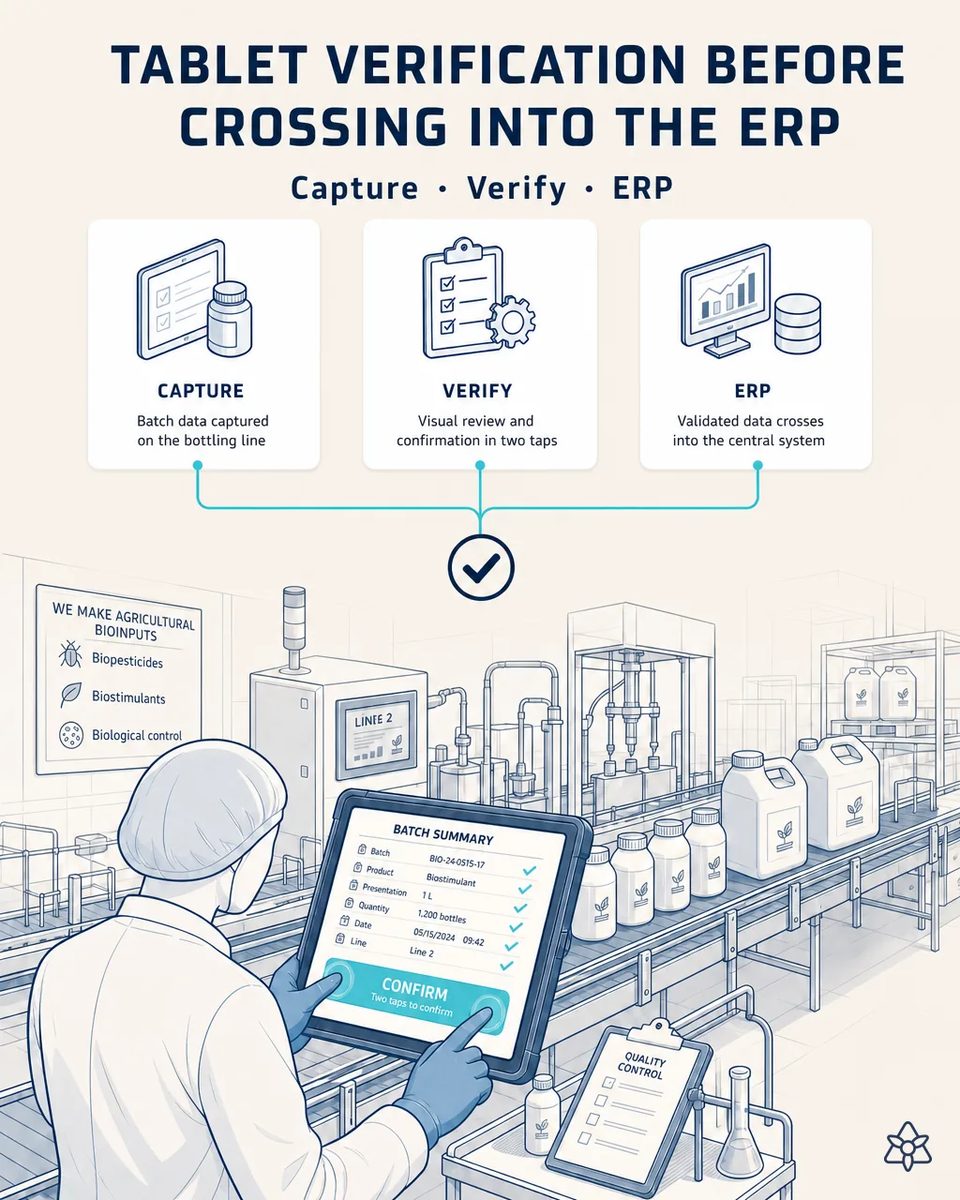
The real barrier is not technology: it is fear of a contaminated ERP.
The main cultural barrier to digitizing isn't technology: it's the fear that an AI enters data on its own and contaminates the ERP that underpins organic certification traceability. Nothing iLEAN captures — a photo, a voice note, a parsed email — enters the central system without a human seeing it first on a tablet at the line.
- In a bioinput plant the ERP is not just accounting: it is the traceability backbone the organic certification rests on, batch by batch.
- The main cultural barrier to digitizing is the fear that an AI enters a batch, a dose or an expiry on its own and contaminates that master.
- The result today is one of two bad outcomes: unvalidated data getting into the ERP, or data nobody captures out of distrust.
- Either way, the day the certifier asks who confirmed a batch record, the answer is not a name with evidence. For a plant whose premium depends on that certificate, it is the weakest point of the whole chain.
Early human verification — a two-second summary, two taps at the bottling line.
The tablet shows a 2-second visual summary. The operator confirms with two taps: check to send to the ERP, or correct before it goes in. No training, no change of habit.
This is the piece that makes the other eleven approvable. Nobody signs off on AI writing into the system that holds the organic certificate together; everybody signs off on AI that prepares the record and waits for a person to confirm it. The two taps are the price of that trust, and they are cheap.
Data entry today versus the two-tap confirmation gate
| Aspect | Today | With iLEAN |
|---|---|---|
| What reaches the ERP | Typed data, or nothing | Only what a person confirmed |
| Time per confirmation | Walk to a terminal and type | A 2-second summary, two taps |
| Who is recorded as confirming | Whoever typed it | The operator at the bottling line |
| A wrong value from the AI | Could slip into the master | Corrected before it enters |
| Training needed | ERP screens and codes | None |
| What the certifier sees | A record | A record with its confirmation trail |
Before: unvalidated data contaminating the ERP, or data nobody captured out of distrust. After: data captured and validated in seconds, a clean master. It's the piece without which the rest of the matrix doesn't get signed off.
An enabling piece — no payback of its own, and we say so.
The block below is an estimate to be validated against your plant's actual data. We put it forward so the committee has an order of magnitude; we refine it during the assessment.
- No standalone payback: it is the enabling piece for the whole matrix, and without it the other pieces do not get signed off.
- Before: unvalidated data contaminating the ERP, or data nobody captured. After: data captured and validated in seconds, and a clean master that quality is willing to defend in front of a certifier.
- Every confirmation is stored with who, when, on which line and what was corrected, which is the trail an organic certifier or a registration inspector asks for.
- And each correction teaches the system where its extraction fails at that specific line, so the share of corrections falls week after week.
Enabling piece for the whole matrix · without it, the other pieces don't get signed off.
And the fair question from the production manager
“If a person confirms everything anyway, what does the AI save?” — the effort is in assembling the record, not in judging it. Reading a photo, a voice note or an email into batch, quantity and expiry is an anchored task where the best models drop below 1.5% error [1]; the operator only checks a summary that arrives already built. The remaining 1.5% is exactly what the two taps are there to catch, by the person who has the container in front of them.
[1] OpenAI paper "Why Language Models Hallucinate", 2025 — on the reliability of AI in anchored tasks.
What people ask about the bottling-line confirmation gate
Can the gate be bypassed when the line is in a hurry?
No. It is part of the architecture, not a setting: nothing crosses into the ERP without a human confirmation, including on the busiest bottling day. Speed comes from the summary being short, not from skipping it.
What does the operator see on the tablet in biosolutions?
A visual summary of the record — batch, product, presentation, quantity, date and line — readable in about two seconds, with a confirm button and a correct option. Values the model is less sure of are highlighted so the eye goes to them first.
Which captures go through the gate?
All of them: work order photos, delivery notes, lab sheets, dictated incidents and parsed supplier messages. The gate is the same for every source, so operators learn one gesture and use it everywhere.
Is the confirmation trail useful for organic certification?
Yes. It shows who confirmed each batch record and when, which is the human accountability a certifier expects behind the traceability. Corrections are kept too, never overwritten.
Should it be deployed before the other cases?
In practice yes, or at the same time as the first one: it is what gives quality and management the confidence to let the rest write into the ERP. Without it, the other eleven cases stay in pilot.
More cases from this series
- Zero typing error on the final labelNo manual typing: the coder receives batch, expiry and registration number straight from the active work…
- Same reactor, now it talksAn external camera reads the reaction curve of a 15-20 year old reactor without touching it, for…
- The batch exists in the system from second zeroHow a bioinput manufacturer digitizes the work order with a phone photo, without changing the operator's…
- From the shared folder to the ERP, no re-typingiLEAN detects the lab's analysis spreadsheet, validates it and posts it to the ERP, cutting…
- Talk to the AI without stopping to walkAn earpiece and iLEAN voice capture the plant lead's operational knowledge while he walks, without…
- The truck no longer waits on the ERPPhoto the delivery note and batch labels: biological raw-material receiving traced in minutes, with…
Tell us what would have to be true for your team to let AI near the ERP.
We work on your plant's real data, not ours. Assessment with no commitment.
Request estimated ROI within 48h ‹ See all cases of agricultural biosolutions See chemicals