The truck no longer waits on the ERP
The truck arrives with a microbial strain, a plant extract or a chemical input. Every batch needs its lot and expiry recorded precisely, because an expired biological raw material loses potency and compromises the final batch.
At the dock, speed wins and the expiry date pays for it.
The truck arrives with a microbial strain, a plant extract or a chemical input. Every batch needs its lot and expiry recorded precisely, because an expired biological raw material loses potency and compromises the final batch. Today the receiving lead either types every line into the ERP — while the truck waits, racking up demurrage — or moves fast and risks a poorly traced batch.
- The truck arrives with a microbial strain, a plant extract or a chemical input. Each container needs its lot and expiry recorded precisely, and a single delivery can carry several lots of the same strain.
- An expired biological raw material loses potency: if it enters a fermenter or a formulation tank unnoticed, it compromises the whole final batch.
- Today the receiving lead either types every line into the ERP while the truck waits and demurrage runs, or moves fast and risks a poorly traced lot that nobody will be able to follow later.
- And for cold-chain materials, every minute the pallet sits at the dock waiting for the ERP is a minute out of refrigerated storage, and that loss of viability is not visible on the label.
Connect in photo mode — delivery note and container labels, read in seconds.
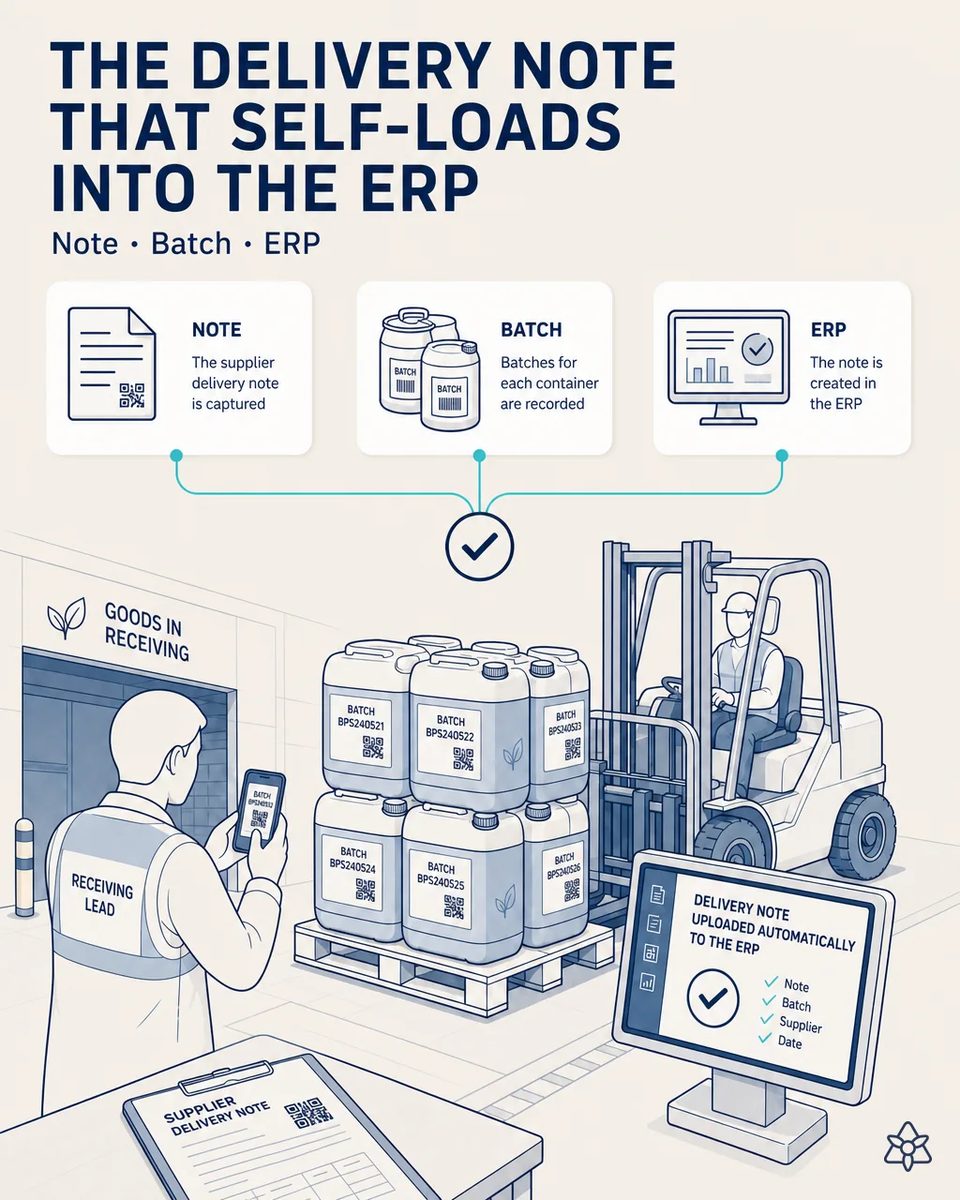
With iLEAN Connect, they photograph the delivery note and the drum labels. Vision AI reads the note's layout and the barcode or QR on each label, extracting lot, quantity and expiry in seconds.
The receiving lead photographs the delivery note and the labels; vision reads the note's layout and each barcode or QR. What used to be the slowest step at the dock becomes one validation tap, and each strain lot enters the ERP with its expiry attached, ready to be checked again when it is called for dosing.
Receiving typed by hand versus receiving by photo
| Aspect | Today | With iLEAN Connect |
|---|---|---|
| Time per receiving | 30-45 minutes | 5 minutes |
| Lot and expiry per container | Typed line by line | Read from the label's code |
| Strain close to expiry | Found at dosing | Flagged at the dock |
| Cold-chain pallet at the dock | Waits for the typing | Moved to refrigerated storage sooner |
| Receiving-module licenses in biosolutions | Several | One |
| Demurrage while the truck waits | Accumulates | Cut short |
With one validation tap, everything enters the ERP: receiving drops from 30-45 minutes to 5. The receiving module goes from several licenses to one. Typical 50 to 70% reduction, estimated payback 3 to 8 months.
Impact estimate — to be validated against what the dock costs you.
The block below is an estimate to be validated against your plant's actual data. We put it forward so the committee has an order of magnitude; we refine it during the assessment.
- Estimated payback 3-8 months.
- Receiving drops from 30-45 minutes to 5, with lot, quantity and expiry for each container already in the ERP and checked against the purchase order.
- A typical 50-70% reduction in receiving/warehouse-module ERP licenses: the module goes from several users to one.
- And no expired or poorly traced biological raw material reaches a fermenter unnoticed, which protects every batch downstream and every grower who applies it.
Estimated payback 3-8 months · typical 50-70% reduction in receiving/warehouse-module ERP licenses.
And the fair question from the production manager
“What if it reads the wrong expiry on a damp label?” — reading a delivery note layout and a barcode or QR on a label is an anchored task, where the best models drop below 1.5% error [1]. The code is cross-checked against the printed text and the delivery note, and a mismatch is not loaded: it is shown to the receiving lead to resolve before the tap. The truck leaves sooner, and the lot that enters is the one actually on the pallet.
[1] OpenAI paper "Why Language Models Hallucinate", 2025 — on the reliability of AI in anchored tasks.
What people ask about receiving biological raw materials by photo
Does it read the QR or barcode as well as the printed text?
Yes, both, and it compares them. When the code and the printed lot or expiry disagree, the line is held for the receiving lead instead of being loaded, which is where a relabeled or mixed pallet is caught before it reaches the cold room.
What if the supplier's delivery note format changes?
The model reads document structure, not a fixed template, so a new layout is handled without reprogramming. The first few are confirmed more carefully until the model has seen that supplier's format several times.
Does it warn about a strain lot arriving with little shelf life left?
Yes. The expiry is compared with your minimum acceptance criteria at the dock, so a short-dated lot is flagged before it enters the warehouse and the decision to accept or reject it is taken while the truck is still there.
Do we need handheld scanners at receiving?
No. A phone camera is enough for the delivery note and the container labels. Gloves and a wet dock are part of the design conditions.
Does it cover chemical inputs as well as biologicals?
Yes. The same flow works for adjuvants, carriers and any input with a lot and expiry; biologicals simply carry more risk if the expiry is wrong, because their potency drops before the date is visible on anything.
More cases from this series
- Zero typing error on the final labelNo manual typing: the coder receives batch, expiry and registration number straight from the active work…
- Same reactor, now it talksAn external camera reads the reaction curve of a 15-20 year old reactor without touching it, for…
- Humans in command, in two tapsNothing iLEAN captures enters a bioinput manufacturer's ERP without a human validating it first.
- The batch exists in the system from second zeroHow a bioinput manufacturer digitizes the work order with a phone photo, without changing the operator's…
- From the shared folder to the ERP, no re-typingiLEAN detects the lab's analysis spreadsheet, validates it and posts it to the ERP, cutting…
- Talk to the AI without stopping to walkAn earpiece and iLEAN voice capture the plant lead's operational knowledge while he walks, without…
Tell us how long a truck of strains or extracts waits at your dock today.
We work on your plant's real data, not ours. Assessment with no commitment.
Request estimated ROI within 48h ‹ See all cases of agricultural biosolutions See chemicals