Zero typing error on the final label
The coder prints batch, expiry and registration number on every bottle or drum. It's the last physical step before the product leaves the plant.
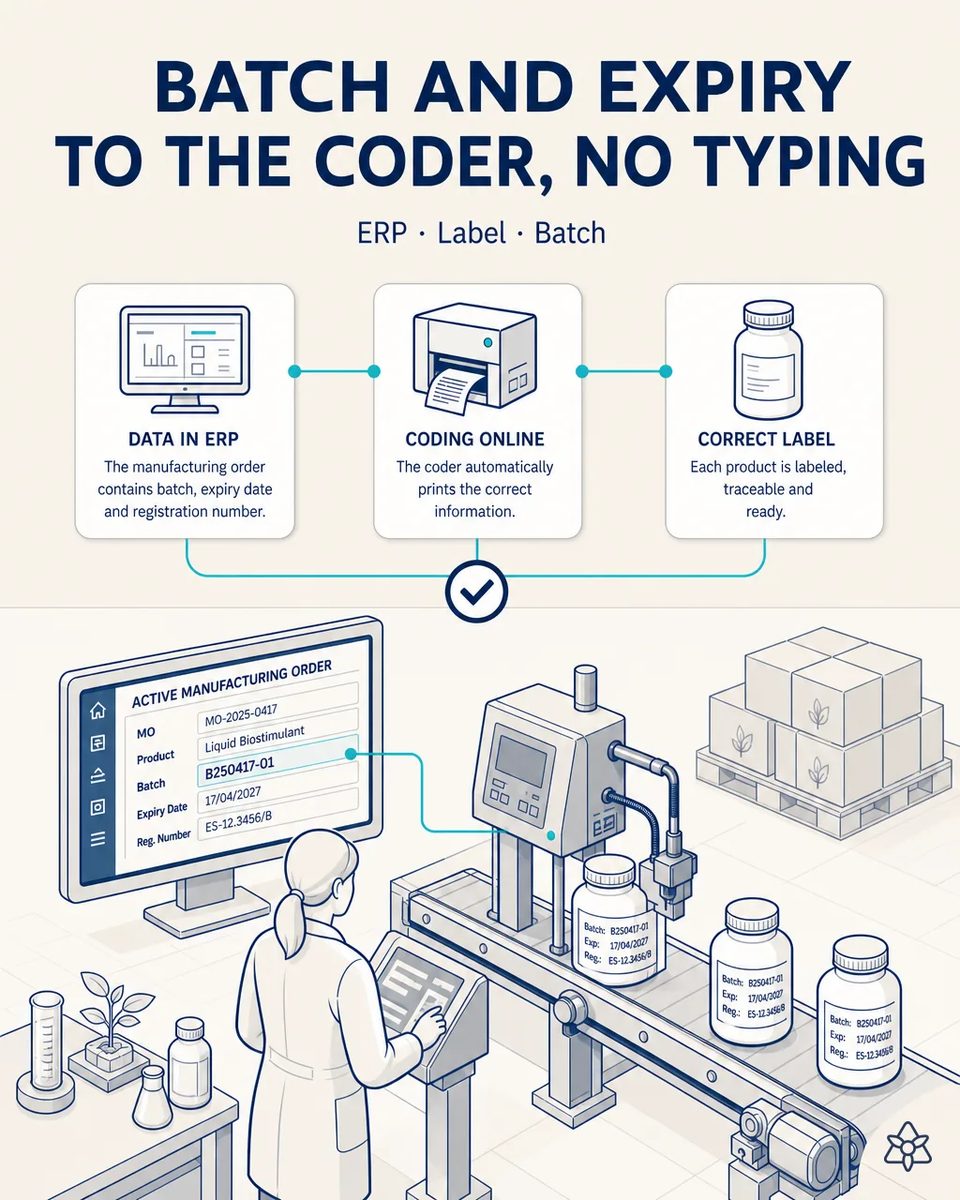
The last step before the product leaves the plant is typed by hand.
The coder prints batch, expiry and registration number on every bottle or drum. It's the last physical step before the product leaves the plant. The coder is 5 to 15 years old and already has an API, but it's isolated from the ERP: on every batch change, someone types the new data by hand into its panel. A mistyped digit means a container with the wrong batch or expiry printed: not legally sellable, and a traceability risk if it reaches the field.
- The coder prints batch, expiry and registration number on every bottle or jerrycan. It is the last physical step before the product leaves the plant.
- The coder is 5 to 15 years old and already has an API, but nobody connected it to the ERP. At every batch change, someone types the new data on its small panel, often against the clock and with the filler already running.
- One mistyped digit means a container with the wrong batch or expiry: not legally sellable, and a traceability risk if it reaches a grower's field.
- And the error is usually found by a customer or an inspector, not on the line, because the print looks perfectly correct. By then the whole batch is in distribution and the only fix is to recall and recode.
Connect in integration mode — the coder and the ERP stitched through their APIs.
iLEAN Connect stitches the coder to the ERP via API: when the ERP marks a work order as started, it publishes batch, expiry and registration automatically. Changing batches is one tap in the ERP, not typing on the coder.
Nothing is replaced: the coder already speaks, it just was never asked. When the ERP marks a work order as started, the batch, expiry and registration are published to the coder automatically. Changing batch becomes one tap in the ERP instead of typing on a small panel at the line, with gloves on and the filler waiting.
The isolated coder versus the coder fed by the work order
| Aspect | Today | With iLEAN Connect |
|---|---|---|
| Source of batch and expiry | Typed on the coder's panel | The active work order |
| Registration number | Typed, or left from the last product | Published with the batch |
| Batch change | Typing at the line | One tap in the ERP |
| Mistyped digit | A container that cannot be sold | Zero typing error |
| Where the error is found | At the customer or the inspection | It is not produced |
| The coder itself | — | Kept, through its existing API |
Before: on every batch change someone types batch, expiry and registration into the coder panel, and one wrong digit leaves unsellable containers. After: a batch change is one tap in the ERP and the final label prints with no typing error.
Impact estimate — to be validated with your format change frequency.
The block below is an estimate to be validated against your plant's actual data. We put it forward so the committee has an order of magnitude; we refine it during the assessment.
- Estimated payback 3-6 months.
- Zero typing error on batch and expiry on the final label, because nobody types them any more: they come from the same work order that drove the formulation.
- Batch changes at the bottling line become faster and stop depending on who is at the coder's panel, or on whether they remembered to change all three fields.
- And the registration number printed always matches the product actually being filled, which is the detail an inspector checks first and the one a grower relies on to know what they are applying.
Estimated payback 3-6 months · zero typing error on batch and expiry on the final label.
And the fair question from the production manager
“What if the ERP sends the wrong data to the coder?” — the coder prints what the work order says, so the source of truth is a single record already confirmed by a person, not a second copy typed at the line. The only extraction involved is checking the printed code back against the order, an anchored task where the best models drop below 1.5% error [1]; a mismatch stops the change before the first container is coded, not after a pallet has been filled.
[1] OpenAI paper "Why Language Models Hallucinate", 2025 — on the reliability of AI in anchored tasks.
What people ask about feeding the coder from the work order
Do we have to replace the coder in biosolutions?
No. Coders of that age usually expose an API or a network protocol already. Within 48 hours we can confirm whether yours can be stitched as it is, from its model and the documentation you already have.
Where does the expiry date come from in biosolutions?
From the product's shelf life defined in the ERP and the batch start date, so it is calculated once and never retyped. If a product's shelf life is revised, every new batch picks it up automatically.
What happens if the coder is offline when the batch changes?
The change is held and the line is warned; the coder does not print with the previous batch's data by default. That is the failure that produces a whole pallet with the wrong expiry.
Does it cover both bottles and jerrycans?
Yes. Each format keeps its own print template on the coder; only the variable data — batch, expiry, registration — comes from the work order, so a format change does not reopen the risk.
Is there a record of what was printed?
Yes. Each batch change is logged with what was sent to the coder and when, which closes the traceability loop with the final label and gives the evidence pack one more piece.
More cases from this series
- Same reactor, now it talksAn external camera reads the reaction curve of a 15-20 year old reactor without touching it, for…
- Humans in command, in two tapsNothing iLEAN captures enters a bioinput manufacturer's ERP without a human validating it first.
- The batch exists in the system from second zeroHow a bioinput manufacturer digitizes the work order with a phone photo, without changing the operator's…
- From the shared folder to the ERP, no re-typingiLEAN detects the lab's analysis spreadsheet, validates it and posts it to the ERP, cutting…
- Talk to the AI without stopping to walkAn earpiece and iLEAN voice capture the plant lead's operational knowledge while he walks, without…
- The truck no longer waits on the ERPPhoto the delivery note and batch labels: biological raw-material receiving traced in minutes, with…
Tell us how many batch changes your coder goes through per week.
We work on your plant's real data, not ours. Assessment with no commitment.
Request estimated ROI within 48h ‹ See all cases of agricultural biosolutions See chemicals