The batch exists in the system from second zero
Every bioinput batch starts with a printed work order: which active ingredient, what dose of each raw material, in what sequence. Today that paper piles up in a folder until someone transcribes it, sometimes days later.
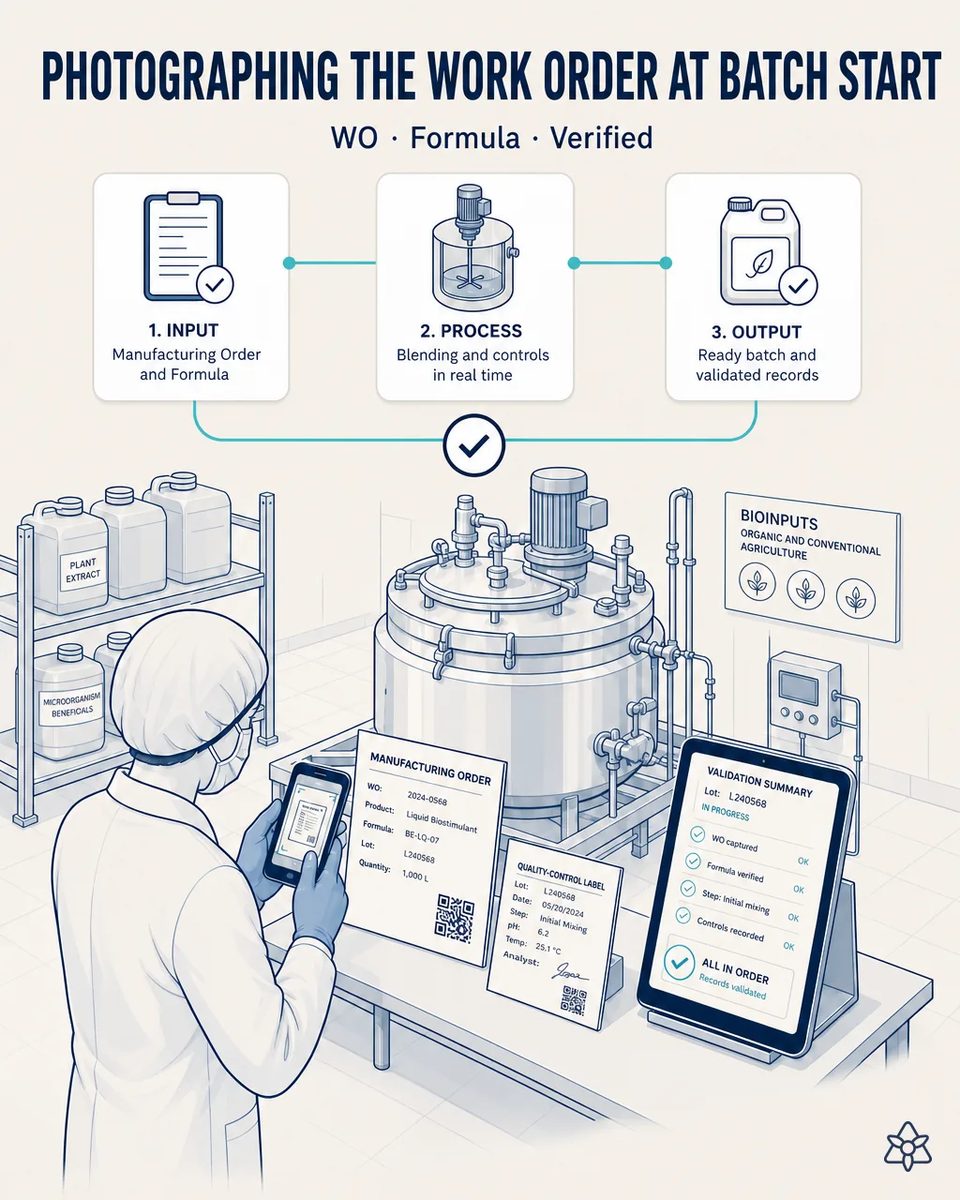
The formula that was actually dosed lives in the margin of a printed sheet.
Every bioinput batch starts with a printed work order: which active ingredient, what dose of each raw material, in what sequence. Today that paper piles up in a folder until someone transcribes it, sometimes days later. With iLEAN Connect, the operator takes two photos with their phone: the work order and the first control label. Zero training, zero change in routine.
- Every batch starts with a printed work order: which active ingredient, which Bacillus or Trichoderma strain, what dose of each raw material and in what sequence it goes into the formulation tank.
- The real batch is rarely the printed one. A carrier topped up because a drum came in denser, an adjuvant added later, a pH corrected by hand: those adjustments are written in pen and nowhere else.
- The sheet then piles up in a folder until somebody transcribes it — hours later on a good day, days later in a week with several campaigns running.
- If a field complaint about efficacy arrives in that window, the batch physically exists, has already been bottled and may have shipped, but no system can say what went into it.
Connect in photo mode — two pictures, and the operator's routine stays as it is.
A model grounded in this plant's reality reads both photos, extracts active ingredient, dose, raw-material batch and notes, and structures them automatically.
The operator does not fill in anything new: they photograph the work order and the first control label, the two documents they already handle. What changes is that the formula actually dosed — pen notes included — stops depending on someone typing it before it gets lost. It is usually the first case approved precisely because it asks the floor for almost nothing.
The work order in a folder versus the work order captured
| Aspect | Today, on paper | With iLEAN Connect |
|---|---|---|
| When the batch exists in the system | Hours or days after dosing | Second zero |
| Pen adjustments to the formula | Lost unless somebody retypes them | Extracted and tied to the batch |
| Strain lot used in the batch | On the sheet, if it was noted | Linked from the first photo |
| First control label (pH, temperature) | Filed with the work order | Read and stored as the batch baseline |
| Answering an efficacy complaint | Searching folders | One query by batch number |
| What the operator does differently in biosolutions | — | Two photos with their phone |
Before: hours of latency until transcription, with formula adjustments scattered on paper. After: the batch exists in central memory from second zero, traceable from minute one. Estimated payback 3 to 7 months depending on daily batch volume.
Impact estimate — to be validated with your daily batch count.
The block below is an estimate to be validated against your plant's actual data. We put it forward so the committee has an order of magnitude; we refine it during the assessment.
- Estimated payback 3-7 months, depending on how many formulation batches you start per day.
- From hours of transcription latency to a batch that exists in central memory from second zero, traceable from minute one.
- Formula adjustments stop being scattered across paper and become part of the batch record, which is what a registration holder needs to show.
- Transcription hours returned to production and quality, who today spend them copying sheets they have already read once.
Estimated payback 3-7 months · from hours of latency to zero-second batch start.
And the fair question from the production manager
“And if it misreads a dose or a strain lot written in pen?” — reading fields from a work order whose layout is always the same is an anchored task, where the best models drop below 1.5% error [1]. And there is a second net: the summary goes to the tablet at the line, and the operator confirms or corrects it before a single value crosses into the ERP.
[1] OpenAI paper "Why Language Models Hallucinate", 2025 — on the reliability of AI in anchored tasks.
What people ask about photographing the formulation work order
Do we need to redesign the work order the ERP prints?
No. The model reads the document exactly as you print it today, with its own layout and its own fields. Changing it would add friction and is not needed. If you later redesign it for other reasons, the model is shown a few examples of the new version and keeps reading.
Does it pick up the adjustments written in pen on the printed sheet?
Yes, and that is where most of the value is: the printed formula is the plan, the handwritten note is what was actually dosed. Low-confidence values are flagged for a person to confirm.
Why photograph the first control label as well?
Because it fixes the starting point of the batch: lot, step, pH and temperature at the first mixing stage. Without it the work order says what was planned, not how the batch began.
Does it work when several campaigns run in parallel?
That is when it helps most. Each photo is tied to its own work order number, so batches of different biostimulants or biopesticides do not mix in the record, even when two formulation tanks start within minutes of each other.
Do we need the ERP connected from the first day?
No. Batches start accumulating in iLEAN's central memory from the first photo, and the push to the ERP is connected once the value has been shown. That keeps the first weeks free of integration work and lets quality judge the extraction on real batches.
More cases from this series
- Zero typing error on the final labelNo manual typing: the coder receives batch, expiry and registration number straight from the active work…
- Same reactor, now it talksAn external camera reads the reaction curve of a 15-20 year old reactor without touching it, for…
- Humans in command, in two tapsNothing iLEAN captures enters a bioinput manufacturer's ERP without a human validating it first.
- From the shared folder to the ERP, no re-typingiLEAN detects the lab's analysis spreadsheet, validates it and posts it to the ERP, cutting…
- Talk to the AI without stopping to walkAn earpiece and iLEAN voice capture the plant lead's operational knowledge while he walks, without…
- The truck no longer waits on the ERPPhoto the delivery note and batch labels: biological raw-material receiving traced in minutes, with…
Tell us how long a formulation batch takes to exist in your system today.
We work on your plant's real data, not ours. Assessment with no commitment.
Request estimated ROI within 48h ‹ See all cases of agricultural biosolutions See chemicals