Color changeovers, verified with visual evidence
Every color change on the glazing line requires a verified cleaning and head adjustment, but today it depends on a human sign-off with no visual evidence. With iLEAN Edge, fixed cameras at every critical point compare the current state to the reference state and block startup until everything checks out.
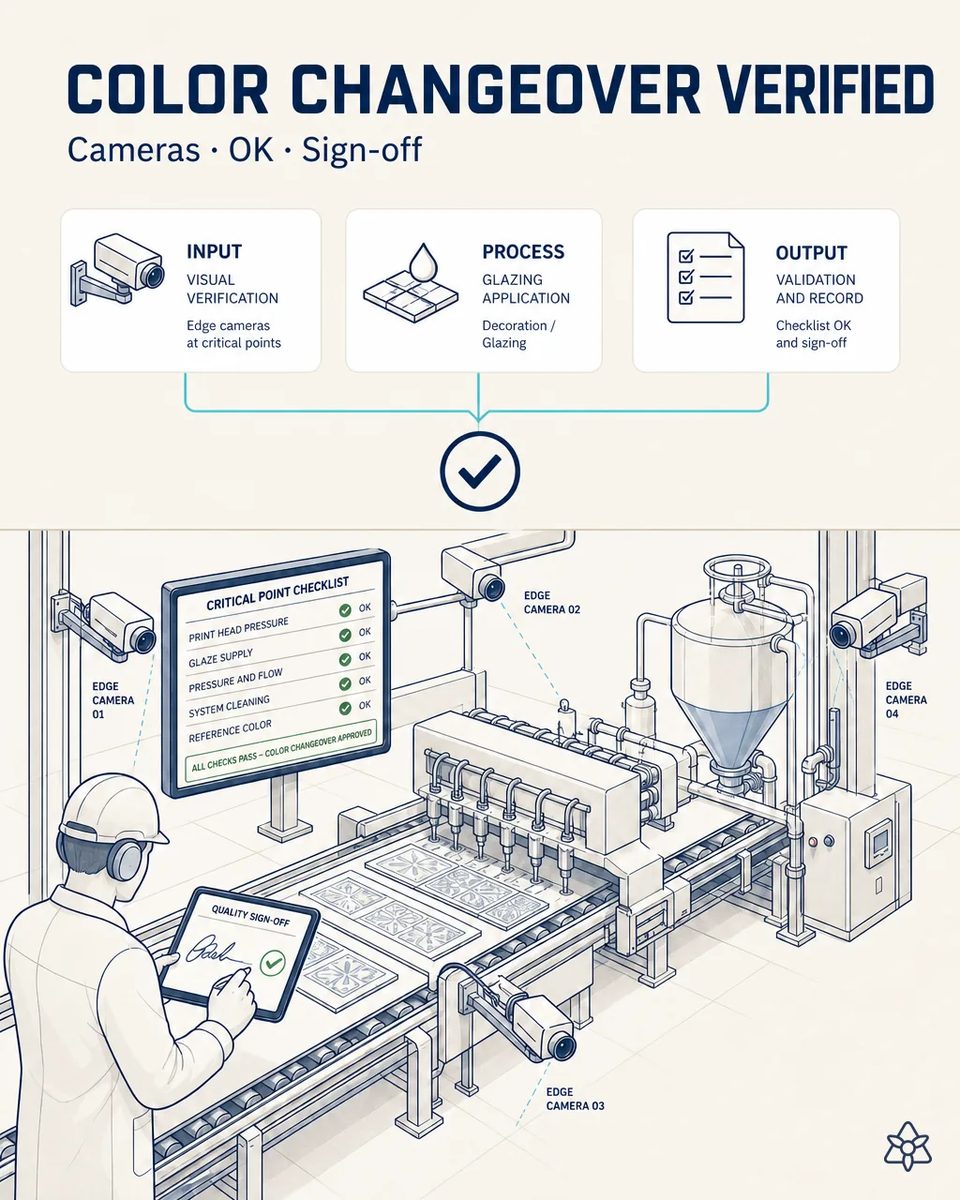
A color changeover signed with no evidence can contaminate the first run.
Leftover glaze from the previous color can contaminate the first batch of the new color, forcing the whole startup run to be scrapped.
- Each color change on the glazing line needs the bell, the airless booths, the tanks and the inkjet heads cleaned and adjusted before the new glaze runs. Each point has its own way of hiding residue. A tank wall, a nozzle or an inkjet head can each carry the previous color into the new run.
- Today that is closed with a human sign-off on a checklist, with no visual evidence of each point. The signature is made under pressure, because the line is waiting.
- Leftover glaze from the previous color in a pipe or a tank can contaminate the first batch of the new color. It is often invisible until after firing. Glaze colors look similar raw and only separate in the kiln.
- When it happens, the whole startup run is scrapped, and the investigation finds a signed checklist and nothing else. It is not bad faith: a signature is not a photo. And with several color changes per week, the exposure adds up quickly.
Edge with JIDOKA AI — the restart waits for OK at every point and a quality sign-off.
Edge + JIDOKA AI. Industrial cameras with CNNs trained to recognize "ready vs. leftover color". Startup blocked until OK + quality sign-off.
The cameras do not decide alone. They compare each critical point with its reference state, and the quality technician signs on that evidence. What changes is not who decides, but what the decision rests on. And the record of each changeover is already the evidence the audit will ask for. It feeds the evidence pack directly, with no extra work.
Color changeover today versus changeover verified by camera
| Aspect | Today | With iLEAN Edge |
|---|---|---|
| Closing the color changeover | A signature on a checklist | OK per critical point plus signature |
| Leftover glaze in tank or pipe | Found after firing | Detected before restart |
| Inkjet head adjustment | Trusted | Compared with the reference state |
| First run of the new color | At risk of scrap | Started on verified evidence |
| Restart while a point is not OK | Possible | Blocked by JIDOKA AI |
| Investigation after contamination | A signature and no proof | Photos of every point |
Blind sign-off with contamination risk → sign-off based on visual evidence per critical point.
Impact estimate — to be validated with your numbers.
The block below is an estimate to be validated against your plant's actual data. We put it forward so the committee has an order of magnitude; we refine it during the assessment.
- We do not fix a payback range, because it depends directly on how many color changeovers you run.
- Fewer scrapped startup runs caused by color contamination, which is where the return comes from. Each startup run saved is glaze, energy, kiln time and press time that are not lost.
- A blind sign-off with contamination risk becomes a sign-off based on visual evidence per critical point.
- With your changeover frequency and the cost of a lost startup run, the return can be estimated before deciding. We would rather calculate it with you than publish a range that does not fit your mix.
Reduced scrapped startups from color contamination. Payback depends on changeover frequency. *Estimate to validate*.
And the fair question from the production manager
“What if the cameras block the restart for no reason?” — the changeover sits on the line's critical path, so it is the right objection. Comparing a known point with its reference state — clean or with leftover color — is an anchored task, where the best models drop below 1.5% error [1]. And in case of doubt the system does not block in silence: it escalates to quality, who decides on the images. The block is always explained: which point, which image and why.
[1] OpenAI paper "Why Language Models Hallucinate", 2025 — on the reliability of AI in anchored tasks.
What people ask about verifying glaze color changeovers
Which points does it check on the glazing line?
Those your team defines at commissioning: usually tanks, pipes, application booths, bell and inkjet heads, each with its reference image. The reference images are taken on your own line, clean and ready, during commissioning.
Can it see leftover color inside a pipe?
It checks what can be seen from a fixed camera: outlets, tanks, booths and the first tiles of the new color. Hidden points are covered by a test piece checked before the restart. The point list grows as the plant learns where contamination actually comes from.
Does the camera check lengthen the color changeover?
The check takes seconds. What lengthens changeovers today is the margin added because there is no evidence. With evidence per point, the decision to restart is taken faster and with less doubt.
Can quality skip it when the line is in a hurry?
An exception can be signed by quality and it is recorded as such. What cannot happen is a restart with no trace of who decided. Exceptions are visible in the dossier, which is where an auditor will look.
Why is there no payback range for the color changeover case?
Because it depends on your number of color changeovers. With that and the cost of a scrapped startup run, the figure is calculated for your plant. We prefer that to publishing a range that would not fit your mix.
More cases from this series
- The glaze printer, fully linked to the ERPHow iLEAN links the digital glaze printer to the ERP so the design recipe travels with no manual…
- The line lead's knowledge no longer dies at shift's endHow the line lead dictates incidents while walking between lines, hands-free.
- The kiln control panel, now connectedHow an external camera digitizes the firing curve of an isolated roller kiln, without touching its SCADA.
- The lab spreadsheet, connected to the ERP in real timeHow iLEAN automatically pushes the quality lab's spreadsheet to the ERP, with license savings.
- The raw-material delivery note, straight to the ERP by photoHow one photo of the delivery note and batch labels pushes everything to the ERP, with no typing.
- The supplier's alert, in seconds, not hoursHow iLEAN reads raw-material delay notices in real time and replans before the line actually stops.
Tell us how many glaze color changeovers you run per week.
We work on your plant's real data, not ours. Assessment with no commitment.
Request estimated ROI within 48h ‹ See all cases of porcelain tile See ceramics