Zero Line Stoppages From Supply Shortfalls
The capital pain of any assembly plant with hundreds of suppliers is an unanticipated line stoppage from a missing JIT part. The iLEAN flagship system coordinates Connect, Edge and Agents in cross-checking verification rings, resequencing production before the line has to stop.
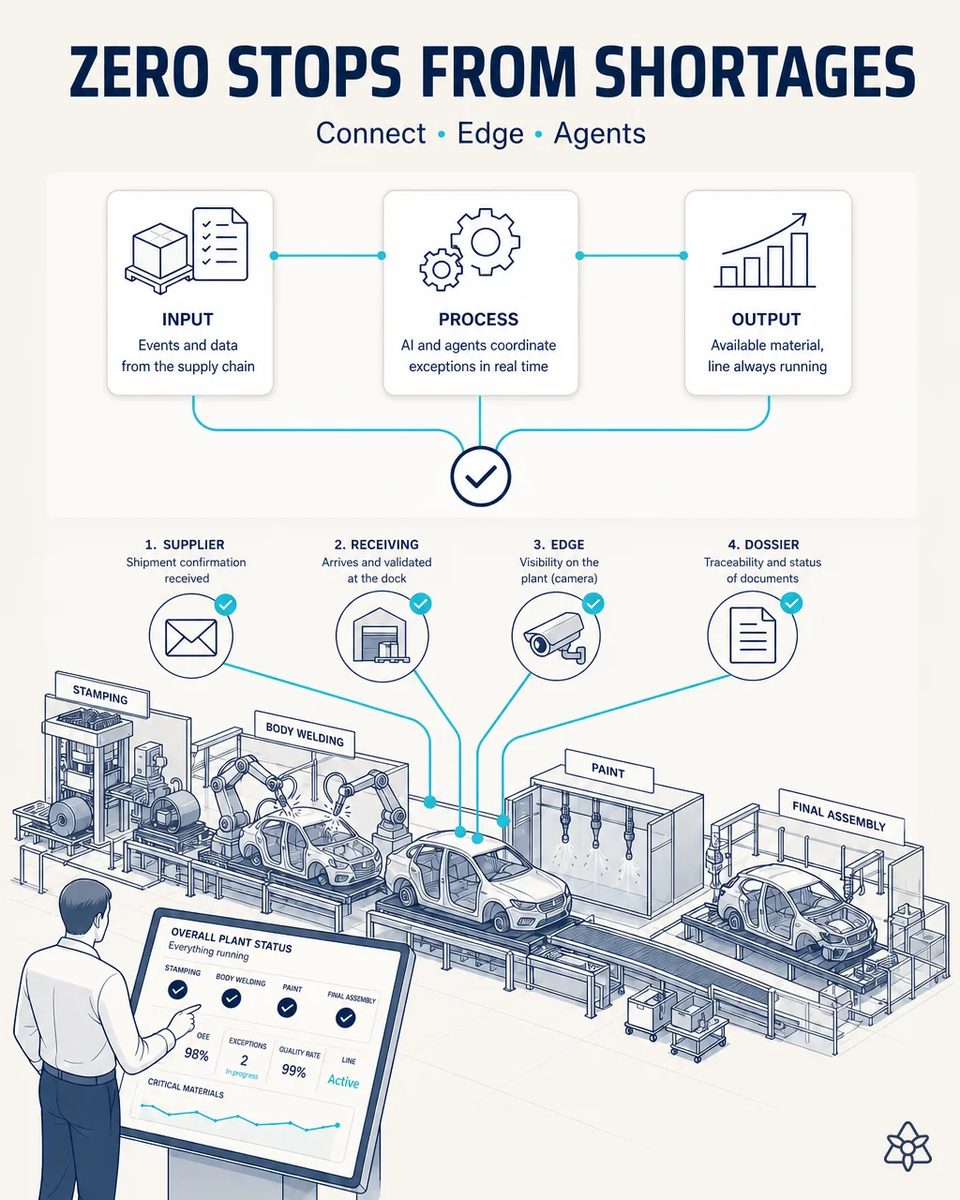
The line does not stop when the part is late. It stops when nobody saw it coming.
An unanticipated line stoppage from a supply shortfall is the biggest recurring economic risk for a plant relying on hundreds of local and international just-in-time suppliers. Each incident costs anywhere from tens to hundreds of thousands of dollars in downtime, plus the risk of missing market volume commitments.
- A plant fed by hundreds of local and international JIT suppliers lives with one recurring risk above all others: the unanticipated line stoppage because a part is not at the station.
- Each incident costs from tens to hundreds of thousands of dollars in downtime, plus the risk of missing the volume committed to the market.
- The signals that would have warned in time usually existed: a supplier email, a truck that did not arrive, a container that never reached the line side. They lived in different systems and different heads.
- So the reaction starts when the andon is already pulled, and the only options left are an emergency shipment or a stopped line.
Connect, Edge and Agents in cross-checking rings — before the line stops.
Connect (gaps 3 and 7) detects the early supplier signal and confirms real physical arrival; Edge plus legacy integration (gaps 8 and 10) confirm the state of the critical point depending on that part; Agents (gap 11) keeps an auditable record of every decision; SMED AI resequences unaffected units and JIDOKA AI blocks when needed — all before the line has to stop.
No single case prevents the stoppage on its own: the supplier alert, the dock receipt and the line-side check each see one part of the picture. The value is in crossing them, and in letting SMED AI resequence the units that do not need the missing part while JIDOKA AI holds the ones that do. The line keeps moving with the units it can build, and the gap is filled when the part arrives.
The rings of the system and what each one confirms
| Ring | Which cases it draws on | What it confirms |
|---|---|---|
| 1 · Early signal | Supplier delay alert (3) | The part will be late, and for which VINs |
| 2 · Physical arrival | JIT receiving at the dock (7) | The part is really in the plant |
| 3 · Critical point | Torque tool and MES (8) | The station can build that VIN correctly |
| 4 · Paint sequence | Color change validation (10) | The body is ready in the right color and order |
| 5 · Evidence | IATF evidence pack (11) | Every decision is recorded and auditable |
| 6 · Response | SMED AI and JIDOKA AI | Unaffected units resequenced, affected ones held |
Reactive line stoppage once the part is already missing at the station → proactive resequencing minutes or hours before the line needs it.
Impact estimate — to be validated with your numbers.
The block below is an estimate to be validated against your plant's actual data. We put it forward so the committee has an order of magnitude; we refine it during the assessment.
- Estimated payback 6-12 months, measured against the first line stoppage avoided, to be validated with materials planning and plant management.
- Each avoided stoppage protects tens to hundreds of thousands of dollars in downtime.
- From a reactive stoppage when the part is already missing at the station to proactive resequencing minutes or hours before the line needs it.
- And protection of the volume committed to the market, which is what plant management really answers for.
Estimated payback 6-12 months against the first stoppage avoided. *To be validated* with materials planning and plant management. (Payback 6-12 months · protects against the cost of downtime)
And the fair question from the production manager
“Do we need all twelve cases running before this works?” — no. The rings are built in layers, and the supplier alert plus the dock receipt already give you the first two. Crossing a delay warning with the live sequence is an anchored task, where the best models drop below 1.5% error [1], and no resequencing happens without a planner confirming it.
[1] OpenAI paper "Why Language Models Hallucinate", 2025 — on the reliability of AI in anchored tasks.
What people ask about preventing supply-driven line stoppages
Where does a vehicle assembly plant usually start?
With the supplier delay alert and JIT receiving, because they close the two most common blind spots: knowing the part is late and knowing whether it actually arrived. Each of them pays on its own before the rings are joined.
Does SMED AI change the sequence on its own?
No. It proposes the resequencing of unaffected units with its impact; the planner confirms and only then does the MES sequence change. JIDOKA AI only blocks the units that would reach the station without the part.
What does crossing the rings add over each case separately?
The supplier says the truck is on time, but the dock has not received it and the line-side buffer of units is running low: only the cross-check sees that combination before the station runs dry.
Does it replace our MES or supply chain planning system?
No. The MES keeps the sequence and the planning system keeps the plan; iLEAN crosses them against what is actually happening at suppliers, at the dock and on the line.
How is the return of the full system estimated before committing?
With your history of stoppages from supply shortfalls, your cost per minute of line downtime and your number of JIT suppliers, we estimate the return layer by layer, so the order of deployment follows where your stoppages actually come from.
More cases from this series
- The Color Change Won't Start Without ProofA paint color change requires a certified nozzle purge; leftover pigment contaminates the first units of…
- The Line Leader Dictates Hands-FreeThe line leader walks the entire shift between stations with hands full. Key observations that die at…
- The IATF Dossier That Builds ItselfOn IATF 16949 audit day, or during a corporate process audit, someone today spends weeks reconstructing…
- The JIT Delivery Note Enters ERP AloneA JIT supplier's truck arrives at the dock on a minute-tight delivery window. With iLEAN Connect, the…
- The Vintage Press Panel That Starts TalkingMany stamping shops live with at least one older-generation press, critical for a specific body part,…
- The Paint Defect That Never Reaches the OvenAt paint-line cadence, the human eye tires and misses subtle finish defects. iLEAN Edge places a camera…
Tell us how many minutes your line stopped last quarter for a missing JIT part.
We work on your plant's real data, not ours. Assessment with no commitment.
Request estimated ROI within 48h ‹ See all cases of vehicle assembly See automotive