The Color Change Won't Start Without Proof
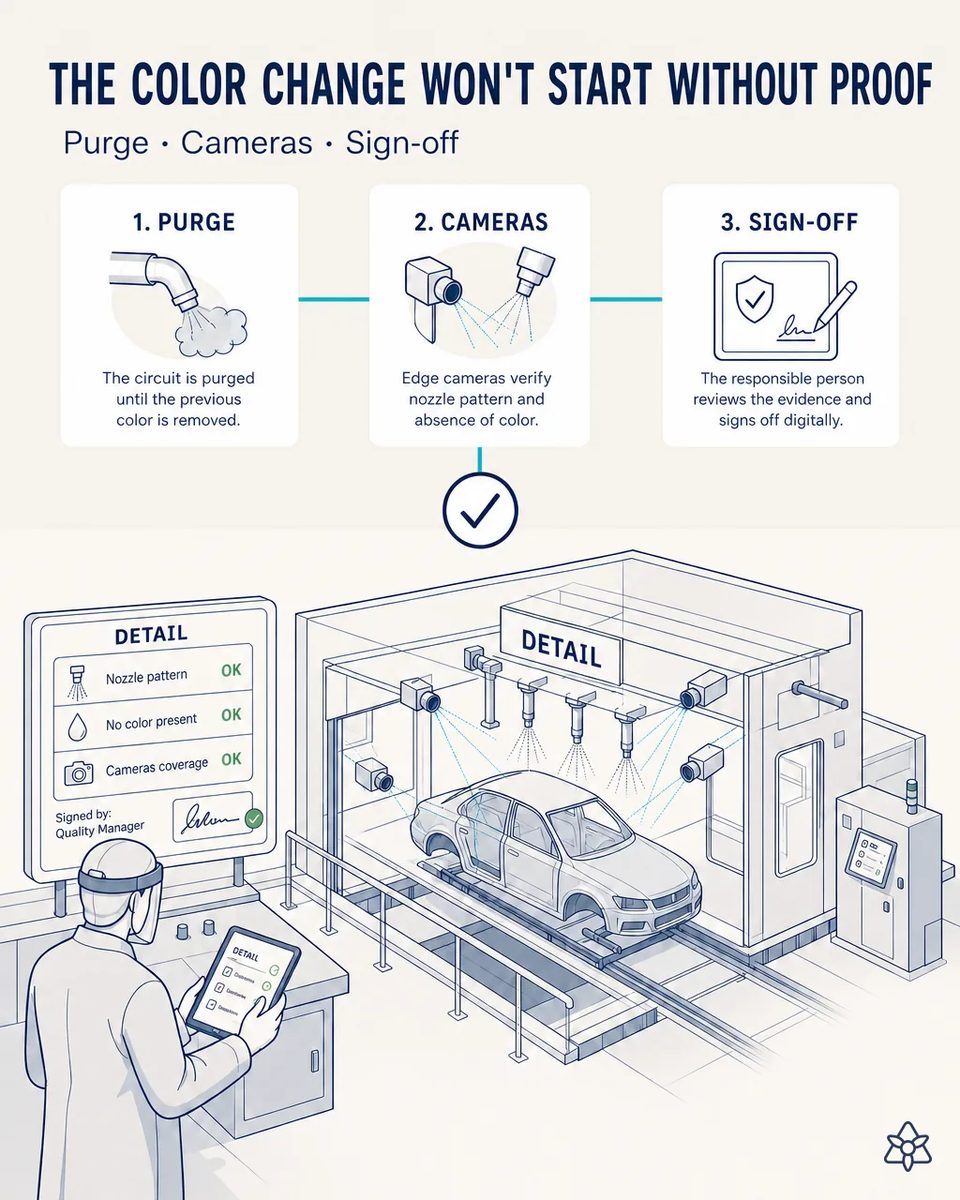
A paint color change requires a certified nozzle purge; leftover pigment contaminates the first units of the new color. With iLEAN Edge, fixed cameras at each critical point won't let the new color sequence start until every camera reads OK and the quality manager signs off on visual evidence.
The paint shop's most frequent event is signed off with no evidence.
A color change is one of the most frequent events of the day in paint, and its validation depends on a human sign-off with no structured evidence. A small margin of error in the purge translates into repaint rework or, worse, a color-defective unit that goes unnoticed until delivery.
- In a plant that paints in customer-order sequence, the color changes many times per shift — sometimes every few bodies. Each change requires a certified purge of the nozzles and lines.
- If pigment from the previous color remains, the first bodies of the new color come out contaminated: a shade off, or specks of the old color in the new one.
- The purge is validated by a human sign-off, with the sequence pressing and nothing structured to look at.
- A contaminated body goes back for a repaint at best; at worst, a shade defect passes unnoticed until delivery inspection.
Edge with JIDOKA AI — the new color does not start until the evidence clears.
Edge + JIDOKA AI: fixed cameras at each critical purge point compare the current state against the 'clean for new color' reference; JIDOKA AI blocks the new sequence from starting until every camera reads OK and the quality manager signs off.
Each critical purge point has its own camera and its own reference image of the clean, ready state. JIDOKA AI does not let the next color start until every camera reads OK and the quality manager signs, now with the evidence on the tablet. The decision stays human; it simply stops being blind. And because the check is the same on the first change of the shift and the fortieth, fatigue stops being part of the equation.
The color change signed blind versus signed on camera evidence
| Aspect | Today | With iLEAN Edge + JIDOKA AI |
|---|---|---|
| Basis for the quality manager's sign-off | Judgment under sequence pressure | OK per critical purge point |
| Leftover pigment in a nozzle | Found on the first bodies | Detected before the next color starts |
| Start of the new color | Whenever someone signs | Blocked until every camera reads OK |
| Exposure across the shift | Every color change in the sequence | Every change, with the same check |
| Contaminated first body | Repaint, or a claim at delivery | Not painted |
| Record of each color change | A signature on a form | Photos, owner and time per point |
Blind sign-off with color-contamination risk → sign-off based on visual evidence per critical point.
Impact estimate — the payback scales with your color changes per shift.
The block below is an estimate to be validated against your plant's actual data. We put it forward so the committee has an order of magnitude; we refine it during the assessment.
- Payback depends on how many color changes you run per shift: we do not fix a range because it varies from plant to plant with color batching and sequence policy.
- Protection against color contamination on the first bodies after each change, which is where the repaint cost of this event sits.
- Sign-off based on visual evidence per critical point, instead of a blind signature given with the sequence pressing.
- And a record of every color change that later serves as evidence in the IATF 16949 process audit, without extra work.
Payback depends on color-change frequency per shift. *Figure to be validated*. (Payback varies by changeover frequency · protects against color contamination)
And the fair question from the production manager
“Won't the cameras hold the line for nothing at every color change?” — comparing a purge point against its own clean-state reference image is an anchored task, where the best models drop below 1.5% error [1]. JIDOKA AI blocks on a verifiable difference from that reference, not on model doubt; when the image is unclear, the point is escalated to the quality manager, who decides with the photo in front of them.
[1] OpenAI paper "Why Language Models Hallucinate", 2025 — on the reliability of AI in anchored tasks.
What people ask about validating color changes in the body paint shop
Which purge points get a camera?
The ones where leftover pigment can reach the next body: nozzles and atomizers, the color changer and the cleaning station. The list is defined with your paint process engineers at commissioning, and each point is trained on the real color pairs of your palette.
Does it slow down color-by-sequence painting?
The check takes seconds and runs while the purge completes. What costs time today is the margin added for lack of evidence, plus the repaints when that margin is not enough.
Who has the final word on starting the new color?
The quality manager. The system enables the start; the person signs, with the photos of every point on the tablet.
Why is there no payback range for this case?
Because it depends almost entirely on how many color changes you run per shift, which varies widely between plants. With your changeover count and contamination history we estimate it before you decide.
Can a color change be released in an emergency without full evidence?
Yes, as a recorded exception signed by the quality manager. What disappears is starting a color with no trace of who decided it, and the exception itself becomes part of the color change record.
More cases from this series
- The Line Leader Dictates Hands-FreeThe line leader walks the entire shift between stations with hands full. Key observations that die at…
- The IATF Dossier That Builds ItselfOn IATF 16949 audit day, or during a corporate process audit, someone today spends weeks reconstructing…
- The JIT Delivery Note Enters ERP AloneA JIT supplier's truck arrives at the dock on a minute-tight delivery window. With iLEAN Connect, the…
- The Vintage Press Panel That Starts TalkingMany stamping shops live with at least one older-generation press, critical for a specific body part,…
- The Paint Defect That Never Reaches the OvenAt paint-line cadence, the human eye tires and misses subtle finish defects. iLEAN Edge places a camera…
- The Paint Lab Spreadsheet Flows to ERPThe paint lab fills out a spreadsheet every shift with control parameters per batch. iLEAN Connect…
Tell us how many color changes your paint shop runs per shift.
We work on your plant's real data, not ours. Assessment with no commitment.
Request estimated ROI within 48h ‹ See all cases of vehicle assembly See automotive