The Paint Defect That Never Reaches the Oven
At paint-line cadence, the human eye tires and misses subtle finish defects. iLEAN Edge places a camera at the cabin exit, infers in milliseconds per body, and diverts the defective unit before the curing oven.
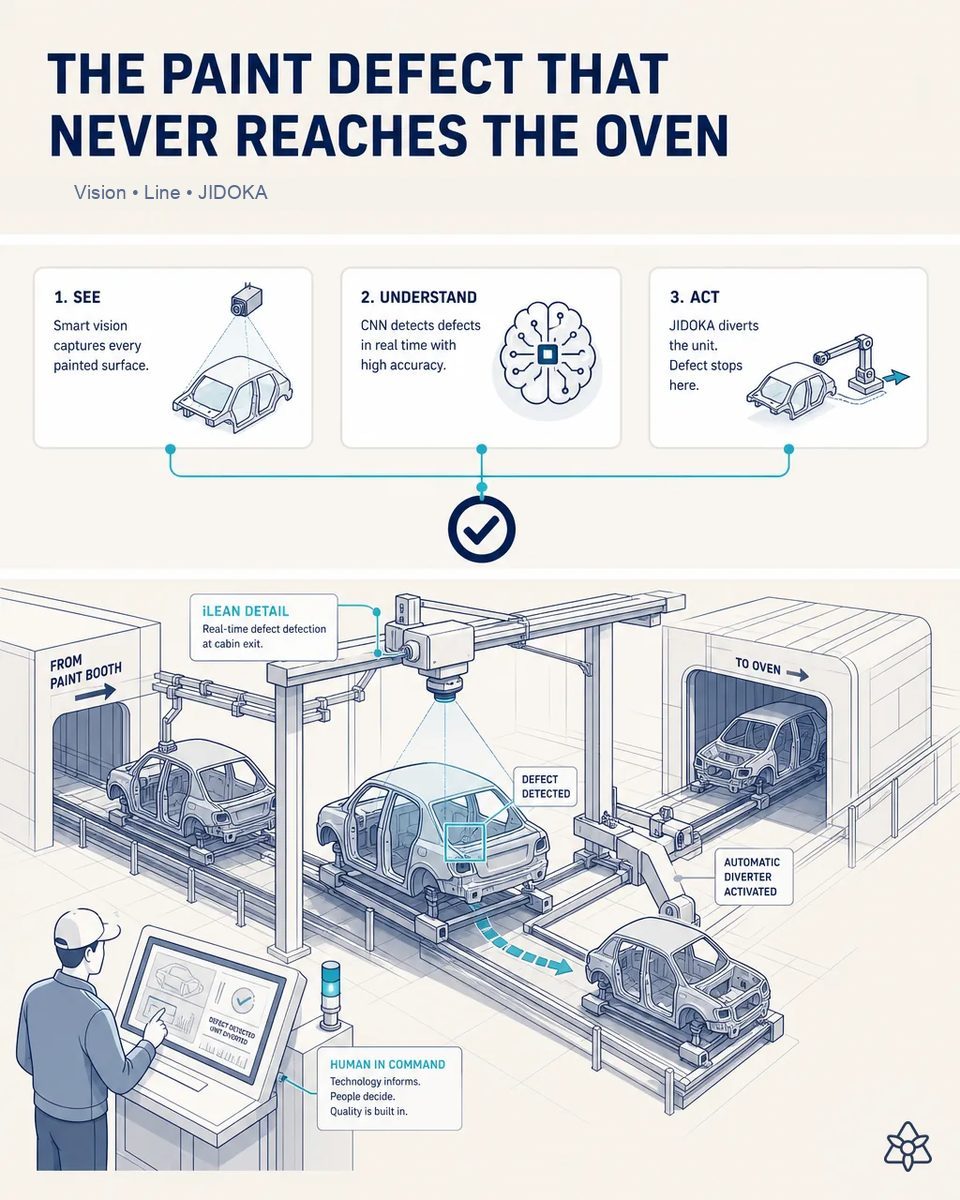
A defect found after the oven costs a repaint; before it, far less.
100% human visual inspection at line cadence is impossible to sustain shift after shift; sampling-based inspection leaves gaps. A defect caught after the curing oven costs far more to fix (full repaint) or reaches the customer directly as a perceived-quality claim.
- Inspecting 100% of every body's surface at paint-line cadence is not humanly sustainable shift after shift. The eye tires; the line does not slow down.
- Inspection usually happens after the curing oven, by sampling or in the light tunnel, where a dirt inclusion, a run or a crater is already baked into the clearcoat.
- Caught there, the unit needs sanding and spot repair, or a full repaint loop through the booth and the oven again.
- Missed there, it reaches final assembly or the customer as a perceived-quality claim on a vehicle that is otherwise finished.
Edge at the booth exit — infer in milliseconds, divert before curing.
Edge: an industrial camera at the cabin exit plus a local GPU run a CNN trained on this plant's actual good/bad finish examples, inferring in milliseconds and diverting the defective unit before the oven.
Moving the eye ahead of the oven changes the economics of the defect: the same inclusion that costs a repaint after curing costs a local repair before it. And because the inspection is local and runs on every body, the plant finally has defect data by booth, color and shift instead of a sample. Paint engineering stops arguing about where the dirt comes from and starts looking at the map.
Post-oven sampling versus Edge at the booth exit
| Aspect | Today | With iLEAN Edge |
|---|---|---|
| Point of inspection | After the curing oven | At the paint booth exit |
| Body coverage | A sample, or what the light tunnel catches | 100% of the bodies |
| Repair for a caught defect | Sanding, spot repair or full repaint | Local repair before curing |
| Defect data by booth and color | Partial | Every body classified |
| Where the paint inference runs | Nowhere: there is no inference | Local GPU next to the booth |
| When the unit is diverted | After it already cost an oven pass | Before the oven |
Partial post-oven sampling → 100% body coverage before curing.
Impact estimate — to be validated with your numbers.
The block below is an estimate to be validated against your plant's actual data. We put it forward so the committee has an order of magnitude; we refine it during the assessment.
- Estimated payback 5-12 months, depending on your current repaint and rework ratio.
- 100% body coverage before curing, against today's partial post-oven sampling, on every shift and at full line cadence.
- Fewer full repaint loops, each of which consumes booth time and oven capacity the line needs for new units.
- And defect classification by booth, color and shift that turns rework into a cause you can actually attack.
Estimated payback 5-12 months depending on current rework ratio. *Figure to be validated*. (Payback 5-12 months · 100% control before curing)
And the fair question from the production manager
“What about false rejects that send good bodies off the line?” — classifying a known defect catalog on your own colors under fixed booth-exit lighting is an anchored vision task, where the best models drop below 1.5% error [1]. The model is trained on this plant's real good and bad bodies, and borderline cases are not diverted blindly: they go to the inspector at the console, who decides, and that decision feeds the training so the same borderline case is handled better next time.
[1] OpenAI paper "Why Language Models Hallucinate", 2025 — on the reliability of AI in anchored tasks.
What people ask about paint defect vision at the booth exit
Why inspect before the curing oven and not after it?
Because the cost of repair changes on the other side of the oven. A defect caught before curing is a local repair; once cured, it is sanding or a full repaint.
Does it keep up with the paint line's cadence?
Yes. Inference runs on a local GPU next to the line and resolves in milliseconds per body, without depending on the plant network or the cloud. If the network drops, the booth exit keeps inspecting.
Is it trained on generic paint defects?
No. It is trained on good and defective bodies from your own line and your own colors. A dark metallic and a solid white do not show defects the same way, and a generic model cannot tell which marks matter on each.
What happens to a diverted body?
It leaves the main flow for a repair station before the oven, and its defect is recorded against the VIN with type and position on the body. That record is what lets paint engineering see whether one booth or one color concentrates the rework.
Does it replace the final light tunnel inspection?
No. The final audit stays. What changes is that far fewer defects reach it, and the ones that do are not the ones a camera could have caught earlier. The light tunnel stops being the first filter and becomes the last.
More cases from this series
- The Color Change Won't Start Without ProofA paint color change requires a certified nozzle purge; leftover pigment contaminates the first units of…
- The Line Leader Dictates Hands-FreeThe line leader walks the entire shift between stations with hands full. Key observations that die at…
- The IATF Dossier That Builds ItselfOn IATF 16949 audit day, or during a corporate process audit, someone today spends weeks reconstructing…
- The JIT Delivery Note Enters ERP AloneA JIT supplier's truck arrives at the dock on a minute-tight delivery window. With iLEAN Connect, the…
- The Vintage Press Panel That Starts TalkingMany stamping shops live with at least one older-generation press, critical for a specific body part,…
- The Paint Lab Spreadsheet Flows to ERPThe paint lab fills out a spreadsheet every shift with control parameters per batch. iLEAN Connect…
Tell us how many bodies per shift go back through the paint booth for a repaint.
We work on your plant's real data, not ours. Assessment with no commitment.
Request estimated ROI within 48h ‹ See all cases of vehicle assembly See automotive