The Vintage Press Panel That Starts Talking
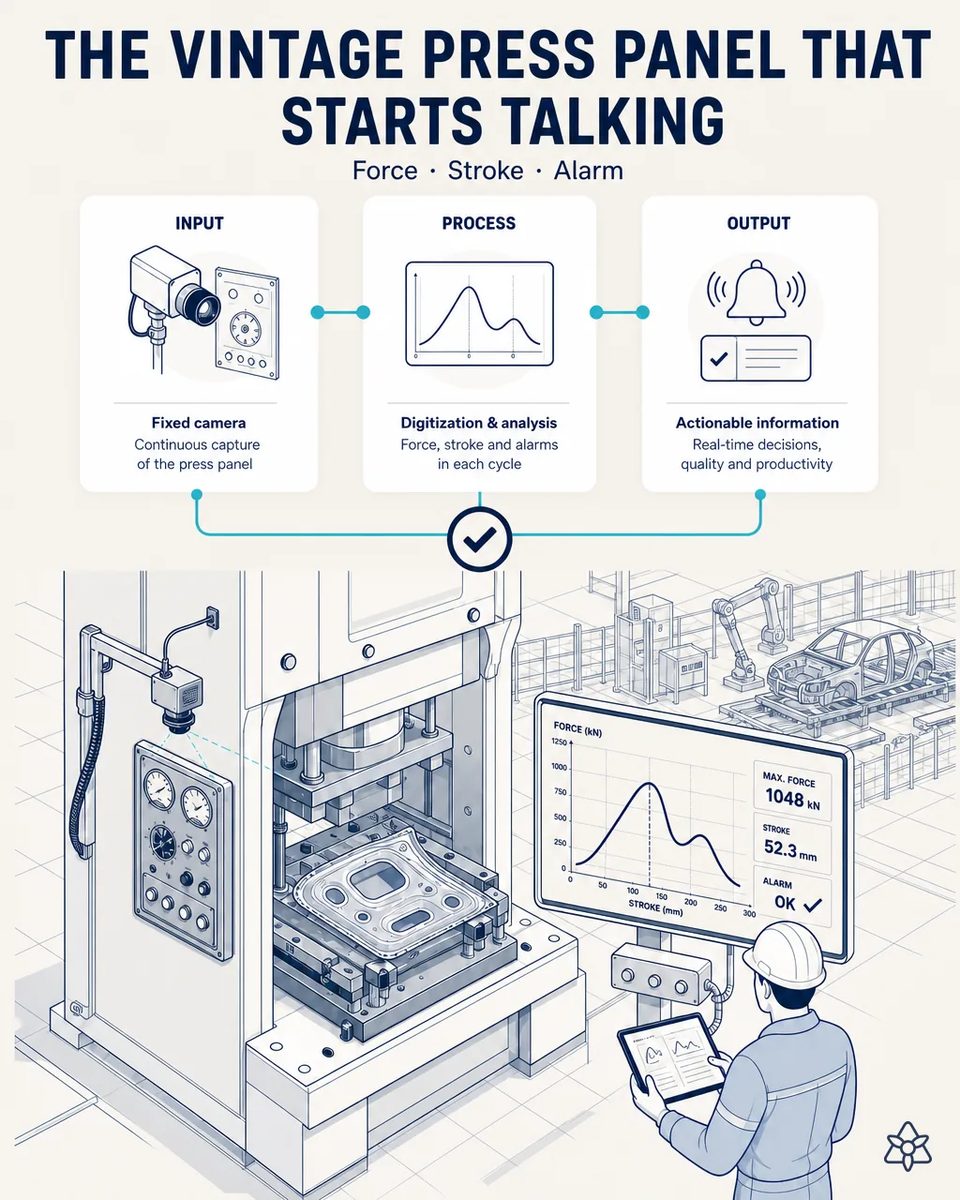
Many stamping shops live with at least one older-generation press, critical for a specific body part, with a network-isolated proprietary control panel. With iLEAN Connect, an external camera pointed at the panel is enough: the press stays exactly as it is, but the plant now has the digitized force curve stroke by stroke in central memory, without touching the original control.
The press that stamps your critical body panel forgets every stroke.
The vintage press is usually the bottleneck for a critical part, and its force/alarm data dies on screen every few seconds because nobody logs it stroke by stroke. Without that correlation, a scrap increase on a specific part can't be attributed to a stamping process drift until the problem is already large.
- Most OEM stamping shops keep at least one older-generation press running a critical outer panel — a hood, a door outer, a body side. Its proprietary control sits off the network by design.
- The force curve and the alarms show on the panel for a few seconds and are gone. Nobody logs them stroke by stroke, because nobody can stand in front of a screen all shift.
- So when splits or necking start showing up on that panel in the body shop, nobody can tell whether the press drifted, the blank batch changed or the lubrication did.
- The question gets answered when the scrap pile is already large, and that panel is often the one holding the whole body line hostage.
Connect in photo mode on the press control — read from the outside.
Connect photo mode over the panel: a fixed industrial camera captures the proprietary control's screen; OCR plus a grounded LLM interpret each frame, structure the force curve by batch/part, and cross-check which work order was in the press at that moment.
The press stays exactly as it is: same control, same software, no new port. What changes is that every stroke leaves a curve behind, tied to the work order and the blank batch that was in the press at that moment. On the machine nobody dares to touch, that is the only approach that gets approved, and it is installed in a single shift.
The stamping press today versus the stamping press being read
| Aspect | Today | With iLEAN Connect |
|---|---|---|
| Force curve per stroke | Seen for seconds on the panel | Stored and tied to the work order |
| Split or necked body panel | Counted as scrap | Traced to stroke, shift and blank batch |
| Alarms on the old control | Reset and forgotten | Logged with timestamp and context |
| Process drift on the outer panel | Noticed when scrap is already high | Visible as a trend before it bites |
| The proprietary press control | — | Untouched, no network opened |
| Press replacement CAPEX | On next year's plan | Deferrable with evidence |
Zero correlation between press force and part cracking/breakage → batch-level root-cause analysis in minutes.
Impact estimate — to be validated with your numbers.
The block below is an estimate to be validated against your plant's actual data. We put it forward so the committee has an order of magnitude; we refine it during the assessment.
- Estimated payback 5-10 months, before counting the replacement investment it helps defer.
- Scrap reduction on the critical panel once press force can finally be correlated with splits and necking.
- Avoided press-replacement CAPEX: the press gets replaced when the data says so, not because it is blind.
- And batch-level root cause in minutes instead of a week of hypotheses traded between stamping and the body shop.
Estimated payback 5-10 months, plus avoided press-replacement CAPEX. *Figure to be validated*. (Payback 5-10 months · avoids press replacement CAPEX)
And the fair question from the production manager
“Can a camera on an old panel be trusted for a root-cause analysis?” — the task is anchored: a fixed screen, values in known positions and physical ranges the press cannot exceed, where the best models drop below 1.5% error [1]. And a frame that reads a force outside the press's possible range is discarded rather than stored, so the series you analyze is one you can defend in front of the body shop and quality. The read can also be checked against the press counter, which never goes backwards.
[1] OpenAI paper "Why Language Models Hallucinate", 2025 — on the reliability of AI in anchored tasks.
What people ask about reading the stamping press panel
Does the press control have to be opened or modified?
No. The camera sits outside the panel and reads what the screen already shows. Nothing is installed on the press control and no network port is opened, so the machine stays as the manufacturer left it.
What does it capture on every stroke?
The force curve, the stroke position, the active alarms and the stroke counter, each frame tied to the work order and the blank batch in the press at that moment.
Can a split on the body side be traced back to a specific stroke?
Yes, by crossing the panel's position in the batch with the stroke that formed it. That turns a scrap count into an answer about shift, blank batch or press condition.
Is it worth doing if the press is due for replacement?
Often more so: the data tells you whether the press is really the cause, and a replacement decided on evidence is easier to defend, or to postpone.
Which other stamping-shop machines can be read the same way?
Any isolated panel with a stable screen: older transfer lines, blank washers, lubrication units. You start with the press that makes the critical panel because that is where scrap costs most, and where the body line feels it first.
More cases from this series
- The Color Change Won't Start Without ProofA paint color change requires a certified nozzle purge; leftover pigment contaminates the first units of…
- The Line Leader Dictates Hands-FreeThe line leader walks the entire shift between stations with hands full. Key observations that die at…
- The IATF Dossier That Builds ItselfOn IATF 16949 audit day, or during a corporate process audit, someone today spends weeks reconstructing…
- The JIT Delivery Note Enters ERP AloneA JIT supplier's truck arrives at the dock on a minute-tight delivery window. With iLEAN Connect, the…
- The Paint Defect That Never Reaches the OvenAt paint-line cadence, the human eye tires and misses subtle finish defects. iLEAN Edge places a camera…
- The Paint Lab Spreadsheet Flows to ERPThe paint lab fills out a spreadsheet every shift with control parameters per batch. iLEAN Connect…
Tell us which body panel your oldest press makes and how you explain its scrap today.
We work on your plant's real data, not ours. Assessment with no commitment.
Request estimated ROI within 48h ‹ See all cases of vehicle assembly See automotive