The Line Leader Dictates Hands-Free
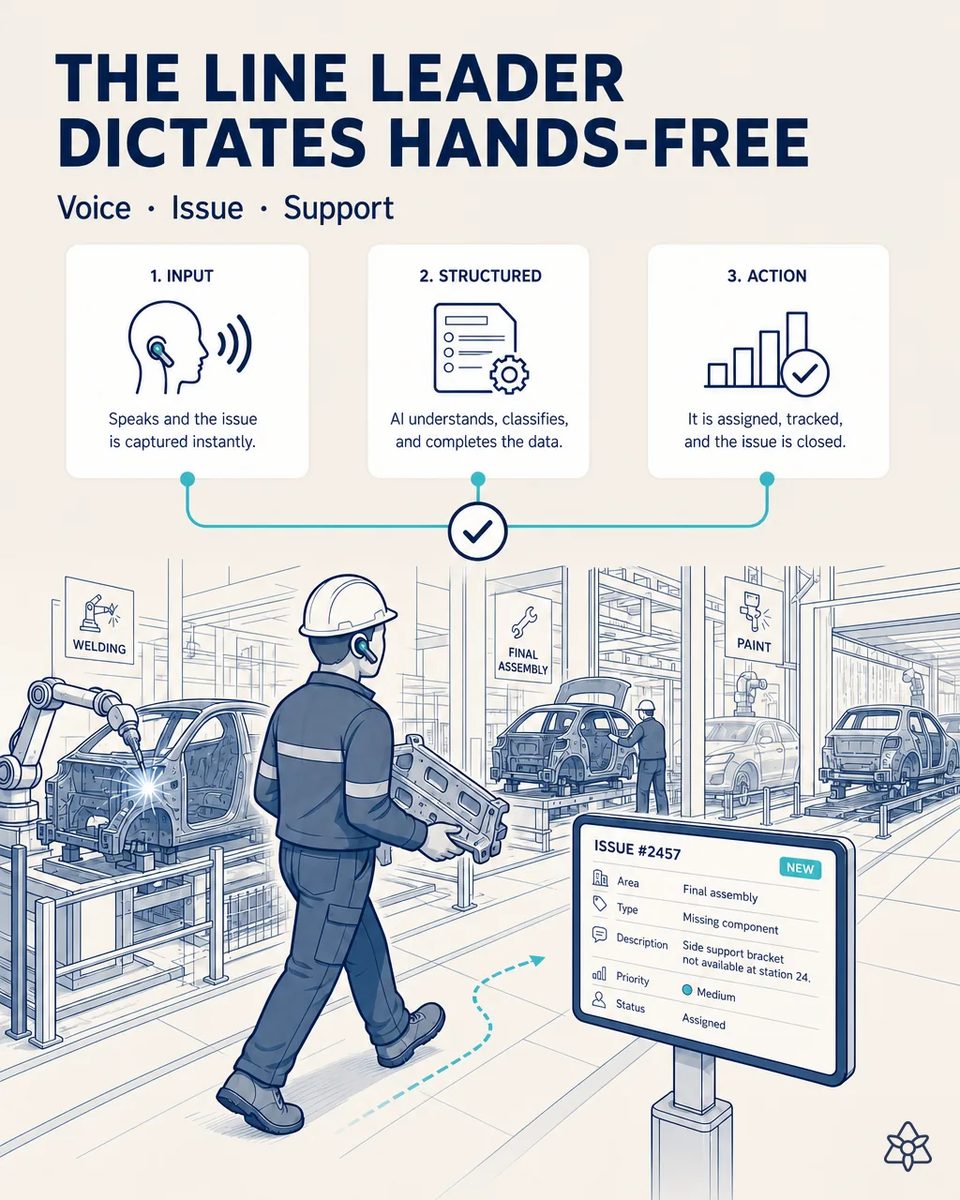
The line leader walks the entire shift between stations with hands full. Key observations that die at shift end today get dictated on the move with iLEAN Connect's earpiece mode: the AI listens, structures them as an issue, and returns concrete support in seconds.
The best data about the line walks around in one person's head.
Critical operational knowledge lives in the line leader's head while walking the plant and never enters the system in structured form. Early quality or staffing observations get lost because nobody has time to write them down before the shift ends.
- The line leader spends the shift moving between stations: covering an absence, fetching a missing bracket, helping an operator get back into takt. Their hands are always full.
- On that walk they see what no system records — a recurring fit issue on one variant, an operator struggling at a new station, a rack running low. Almost none of it gets written down.
- What survives is what they remember to mention at the shift handover, and the rest disappears when the shift ends.
- So the continuous-improvement team works from andon pulls and defect counts, and misses the early signal that the person on the floor noticed hours before.
Connect in voice mode — dictated on the move, structured by the AI.
Connect voice mode: a Bluetooth earpiece with a custom wake-word captures the line leader's dictation without breaking stride; the LLM structures the note as an issue tied to the active station/shift and returns support by voice or tablet push.
The line leader does not stop, does not take out a phone and does not type: a wake-word and one sentence are enough. The note becomes an issue tied to the station and the shift, and it is crossed with what quality and the sequence already know. What was a hunch becomes something the team can work on.
The line leader's observations today versus dictated hands-free
| Aspect | Today | With iLEAN Connect |
|---|---|---|
| How an observation is captured | Memory, or a note on paper | Dictated without breaking stride |
| Where it ends up | The shift handover, if remembered | An issue tied to station and shift |
| Cross-check with quality data | None | Against live defect and sequence data |
| Support for the line leader | A phone call to whoever is free | Returned by voice or tablet push |
| Recurring fit issue on one variant | Noticed by one person | Visible as a pattern across shifts |
| The line leader's hands | Busy with the line | Still busy with the line |
Knowledge that dies at shift end → enters the system in real time and cross-checks against live quality/sequence data.
Impact estimate — strategic value for continuous improvement, not a payback figure.
The block below is an estimate to be validated against your plant's actual data. We put it forward so the committee has an order of magnitude; we refine it during the assessment.
- No standalone payback: this is strategic value, and we do not put a number on it because it depends on what your continuous-improvement team does with the signal.
- It is an enabling piece: it feeds observations to the cases that do carry a return, from the torque tool to the paint shop.
- Knowledge that used to vanish at shift end enters the system in real time, tied to station, shift and unit, and is crossed with live quality and sequence data.
- We validate its value with your continuous-improvement lead, counting how many improvement actions start from a dictated note instead of a defect.
Strategic value, not directly monetizable. *To be validated* with the continuous-improvement lead. (Strategic value · enables continuous improvement)
And the fair question from the production manager
“Will it understand the line leader over the noise of an assembly hall?” — structuring a short dictated note into station, type and priority against your station list and issue catalog is an anchored task, where the best models drop below 1.5% error [1]. The earpiece filters ambient noise around the wake-word, and the structured issue is read back so the line leader can correct it with one more sentence.
[1] OpenAI paper "Why Language Models Hallucinate", 2025 — on the reliability of AI in anchored tasks.
What people ask about hands-free dictation on the assembly line
Does the line leader have to stop walking to dictate?
No. A Bluetooth earpiece and a custom wake-word are enough; the note is dictated while walking between stations, with hands still on whatever they are carrying.
How does the note know which station it refers to?
From what the line leader says and from the active shift context. If the station is missing or ambiguous, the system asks back before filing the issue.
Is this a way of tracking what the line leader does?
No. It only records what the line leader chooses to dictate after the wake-word. Nothing is captured in between, and the issues belong to the line, not to a personal performance report.
What kind of support comes back?
The data that matters for that station: recent defects on that variant, the next units in sequence or an open issue that already describes the same problem, so the same fault is not filed twice by two different shifts.
Why is there no payback figure for hands-free dictation?
Because its value shows up in other cases and in continuous improvement, not as a line item of its own. We prefer to say so rather than invent a number.
More cases from this series
- The Color Change Won't Start Without ProofA paint color change requires a certified nozzle purge; leftover pigment contaminates the first units of…
- The IATF Dossier That Builds ItselfOn IATF 16949 audit day, or during a corporate process audit, someone today spends weeks reconstructing…
- The JIT Delivery Note Enters ERP AloneA JIT supplier's truck arrives at the dock on a minute-tight delivery window. With iLEAN Connect, the…
- The Vintage Press Panel That Starts TalkingMany stamping shops live with at least one older-generation press, critical for a specific body part,…
- The Paint Defect That Never Reaches the OvenAt paint-line cadence, the human eye tires and misses subtle finish defects. iLEAN Edge places a camera…
- The Paint Lab Spreadsheet Flows to ERPThe paint lab fills out a spreadsheet every shift with control parameters per batch. iLEAN Connect…
Tell us how many line leaders walk your assembly line and where their notes end up today.
We work on your plant's real data, not ours. Assessment with no commitment.
Request estimated ROI within 48h ‹ See all cases of vehicle assembly See automotive