The Paint Lab Spreadsheet Flows to ERP
The paint lab fills out a spreadsheet every shift with control parameters per batch. iLEAN Connect detects the spreadsheet being filled, absorbs it in real time, and after human validation pushes it to the ERP automatically — with a typical 50-80% reduction in quality-module licenses.
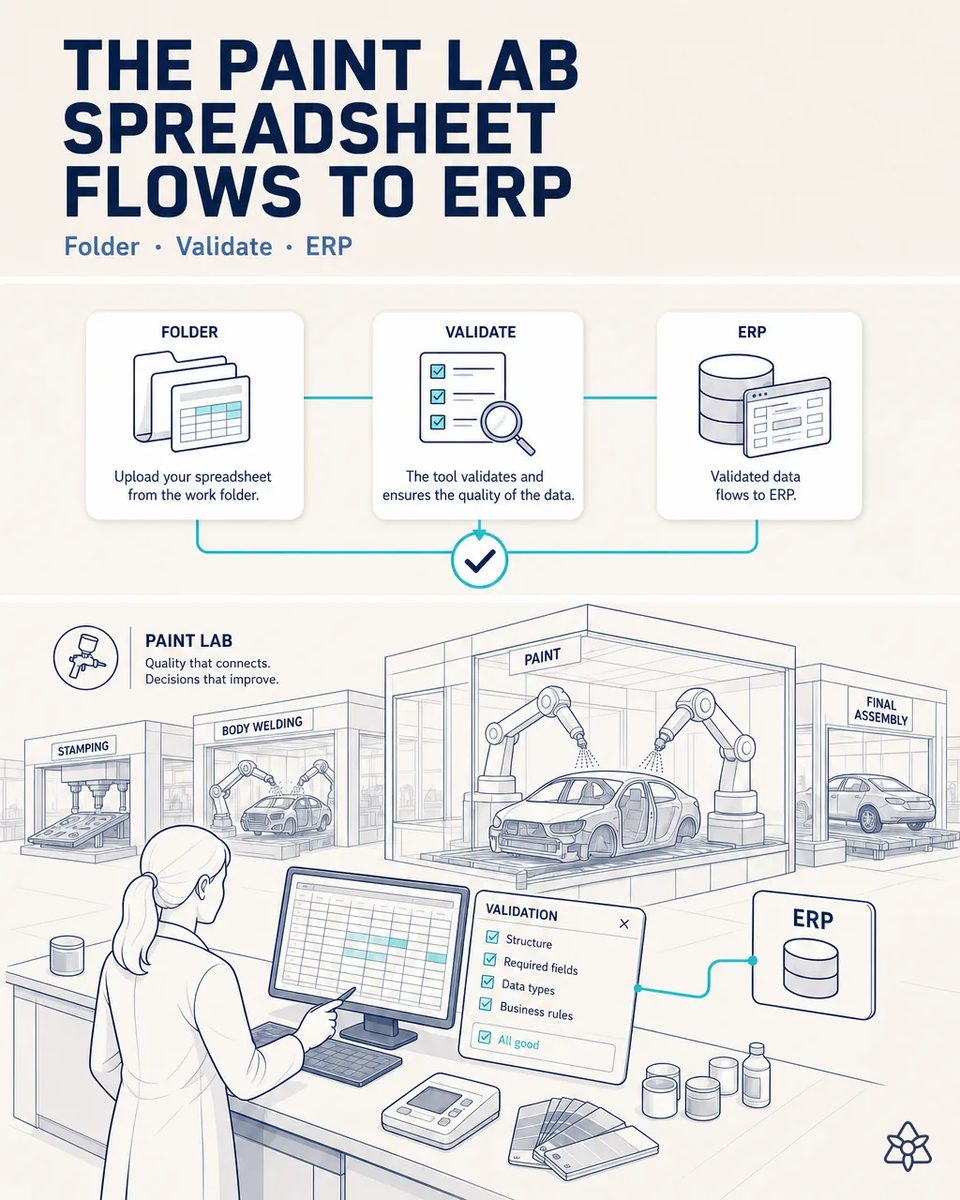
The paint shop's real quality data lives in a spreadsheet the ERP never sees.
Two parallel worlds coexist: the real paint-lab spreadsheet (where the live data lives) and the official ERP (data transcribed with a days-long lag by someone spending hours/week copy-pasting and making mistakes). The IATF 16949 auditor finds quality data that was never cross-checked between the two worlds.
- Every shift, the paint lab fills a spreadsheet with the control parameters of each batch: e-coat bath solids and conductivity, topcoat viscosity, film build measured on the body, appearance readings per color.
- That spreadsheet is the live data. The ERP gets it days later, copied by someone who spends hours a week retyping and occasionally shifting a row.
- Between the two worlds, decisions on the paint line are made with numbers the official system does not hold yet.
- And on IATF 16949 audit day, the auditor asks for paint quality data for a period and finds two versions that nobody ever reconciled.
Connect listening inward — the folder is watched, not the technician.
Connect 'listen inward': it watches the lab's shared folder (not the person), reads the delta when the file is saved, parses it with a grounded LLM, shows the validation on screen to the quality manager, and after confirmation pushes it to the ERP via API.
The lab keeps the spreadsheet it trusts. Connect reads only what changed when the file is saved, shows the quality manager what is about to enter the ERP, and pushes it by API after confirmation. Retyping disappears, and so do the licenses that existed only to retype. The paint engineer sees the e-coat bath trend the same morning, not the following week, while there is still time to correct it.
Paint lab data retyped by hand versus pushed from the folder
| Aspect | Today | With iLEAN Connect |
|---|---|---|
| Lag from lab bench to ERP | Days | Zero, on save |
| Hours spent retyping | Several per week | None |
| Shifted row or typo | Enters looking like valid data | Caught against plausible ranges |
| E-coat and topcoat readings by batch | Two versions to reconcile | One validated record |
| Quality-module licenses | Paid for to key in data | Typically 50-80% fewer |
| Paint data for the IATF auditor | Reconciled by hand before the visit | Already consistent |
A days-long gap between real data and ERP data → zero second. Hours/week transcribing → zero.
Impact estimate — to be validated with your numbers.
The block below is an estimate to be validated against your plant's actual data. We put it forward so the committee has an order of magnitude; we refine it during the assessment.
- Estimated payback 4-9 months, before counting the license saving.
- A typical 50-80% reduction in quality and lab-module licenses, because the people who only opened the ERP to type no longer need access.
- From a days-long gap between lab and ERP to zero, and from hours of transcription a week to none.
- And the paint quality data the auditor sees is the data the line actually ran with, batch by batch and color by color.
Estimated payback 4-9 months plus a typical 50-80% reduction in quality/lab-module licenses. *Figure to be validated*. (Payback 4-9 months · -50/-80% quality-module licenses)
And the fair question from the production manager
“What if it parses the wrong column and puts a viscosity where a film build should be?” — parsing a spreadsheet against your lab's own template is an anchored task, where the best models drop below 1.5% error [1]. And each value is checked against the plausible range for that parameter before it is shown to the quality manager, who confirms before anything reaches the ERP.
[1] OpenAI paper "Why Language Models Hallucinate", 2025 — on the reliability of AI in anchored tasks.
What people ask about pushing the paint lab spreadsheet to the ERP
Does the paint lab have to stop using its spreadsheet?
No. The spreadsheet stays exactly as it is, with its tabs and formulas. Connect reads it; it does not replace it. If the lab adds a column next month, the template is updated once and the reading continues.
Is anything installed on the lab technician's computer?
No. Connect watches the shared folder where the file is saved, not the workstation or the person using it. The technician's activity is not tracked and their way of working does not change.
Does it reprocess the whole file every time it is saved?
No, it reads only the delta: the new readings since the last save. History is never duplicated in the ERP, and a row edited after the fact is sent as a correction, with the previous value kept.
How are readings tied to the right paint batch and body color?
Each row is matched to the paint batch and the color in the active sequence, so the reading follows the bodies that were painted with that batch. When a shade complaint arrives on a VIN, the lab conditions of that day are one query away.
Where does the quality-module license saving come from?
From the people who open the ERP's quality module only to key in lab data. Once the data arrives on its own, those users are no longer needed; the typical range is 50-80% of those licenses.
More cases from this series
- The Color Change Won't Start Without ProofA paint color change requires a certified nozzle purge; leftover pigment contaminates the first units of…
- The Line Leader Dictates Hands-FreeThe line leader walks the entire shift between stations with hands full. Key observations that die at…
- The IATF Dossier That Builds ItselfOn IATF 16949 audit day, or during a corporate process audit, someone today spends weeks reconstructing…
- The JIT Delivery Note Enters ERP AloneA JIT supplier's truck arrives at the dock on a minute-tight delivery window. With iLEAN Connect, the…
- The Vintage Press Panel That Starts TalkingMany stamping shops live with at least one older-generation press, critical for a specific body part,…
- The Paint Defect That Never Reaches the OvenAt paint-line cadence, the human eye tires and misses subtle finish defects. iLEAN Edge places a camera…
Tell us how many people retype paint lab readings into your ERP each week.
We work on your plant's real data, not ours. Assessment with no commitment.
Request estimated ROI within 48h ‹ See all cases of vehicle assembly See automotive