The JIT Delivery Note Enters ERP Alone
A JIT supplier's truck arrives at the dock on a minute-tight delivery window. With iLEAN Connect, the receiving supervisor photographs the delivery note and container labels; after one validation tap, everything enters the ERP — with a typical 50-70% reduction in receiving-module licenses.
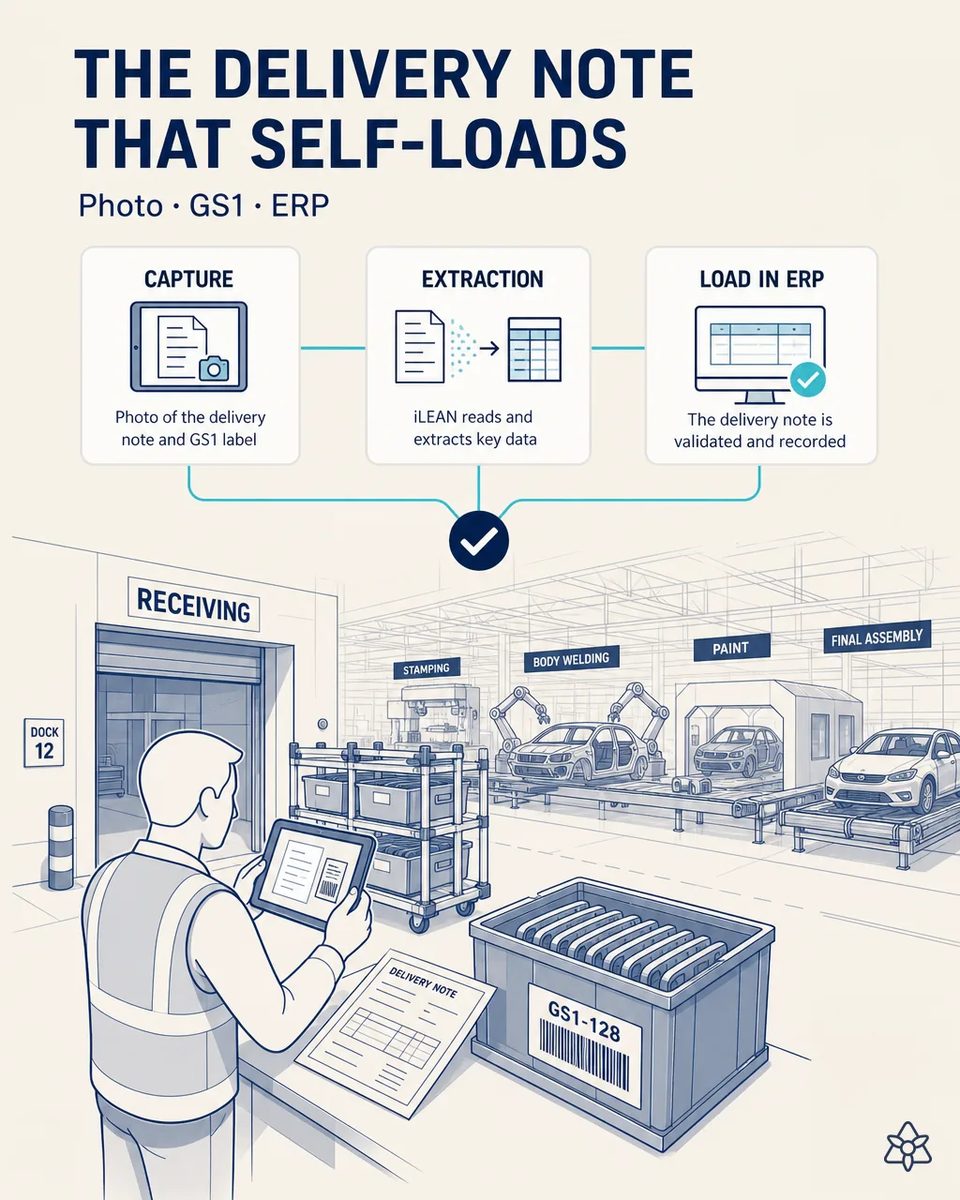
The JIT window is measured in minutes; typing is measured in mistakes.
The JIT truck has a minute-tight delivery window; if the receiving supervisor types slowly into the ERP the window is missed, and if they type fast, mistraced batches get entered. Those batch errors surface weeks later in a non-conformance that nobody can trace back to the exact container.
- A JIT truck gets a minute-tight unloading window at the dock, and the next truck is already waiting behind it.
- If the receiving supervisor types slowly into the ERP, the window is missed. If they type fast, the wrong batch gets entered against the wrong container.
- Every supplier prints its own delivery note format, and container labels mix GS1-128, QR codes and plain text.
- A batch error made at the dock surfaces weeks later in a non-conformance, and nobody can trace it back to the exact container or the VINs it went into.
Connect from photo to ERP — the supplier does not change a thing.
Connect photo-to-analog mode: vision AI recognizes the delivery-note format without requiring supplier changes, and reads GS1-128/QR/barcode/plain OCR on container labels. One validation tap on the dock tablet, automatic push to ERP.
Vision recognizes each supplier's delivery note as it is, and reads whatever is printed on the container label. The supervisor checks one screen and taps once. The window is met, the batch is right, and the container can be followed all the way to the VIN. On a dock that receives a JIT truck every few minutes, that is the difference between a receiving team that keeps up and one that builds a backlog by mid-shift.
JIT receiving typed by hand versus received from a photo
| Aspect | Today | With iLEAN Connect |
|---|---|---|
| Dock time per JIT truck | Blocked by manual typing | Minutes |
| Supplier delivery note formats | Each one learned by a person | Recognized as they are |
| Container label reading | Typed from the label | GS1-128, QR, barcode or OCR |
| Batch entered against the wrong container | Found weeks later | Caught at the dock |
| Container-to-VIN traceability | Broken at receiving | Complete from the photo |
| Receiving and warehouse licenses | One per person who types | Typically 50-70% fewer |
Unloading blocked by manual typing → minutes. Hidden batch errors → zero. Broken container-to-VIN traceability → complete via photo and GS1.
Impact estimate — to be validated with your numbers.
The block below is an estimate to be validated against your plant's actual data. We put it forward so the committee has an order of magnitude; we refine it during the assessment.
- Estimated payback 3-8 months, before counting the license saving.
- A typical 50-70% reduction in receiving and warehouse-module licenses.
- Unloading time back to minutes, and the JIT window stops depending on how fast someone types or how many trucks are queuing in the yard.
- And batch errors that used to surface in a non-conformance weeks later are stopped at the dock, with every container traceable to the units it ended up in.
Estimated payback 3-8 months plus a typical 50-70% reduction in receiving/warehouse-module licenses. *Figure to be validated*. (Payback 3-8 months · -50/-70% receiving-module licenses)
And the fair question from the production manager
“What if it reads the wrong batch number off a scuffed label?” — reading a delivery note and a container label whose formats are known is an anchored task, where the best models drop below 1.5% error [1]. When the label carries a GS1-128 code, the barcode and the printed text are cross-checked against each other and against the supplier's advance shipping notice, and any mismatch stops at the dock tablet. Nothing reaches the ERP until the supervisor confirms it.
[1] OpenAI paper "Why Language Models Hallucinate", 2025 — on the reliability of AI in anchored tasks.
What people ask about photographing JIT delivery notes at the dock
Do JIT suppliers need to change their delivery note format?
No. The model learns each supplier's format as it arrives. Onboarding a new supplier means a few sample notes, not a change request sent to them. Suppliers who change their template are picked up the same way, without a project.
Which container labels can it read?
GS1-128, QR codes, standard barcodes and plain printed text through OCR. Most JIT containers carry at least one of them, and when a label carries two, both are read and compared.
How long does the supervisor spend per truck?
One photo of the note, one of the labels, a glance at the summary and one validation tap. The time that used to go to typing goes back to unloading, and the next truck in the yard stops waiting for the previous one's paperwork.
How is a container followed to the VIN it was built into?
The batch is tied to the container at the dock, the container to the line-side delivery, and the line-side consumption to the VIN in the MES. The chain stops breaking at receiving.
Does it replace the ERP's receiving module?
No. The ERP stays the record; what changes is how the data gets in, which is why so many receiving licenses stop being needed. The receiving process and its approvals stay exactly as they are.
More cases from this series
- The Color Change Won't Start Without ProofA paint color change requires a certified nozzle purge; leftover pigment contaminates the first units of…
- The Line Leader Dictates Hands-FreeThe line leader walks the entire shift between stations with hands full. Key observations that die at…
- The IATF Dossier That Builds ItselfOn IATF 16949 audit day, or during a corporate process audit, someone today spends weeks reconstructing…
- The Vintage Press Panel That Starts TalkingMany stamping shops live with at least one older-generation press, critical for a specific body part,…
- The Paint Defect That Never Reaches the OvenAt paint-line cadence, the human eye tires and misses subtle finish defects. iLEAN Edge places a camera…
- The Paint Lab Spreadsheet Flows to ERPThe paint lab fills out a spreadsheet every shift with control parameters per batch. iLEAN Connect…
Tell us how many JIT trucks reach your dock per shift and how long each one waits for typing.
We work on your plant's real data, not ours. Assessment with no commitment.
Request estimated ROI within 48h ‹ See all cases of vehicle assembly See automotive